
|
 |
This is a public post so please share it widely. If you enjoy this newsletter, I hope you’ll consider upgrading to a paid subscription.
For those who don’t want a Substack account, you can keep Off Message going with a donation. All support is appreciated, and donations of $75 or larger come with a comped annual subscription—all content unlocked and emailed to the address provided.


 |
Donald Trump makes it hard to imagine the future of Republican politics, because he’s such an inimitable figure. Before he was a politician, he was a celebrity real-estate developer—an inheritance he plied into hosting a hit reality television show premised on the notion that he was a decisive board-room executive.
His pathological shamelessness feeds a kind of charisma. Without charisma he wouldn’t have become a celebrity; without celebrity, he wouldn’t have become understood in the culture (wrongly, it happens) as a talented deal maker. His gift for building and maintaining a fandom made him a natural demagogue; his unearned reputation lent him credibility among voters who expect competence from their leaders. Then, of course, he became president, and normalized himself. He became self-perpetuating.
But he’s terribly unpopular on the whole, and will eventually die.
So we’re left to wonder: Will his successor have to replicate most or all of these traits, and (if so) can anyone in Republican politics actually do it? Conventional wisdom leans respectively toward the answers “yes” and “no.” He won’t allow his insurgency to be reversed by a person with more rectitude. Yet candidates who try to mimic Trump underperform in their elections, and lose in the swing states he’s won twice. Nobody’s got the same aura. Not his sons, not his allies in Congress, not his loyalists (or erstwhile allies) in right-wing media, and certainly not his vice president. The Republican Party is now wired to follow the example he’s set, but the example he’s set is a loser when followed by a typical charlatan or fanatic.
Democrats don’t really have this problem. They have a different problem, in that their party’s brand is toxic. Their own supporters want new leaders to emerge. But waiting in the wings, even within the party mainline, are plenty of elected leaders who overperform in their races, and raise a lot of money. They just aren’t closely associated with the congressional leadership, or the Biden administration.
But progressives, mounting an insurgency of their own, might have this problem. It’s something they should take seriously, insofar as they want to build out their own political viability, gain power within the Democratic Party, or even elect a president. And it’s something frustrated moderates should keep in mind as they lick their wounds from a bruising primary season. What seems ascendant now can always shed its wings.
The analogy isn’t perfect. But it’s good enough! At least for the purposes of looking ahead literally one cycle. The future is much murkier.
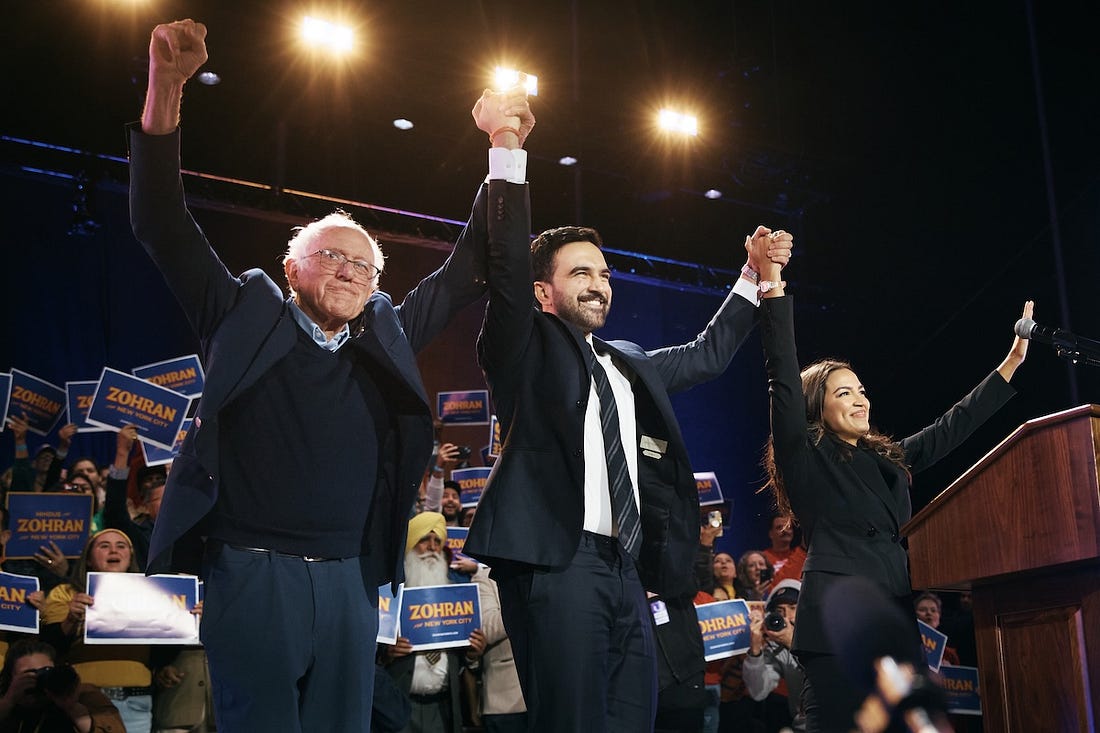
The progressive ascendancy that began (depending when you want to start the clock) in the Occupy movement, or the 2016 election, owes a lot of its political durability to Bernie Sanders.
Sanders was not exactly a pop-culture icon before the 2010s, and certainly wasn’t a billionaire. But in-the-know progressives have viewed Sanders as a role model for a long, long time. This is perhaps a bit overdetermined, because I attended college at U.C. Berkeley, but I’d heard of Bernie Sanders before I had any kind of developed politics. After the September 11 terrorist attacks, campus activists were proud that our representative, Barbara Lee, was the only member of Congress to oppose a military response, but it was a small scandal and disappointment that the only self-described socialist in federal office didn’t join her. At least that’s how I remember it 25 years later.
In any event, Sanders capitalized on that cult following in Barack Obama’s first term, when he spoke for eight hours on the Senate floor, protesting a measure to temporarily extend George W. Bush’s regressive tax cuts. That speech snowballed in real time, building an audience large enough to crash the Senate’s livestream. It resonated widely enough that he repurposed the text into a book called The Speech: A Historic Filibuster on Corporate Greed and the Decline of Our Middle Class.
Sanders threatened to primary Obama, in the manner that he would eventually challenge Hillary Clinton’s coronation, in order to channel progressive frustration with Obama’s economic policies. Obama advisers, including Senate Majority Leader Harry Reid, talked him out of it. They were, perhaps, less surprised than most when his 2016 campaign didn’t flame out as many pundits expected it would.
This made him the undisputed leader of the new new left, the most important socialist in America since Eugene Debs, a distinction he maintains to this day.
He is also 84 years old. He is almost certainly not going to run for president again. He has endorsed a number of House and Senate candidates this cycle, including candidates who challenged incumbent Democrats. Some of them have won their primaries. But this cycle will be over soon, confronting his movement with a pivotal question: And Then What?