
|
 |



The company that owns Truth Social, which is itself mostly owned by Donald Trump and his family, is marketing a new, premium service, according to the Financial Times. Pay a fee, and you can get access to posts from Donald Trump and the other “highest ranking” accounts on the network whole “milliseconds” before everyone else.
The whole scheme would be a little more believable if the service, rather than being yet another transparent opportunity for companies and wealthy people to shove money at the president, were something anyone actually wanted to buy. Happy Friday.
 |
The Call Is Coming from Inside the White House
by Sam Stein
When our nation’s intelligence agencies put together a report on the impact foreign governments and actors had on the 2020 elections, they broke down the results into two categories.
There was election interference targeting “the technical aspects of the election, including voter registration, casting and counting ballots, or reporting results.” And there was election influence, defined as efforts “to affect directly or indirectly a US election—including candidates, political parties, voters or their preferences, or political processes.”
The authors of that March 2021 National Intelligence Council report were pretty clear about which category was more consequential. Their first “Key Judgment”—the very first substantive sentence of the assessment—is that “We have no indications that any foreign actor attempted to alter any technical aspect of the voting process in the 2020 US elections, including voter registration, casting ballots, vote tabulation, or reporting results.”
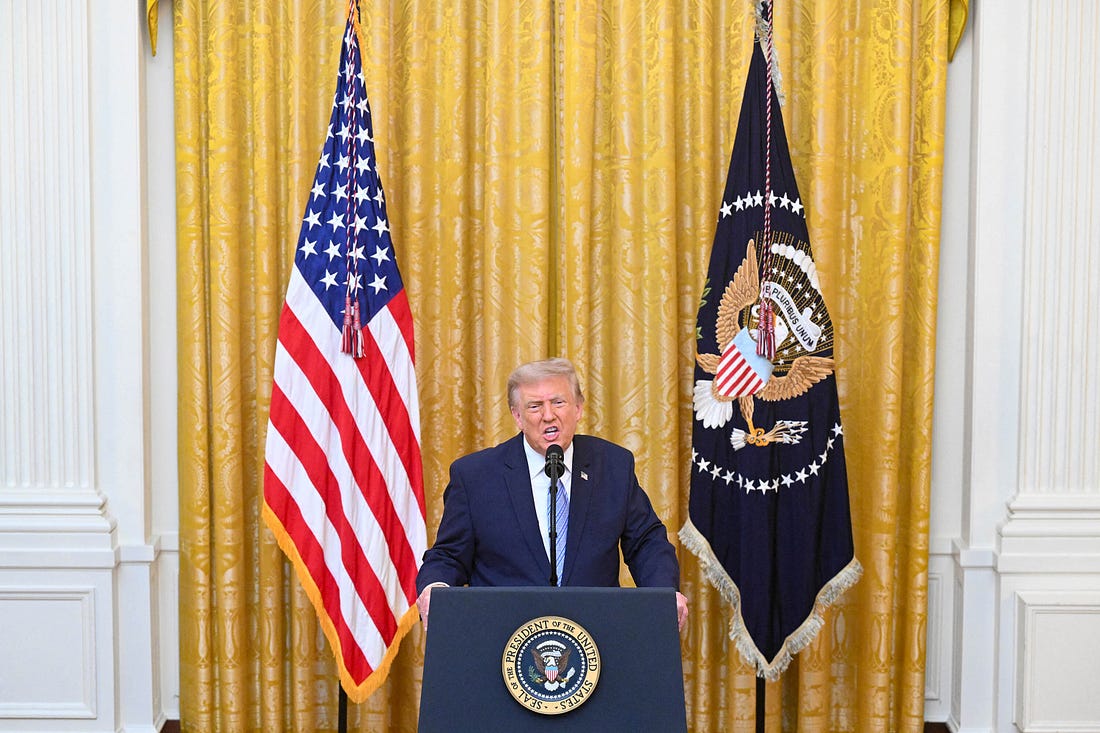
It’s worth considering these lines in light of Donald Trump’s speech last night. Because while the president spent a primetime address rehashing old, unsubstantiated claims of foreign election interference, he was actively engaging in an act of domestic election influence. Put more bluntly, Trump used the bully pulpit to undermine U.S. elections in ways that no other president has—in ways that adversarial governments could only dream of.
To understand how destructive the speech was, go back and read that report, which was started under the first Trump administration. Time and again, the authors underscore the threat posed by outside actors trying to undermine faith in U.S. elections.
“Some foreign actors, such as Iran and Russia, spread false or inflated claims about alleged compromises of voting systems to undermine public confidence in election processes and results,” the intelligence community found.
The concept of “confidence” in elections comes up repeatedly. The report assesses that Russia’s government ran an influence operation denigrating Joe Biden, supporting Trump, and “undermining public confidence in the electoral process.” It notes that Iran attempted both to “undercut former President Trump’s reelection prospects” and “undermine public confidence in the electoral process.” It relays that Moscow has “longstanding goals of undermining confidence in US election processes.” And it says that, “Some foreign actors . . . spread false or inflated claims about alleged compromises of voting systems to try to undermine public confidence in election processes and results.”
That last line, in particular, stood out to me as I watched Trump’s speech. Because if you removed “foreign actors” from it, you would have an apt description of . . . Donald Trump.
The president spread false and inflated claims about China’s covert efforts to undermine his 2020 bid. He bemoaned alleged compromises of our voting systems, specifically Venezuela’s supposed manipulation of electronic voting machines. And he undermined confidence in our election processes by comparing them unfavorably to “any” third-world country.
“Great damage has been done to our country. Our elections were left vulnerable to being rigged and stolen, and the trust of the American people was lost,” Trump proclaimed, surely aware at some psychological level that he is the one who destroyed that trust, and was doing so again as he spoke that line.
Over and over, Trump has sowed doubt in our elections, treating them not as a bedrock of our government but as a grade that could be appealed, forged, or changed through sufficient whining or cheating. After he lost the 2016 Iowa caucus, Trump declared that, “Based on the fraud committed by Senator Ted Cruz . . . either a new election should take place or Cruz results nullified.” I vaguely recall being flabbergasted at the time. I thought it was a bit. I didn’t realize it was an ethos.
And now it’s a doctrine—pushed by Trump but actively embraced by the rest of his party. Hours before Trump spoke last night, Sen. Tommy Tuberville (R-Ala.) claimed four or five of his colleagues in the Senate “didn’t legally win” office. He had no evidence for his claim. Earlier this week, DNI nominee Jay Clayton refused to say that Joe Biden won the 2020 election. He’s considered the sane alternative to the man currently in that post, Bill Pulte.
That these top officials feel free, even compelled, to act like this is a greater problem facing our elections than anything we’ve seen so far from a foreign adversary. Because if one party will not accept results that don’t go its way, then there is nothing to “fix” at all. At that point, the election’s legitimacy is tied strictly to its outcome, not its administration.
The White House released a bevy of documents last night meant to support Trump’s speech. They were underwhelming as far as the president’s claims go. But this statement by the NIC stood out to me, again for how it almost perfectly described what Trump himself is doing:
We assess that adversaries could also make false claims about their ability to manipulate US election infrastructure as part of a broader effort to undermine confidence in US democratic processes. Much of the voting public probably knows little about the process of administering US elections, which could allow false narratives to gain traction. Government efforts to investigate and publicly invalidate such claims could take weeks or months, providing time for concerns about election security to spread.