Why Netflix’s new strategy will fall short, Italy’s new regional flight plan, South Korean defence is booming and Salvador Dalí’s beach hut.
|
Monday 20/7/26
|

|
|
London
Paris
Zürich
Milan
Bangkok
Tokyo
Toronto
|
|
|
|

Good morning from Midori House. For more news and views, tune in to Monocle Radio. Here’s what’s coming up in today’s Monocle Minute:
THE OPINION: Netflix’s new strategy is going to fall short
AVIATION: Takeoff for Italy’s new short-haul-flights plan
DEFENCE: South Korean defence is shooting for the stars
DAILY TREAT: Keep it surreal at Salvador Dalí’s beach hut
THE LIST: Three stories you might have missed
|
|
Netflix’s short-sighted bet on short-form content
By Tom Webb
|
Ask people what they want from life and their answers rarely match their behaviour. We all say that we would like to eat better, read more and spend less time on our phones. But entire industries are built to exploit our impulse for mindless scrolling and feed us food or information that we don’t really want. Today, streaming platforms are no different – and in chasing our behaviours, they risk forgetting what audiences actually value.
Netflix announced an investment in short-form video this month that is designed to compete with YouTube. Like all bad audience research, the plan mistakes consumption for satisfaction. Just because audiences are increasingly spending more time watching short videos does not mean that they want their subscription service to do the same. As history has shown us through the rise and fall of myriad media companies, success rarely comes from chasing every trend. The strongest brands create spaces where creativity finds a home.

|
|
|
Screen test: Will Netflix’s latest gamble come up short?
|
|
Netflix’s huge global success came from offering audiences and producers an alternative to cinema and television. It gave filmmakers the time and space to make ambitious work that was shunned by traditional studios for being long and/or expensive. Martin Scorsese’s
The Irishman proved Hollywood wrong, as audiences stuck it out through three and a half hours of gangster clichés. Viewed by more than 26 million households in its first seven days, it proved that attention spans were not collapsing.
Yet what media executives have found impossible to ignore is the countless hours of short-form content that younger audiences are consuming – looking enviously at the extraordinary numbers that it can generate. Their panic-spends in the pursuit of this attention, clicks and traffic is all in a seemingly misguided belief that this could convert to subscriptions and customer loyalty.
Documentary filmmaker Evan Williams has described Netflix’s move as “the race to the bottom”. His concern isn’t that short-form video exists but that “every platform begins to resemble every other”. If Netflix becomes another endless stream of vapid, rapid clips, it erodes the very proposition that made it successful: a place where viewers can settle in for something memorable.
There is a growing recognition that doomscrolling often leaves people feeling drained and, in many cases, depressed. While it might be highly consumable, it certainly isn’t striking or enjoyable. “It’s like junk food,” says Williams. “It satisfies an immediate craving but leaves little behind. People are not stupid. They want material, they want to learn.” The great irony here being that the overwhelming amount of short content has actually increased the desire for something more substantial – book sales are strong, documentaries are dominating public discourse and
podcast listenership is still growing.
Netflix seems to be ignoring its competitive advantage for a spike in short-term numbers. But why would consumers come to Netflix for short-form videos when they can stay on Tiktok, Instagram or YouTube? If anything, the platform’s existing subscriber base is likely to want a long-form palette cleanser from all the clips they encounter throughout the day. It’s what attracted talents such as Scorsese in the first place; a lesson Netflix might’ve forgotten. If Netflix is to thrive into the future, it will not be through replicating what’s already filling phones around the world – but through investing in immersive storytelling that people want to spend time exploring.
Tom Webb is Monocle’s deputy head of radio. For more opinion, analysis and insight, subscribe to Monocle today.
Further reading:
-
The UK’s under-16 social-media ban won’t make Big Tech safer
-
Australia wants tech giants to fund journalism – but is it too little, too late?
-
The summer of cinema is urging us to break the spell of our screens
|
|
Your Alpine Summer Spritz
|
AVIATION: ITALY
New short-haul-flight model set to give easy access to Italy’s remote corners
Italy is undergoing a regional air-travel revolution (writes Ed Stocker). In a move first announced last year, Italy’s national civil aviation authority has been developing a plan for what it calls regional air mobility (RAM), focusing on small aircraft with a handful of seats flying less-serviced routes to diminutive airstrips – a new model for short-haul flights. The idea is to empower Italy’s farther-flung regions and give new traffic to local airports. Though the first test flight happened in 2025 – a 50-minute journey between Fano to Rome Urbe aboard a King Air B200 nine-seater – things are yet to fully get off the ground.
But the signs are positive. Last week, airplane manufacturer Tecnam said that it wants to create a new regional airline that will launch from Rome’s Urbe, an airport that plans to start RAM flights later this year. Tecnam’s mooted new airline would join the likes of Airidea, which launched in June with the aim of connecting its Genoa hub with the rest of the country. Flying under the radar for now, regional air travel in the
bel paese could soon be cruising.
|
|
defence: south korea
Shooting for the stars: South Korea on track to become a top-four-defence exporter
Canada’s recent decision to plump for German submarines instead of South Korean boats was a disappointment to the latter’s defence industry – but at least there’s the consolation that the nation has not, of late, been disappointed often (writes Andrew Mueller).
Hanwha Ocean, the eventually rejected bidder for the Royal Canadian Navy’s submarine business, might be on the verge of bouncing back with an order from the Royal Thai Navy for a new frigate worth circa €450m, and the prospect of three more such vessels to follow. The Royal Thai Navy is expected to announce this month its choice between Hanwha, fellow Korean firm Hyundai and Turkey’s ASFAT; reporting in Korean media suggests that Hanwha is the front-runner.

|
|
|
Due an upgrade: Royal Thai Navy personnel rowing in sync
|
|
When South Korea’s Defence Acquisition Programme Administration – an agency of the Ministry of Defence – was founded in 2006, South Korea’s annual defence exports were worth around €220m. Last year, it cleared €13bn – and the country has declared its ambitions of becoming one of the world’s top-four-defence exporters. It is no forlorn hope. South Korean manufacturing generally has become a byword for innovation and reliability. Its defence sector is kept sharp by living in the shadow of the volatile neighbour to the north.
These developments haven’t been lost on Europe. The (colossal) Polish military of the future will be spearheaded by Hyundai’s K2 tank and Korean Aerospace Industries’ FA-50 fighter jet. Norway’s high frontier with Russia is defended partly by the Hanwha-built K9 self-propelled howitzer. And by way of further burnishing the reputation of South Korean kit, the Cheongung II surface-to-air missile proved 96 per cent effective when deployed by the United Arab Emirates during recent hostilities with Iran. For South Korea’s defence sector, these are – pun intended but inevitable – boom times.
|
|
• • • • • DAILY TREAT • • • • •
Keep it surreal with a trip to Salvador Dalí beach hut
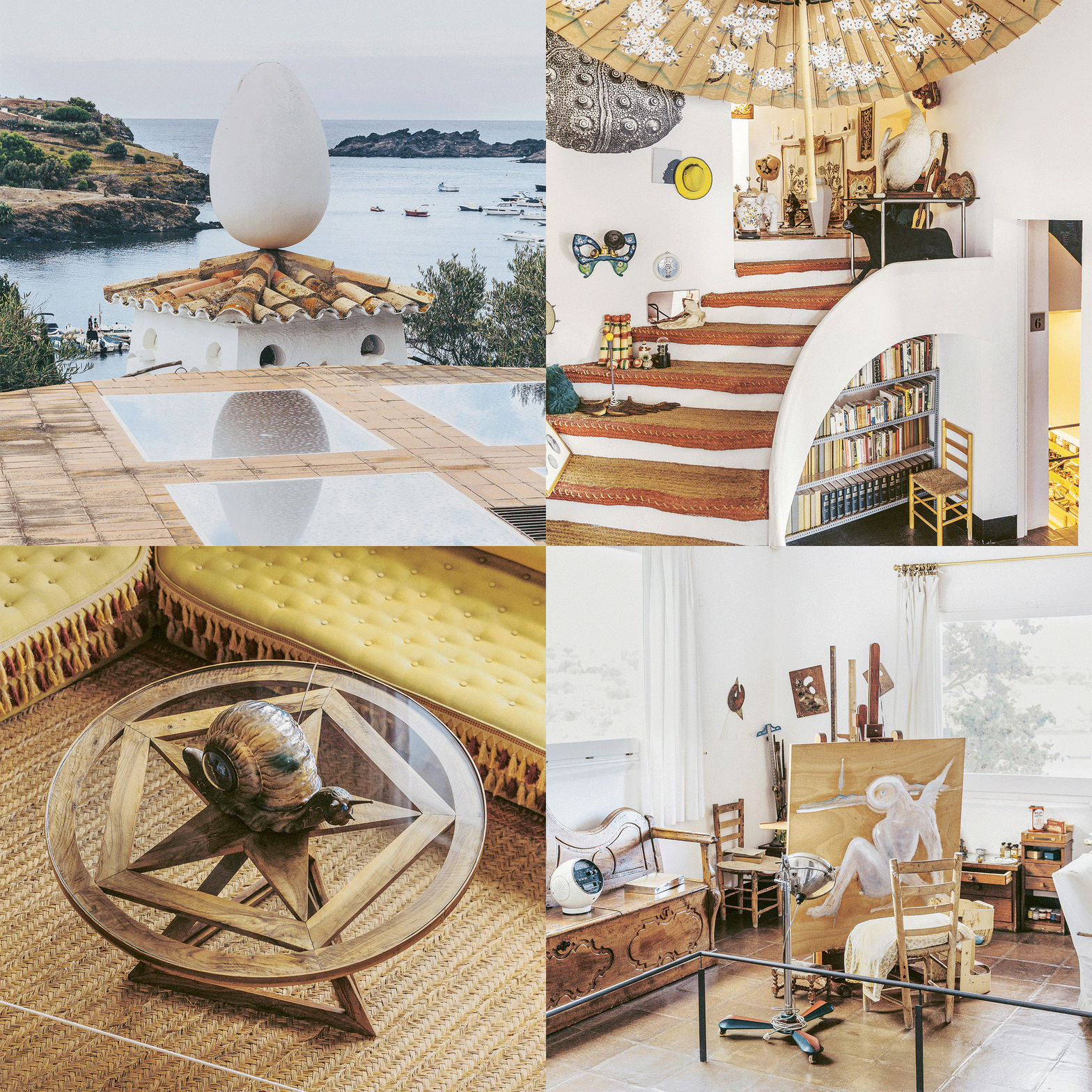
In 1930, Salvador Dalí bought a small beachside hut in a fishing village called Portlligat, near Cadaqués. He lived in this remote corner of northeastern Catalonia until the early 1980s and, over the years, expanded the house into a sprawling, labyrinthine home linked by narrow corridors.
In 1997, almost a decade after his death, the house became a museum run by the Fundació Gala-Salvador Dalí, which preserved all its original interiors. More than just a space to melt away the minutes, this is something of a cabinet of curiosities, with gilded candelabras, taxidermised birds and porcelain vases arranged haphazardly throughout its whitewashed walls.
salvador-dali.org
|
|
| | |