Senate candidate Haley Stevens talks often about manufacturing, taking on President Donald Trump and why she’s the Democrat best positioned to win Michigan. The congresswoman has far less to say about the pro-Israel group that has spent millions trying to get her elected. Plus, an update on Democrats' moves in the Maine Senate race, a look at Arizona's primary this week and one extraordinary photo from this weekend's World Cup final. |
|
|
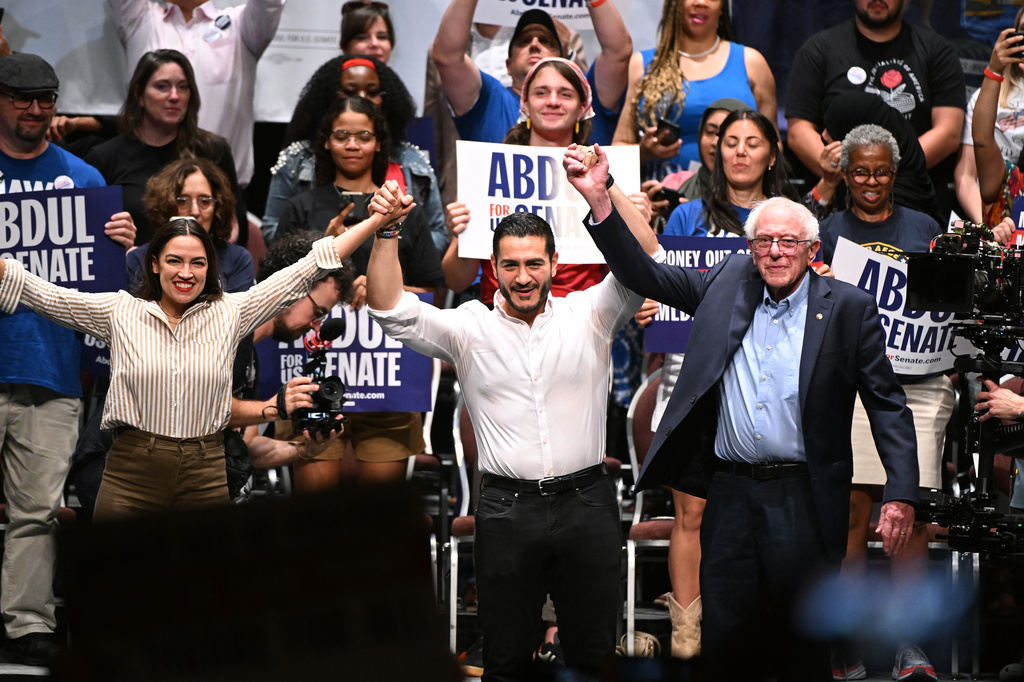
From left foreground, U.S. Rep. Alexandria Ocasio-Cortez, D-N.Y., Michigan Democratic U.S. Senate primary candidate Abdul El-Sayed, and U.S. Sen. Bernie Sanders, I-VT. join hands together following a campaign rally, Saturday, July 18, 2026, in Detroit. (AP Photo/Jose Juarez) |
AIPAC has spent a record amount on Michigan's Senate primary, the biggest test of its influence yet — By Joey Cappelletti
The American Israel Public Affairs Committee, or AIPAC, and its affiliated groups have spent close to $30 million backing Stevens — their largest investment ever in a single race — as they seek to defeat progressive favorite Abdul El-Sayed in the Aug. 4 primary. Stevens has largely avoided discussing the organization directly, even as its spending has reshaped the race. Asked twice about AIPAC during a July campaign stop in West Michigan, she responded for more than 800 words without mentioning the group a single time. Israel came up only once, when she said she “wanted to see the U.S. and Israel working together to rebuild Gaza.”
The exchange illustrates how politically fraught AIPAC has become in Democratic politics as the war in Gaza has divided the party over U.S. support for Israel. AIPAC works to elect lawmakers who support its mission of strengthening the U.S.-Israel relationship and advancing policies it says enhance the security of both countries. The issue carries particular weight in Michigan, home to the nation’s largest Arab American population. Beyond Michigan, El-Sayed’s progressive allies are framing the race as a broader test of whether grassroots organizing can overcome unprecedented outside spending. Read more from Cappelletti on AIPAC's Michigan Senate race role. |
|
| |
Troy Jackson moves ahead in Democrats' Maine Senate race |
U.S. Senate candidate Troy Jackson takes part in a debate at the WCSH-6 television studio, Thursday, July 16, 2026, in Portland, Maine. (AP Photo/Robert F. Bukaty) |
Troy Jackson, a former state legislator, moved into a strong position to replace Graham Platner as the Democratic candidate for U.S. Senate in Maine after several of his opponents dropped out Sunday.
The quick change in the landscape of the race came on a weekend when party committees across the state began choosing delegates for a nominating convention that will meet July 25 to select a new candidate to face Republican U.S. Sen. Susan Collins in November.
Between Saturday and Sunday. Troy Jackson’s campaign touted they had secured hundreds of delegates who had promised to back him at the convention, including all of their preferred delegates for Maine's most populous county, Cumberland.
His strength caused an exodus. Maine Secretary of State Shenna Bellows withdrew Sunday morning, saying Democrats didn't have “a day to waste in unifying" around the goal of defeating Collins. Nirav Shah, former director of Maine’s Center for Disease Control and Prevention, dropped out and endorsed Jackson in the early evening. He was quickly followed by Dan Kleban, the co-founder of Maine Beer Company, and Jordan Wood, both of whom also endorsed Jackson.
With all of his most formidable opponents out, Jackson looked tough to beat at next weekend's convention.
Read more from AP about Jackson clearing the field in Maine. |
|
|
|
AP Elections Spotlight: What to expect in Arizona’s state primary |
Members of the Arizona State University Barrett Choir wave Arizona state flags during the celebration of the 100th anniversary of Arizona's statehood, Feb. 14, 2012, in Phoenix.(AP Photo/Ross D. Franklin) |
The big picture: Arizona Republicans will choose a nominee in a state primary Tuesday to challenge Democratic Gov. Katie Hobbs in November. Voters across the state will also set the general election matchups for competitive U.S. House seats and for a full range of state and local offices.
The Arizona governorship is a top takeover opportunity for Republicans in a midterm environment where voters historically have punished the party occupying the White House. The eventual winner, along with his or her statewide political organization, could play an important role in the 2028 presidential campaign, as Arizona is once again expected to be a critical battleground.
The challengers: Two Arizona congressmen and two businessmen are vying for the Republican gubernatorial nomination. Five-term U.S. Rep. Andy Biggs is a former chair of the conservative House Freedom Caucus and has Trump's endorsement. Eight-term U.S. Rep. David Schweikert is giving up his competitive swing district seat after narrowly prevailing against strong Democratic challenges in the last three elections. Businessmen Ken Miceli and Scott Neely have backgrounds in the construction industry.
Replacing Schweikert: The 1st District GOP race features state Rep. Joseph Chaplik, sportscaster and former Arizona Cardinals placekicker Jay Feely and technology and telecommunications executive John Trobough. The Democratic primary includes two candidates from the 2024 primary for this same seat: former state Rep. Amish Shah and former local news anchor Marlene Galán-Woods, as well as publisher Rick McCartney and entrepreneur Jonathan Treble. Another Republican-held seat that is key to Democratic hopes of retaking the U.S. House is in the 6th Congressional District, where Rep. Juan Ciscomani seeks a third term. He and his Democratic opponent, Marine Corps veteran JoAnna Mendoza, are unopposed in their primaries.
Read more from Robert Yoon on Arizona's primary election. |
|
|
|
President Donald Trump is pictured as confetti falls at the conclusion of the World Cup championship final soccer match between Spain and Argentina in East Rutherford, N.J., Sunday, July 19, 2026. (AP Photo/Jacquelyn Martin) |
Washington-based photo journalist Jacquelyn Martin was there as Trump presented the World Cup trophy to Spain, the winner of Sunday’s final against Argentina.
For the White House, Sunday’s match was the culmination of well over a year of navigating a litany of logistical challenges alongside co-hosts Canada and Mexico for what would be the biggest World Cup in history. It had to balance the Trump administration’s hard-line migration policies that barred fans from some World Cup qualifier countries from entry into the United States. Explore more of Martin's work covering politics and Washington. |
|
|
|
|