What matters in U.S. and global markets today.

Start the day with Reuters on the stories moving U.S. and global markets. Subscribe for $1/week.


Morning Bid U.S.

Morning Bid U.S.

A Reuters Open Interest newsletter

What matters in U.S. and global markets today


By Mike Dolan, Editor-at-Large, Finance & Markets

Global stock markets may just be weary of the back-and-forth in the Middle East, but they latched onto a sliver of hope in the still-raging U.S.-Iran conflict overnight. Reports of some mediation efforts sent Brent crude prices back below $90 per barrel, even as renewed fighting continued into its 10th day and the conflict risked spreading.

I'll get into that and more below.

But first, check out my column on why markets are likely hoping new UK Prime Minister Andy Burnham succeeds, whether they agree with his policies or not.

And listen to the latest episode of the Morning Bid daily podcast. Subscribe to hear Reuters journalists discuss the biggest news in markets and finance seven days a week.


Data refreshes every time you open this email. For more U.S. market news, click here. Please send any feedback to morningbid@thomsonreuters.com.


Today's Market Minute

  • Yemen's Iran-aligned Houthis said on Monday they would impose a naval blockade on Saudi Arabia, opening a potential new front against the United States in its war with Iran and raising the threat to global energy supplies and trade beyond the Gulf.
  • President Donald Trump unveiled 50% tariffs on a wide range of imports from Canada on Monday in response to what the U.S. administration called its discriminatory treatment of American-made cars, alcohol and dairy goods, threatening a new front in a global trade war.
  • Britain's new prime minister, Andy Burnham, named former defence secretary John Healey as finance minister on Monday, just weeks after he resigned from the previous government with a stinging rebuke of how the ‌Treasury had fallen short on defence spending.
  • Europe has one answer for almost every major energy challenge it faces: electrify. But building renewable power generation is the easy part. Convincing millions of households, drivers and industrial firms to use it may prove far harder, argues ROI Energy Transition Columnist Gavin Maguire.
  • The intense volatility rocking South Korea’s chip-heavy stock market has come to America, but Wall Street has suffered only modest losses in response. Will the vulnerability among highly leveraged investors cause serious damage in the U.S. as well? ROI markets Columnist Jamie McGeever dives in.
 

Tariff reprise

A playbook appears to have developed over the five months of the Iran war where each new escalation quickly deescalates into another round of talking. But markets may be a bit blasé this time around, as the threat by Yemen’s Houthi militia to block Saudi shipping potentially opens a new front in the conflict. 

Regardless, the dip in crude prices below $90/bbl on Monday was enough to spark a decent rally in Asia stocks, with Tokyo and Seoul stocks up briskly on Tuesday and U.S. futures in positive territory too. Eyes are more likely trained on the big tech earnings about to hit the Street, as Alphabet is due to report on Wednesday.

Otherwise the focus this morning was Donald Trump’s new tariff salvo against Canada and new British Prime Minister Andy Burnham’s surprise pick for finance minister. Trump re-opened regional trade wars by saying he would apply 50% tariffs against some $20 billion of Canadian imports next month, goods such as wine, cement and clothes that account for some 5% of Canadian exports south of the border. Canadian PM Mark Carney said he would double down on negotiations to resolve the issue.

In the UK, Burnham said he would appoint former defence minister John Healey as his new Chancellor of the Exchequer, quashing reports that interior minister Shabana Mahmood was due to get the job. This raises speculation that defence spending may be carved out of the UK’s standing fiscal rules. Burnham’s team also announced moves to cut tax on electricity prices, which would be funded by scrapping a digital ID program. That may help lower UK inflation a bit later in the year, taking pressure off the Bank of England to tighten policy.

With that, onto today's column.


Burnham kicks off UK premiership with lucky breaks. Investors hope they last

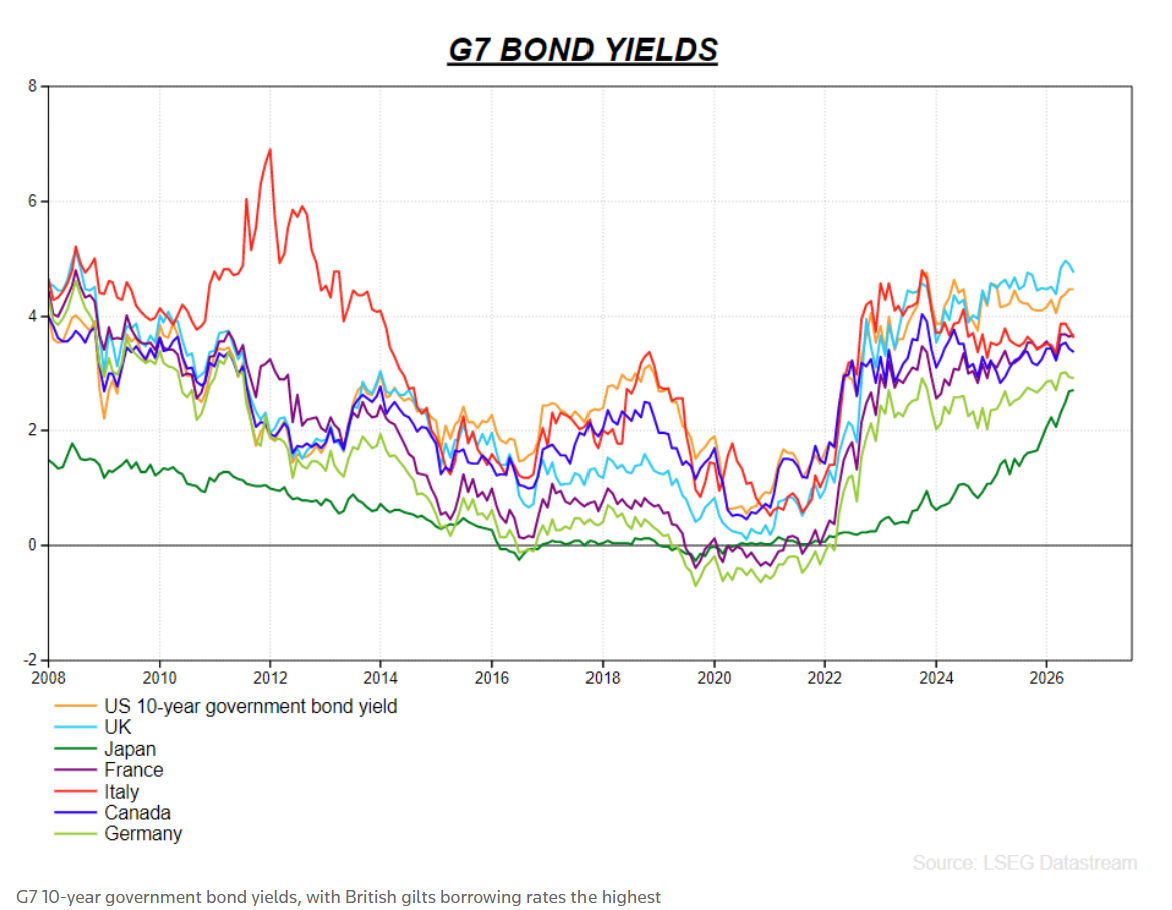
Britain's new Prime Minister Andy Burnham appears to have room to juggle some popular economic policies without dropping the ball on the bond markets. Investors are likely cheering him on so that they don't have to dodge much bigger risks down the line.

After weeks of speculation and intrigue, Burnham was finally confirmed as premier on Monday, replacing Keir Starmer as the country's seventh PM in a decade. Compared with Starmer's careful — some might say overly careful — stewardship of the economy, Burnham is seen as something of a maverick, someone potentially willing to take more risks to underline ‌his "man of the people" image and burnish his credentials among the left wing of the ruling Labour Party.


Graphics are produced by Reuters.

Read the full column