




We got lots of important elections stories this week, but none stranger than the outcome in the Republican primary for Michigan’s swingy 8th district, where Trump’s endorsed candidate, Navy veteran Amir Hassan, endured a shocking loss to a man named Tom Smith—who wasn’t even running anymore, having dropped out of the race last month. Smith carried the primary 50 percent to 33 percent, and was as surprised as anyone. Appearing at a GOP unity lunch yesterday, he had this to say: “I’m Tom Smith. I’m running for the 8th congressional district to unseat communist Comrade Rivet, and I’ll need your help to do it.” Those were his full remarks.
For most GOP candidates, Trump’s endorsement is a golden ticket to the lizard-brain love of the GOP base. Sometimes, however, it’s apparently not enough to overcome a different kind of lizard-brain difficulty: running against a man named Tom Smith when your name is Amir Hassan. Happy Thursday.
 |
Trump’s Midterms Spitball
by Andrew Egger
Nobody can say with much certainty what will happen in the November midterms. After all, polling is broken and the world is crazy.
But with Election Day just three months away, we can start to hazard a few confident guesses. Donald Trump is less popular than ever, having squandered his second year back in office on a fruitless, expensive war, an elections bill that has been DOA for months, and a cornucopia of vanity projects and self-enrichment schemes. If Trump loses the Republican trifecta this November, he will close out the most favorable years of his second term with few durable victories. It’s amazing, given his Napoleonic aspirations, his total contempt for laws and norms, and his desperate thirst to punish enemies high and low. But when it comes to actual points on the board, the first half of Trump 2.0 is shaping up a lot like the first half of Trump 1.0: Fewer border crossings, one big tax-cuts bill, and… that’s it.
The big difference, of course, has been in the amount of damage inflicted. Trump has dragged America from crisis to crisis, rattling the global economy, our international alliances, the rule of law, and our norms against political and personal corruption. And there’s one area where Trump could still do immense harm before next year—in the administration of the coming elections.
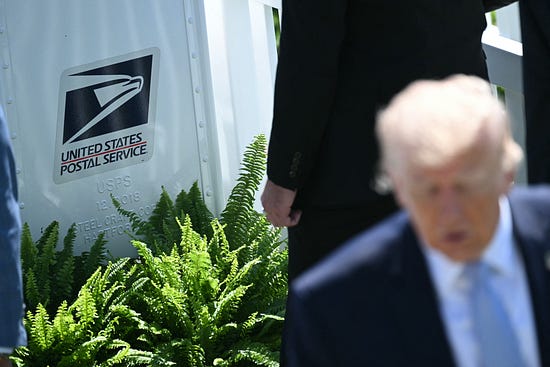
In March, Trump issued an executive order that was a naked attempt to clamp down on mail-in voting. It ordered the U.S. Postal Service to draft new rules refusing to deliver ballots to voters not on federally approved citizen lists—and not to deliver ballots at all in states that refuse to hand over their voter rolls.
That order has been stayed for months, although there have been legal wrinkles. Although one court ruled that the White House doesn’t have this sort of controlling power over elections, full stop, another ruled that because the USPS hasn’t finalized its rules, those rules are not yet eligible for legal challenge. Last month, the administration asked the Supreme Court to lift the stay, arguing that until the rules are in place, states can’t prove they’d be harmed by them. And this week, the litigants—23 states and the District of Columbia—asked the court to leave the stay in place, arguing that lifting it “would allow the federal government to rush out an unprecedented, legally indefensible voter-verification and ballot-interception program that would, among other things, give the U.S. Postal Service far-reaching new powers and responsibilities.”
That outcome is, of course, exactly what the federal government hopes to achieve. Its explicit argument is that the court shouldn’t just rule in their favor, but should do so with haste—since how else will they be able to get the new voting regime up and running in time for the midterms? “Absent a stay,” Solicitor General John Sauer argued in his petition to the court last month, “there will not be sufficient time to obtain appellate relief before the November election.”
If the justices were to agree, it would be a recipe for instant election chaos. Democratic states would immediately be presented with a terrible dilemma: Do they submit to a partial federal takeover of their elections—handing over their voter rolls to Stephen Miller and co. for God-knows-what federal purpose, allowing the White House final administrative say over who gets a ballot mailed to them and who doesn’t? Or do they resign themselves to carrying out their elections in November without the assistance of the Postal Service—essentially giving themselves over to the “no mail in ballots” world that Trump has actually wanted all along?
It’s a grim prospect, and yet one that people seem to be sleeping on. “I think everyone agrees that it’s not going to be implemented for 2026,” Notre Dame Law School professor and elections expert Derek Muller told VoteBeat this week. “The logistics are so horrific.”
I would love to find these sentiments reassuring. But I also wonder whether some of these cheerful assumptions have been overtaken by events. In a normal world, with normal people in charge, the “there’s no non-insane way to try to do this” line of reasoning would make me pretty confident the federal government wouldn’t try. But the administration keeps insisting they want to try, and I’m not sure there’s anything in their track record to suggest that “if you do this, there will be total chaos” is a significant deterrent. In fact, it’s an encouragement.
To be clear, I’m not saying this crisis is very likely. If I were a betting man, I would expect the Supreme Court to take a safe line here, abstaining from taking any action that might throw election administration into chaos right as people start voting.¹
But it’s not exactly difficult to construct a counterfactual possibility—one where the Court, in its law-nerd wisdom, rules in Trump’s favor on the narrow procedural question of standing and hands the administration broad ambiguous discretion in how to move forward with implementation. If they do decide that the legal challenges against the president’s order are not yet ripe, we may all suddenly be waking up to a world where Trump has broad leeway to cause election chaos in blue states and the only question left is: Well, would he do it?
The Supreme Court could put the whole thing to bed tomorrow. Even if they allow the executive order to go forward on procedural grounds, the states could quickly sue again after the USPS begins implementation and a lower court could move to freeze the administration once more.
Would it affect the outcome of the midterms? Perhaps not. Mass confusion and chaos could end up harming Republicans more than Democrats, who remain more motivated to vote by any means possible. But we don’t really know how it would bounce in terms of actual results.
Is it all still enough to keep me up nights until this whole thing is resolved? I’m afraid so. It’s amazing how thin the guardrails are everywhere you look with folks like this in charge.
Scenes From an Italian Restaurant
by Cathy Young
Ukrainian drones are still methodically taking out online retail warehouses and oil refineries across Russia. But on Saturday night, it was an upscale Italian restaurant in Moscow that was the target. The dramatic strike was timed for a birthday bash being held for a member of Russia’s top brass. A woman entering with a gift box was stopped by a security guard; when he tried to inspect the box, it set off a massive explosion. General Alexander Chaiko, 55, who was also celebrating his recent appointment as commander-in-chief of Russia’s Aerospace Forces, survived the explosion and may be unhurt. But five people are dead—reportedly including another unnamed Russian general—and nineteen are injured.
Ukraine has neither confirmed nor denied responsibility; but it had very good reasons to hunt Chaiko, whom it considers a war criminal. At the start of the Russian invasion in early 2022, he was in command of troops advancing on Kyiv. That operation included the nearly month-long occupation of Bucha and other nearby towns, with its well-documented horrors. Chaiko was likely on the ground when these atrocities were committed. There’s also an intercepted audio in which he apparently gives orders to bomb a village and “wipe it off the face of the earth.”
Yet the method chosen to target him made civilian casualties inevitable—prompting some normally pro-Ukraine exiled Russian commentators, such as TV-RAIN host Mikhail Fishman, to call the bombing a terrorist attack. Others such as military analyst Yuri Fedorov strongly disagreed, arguing that the killing of a combatant can never be described as terrorism regardless of collateral damage.
There are troubling ethical issues beyond that. The courier, who died instantly, almost certainly thought she was delivering an ordinary gift box. Was she an innocent victim? Yes. But defenders of Ukraine’s actions in this case have responded that Russia is taking innocent lives in Ukraine every day. Just yesterday, a barrage of Russian ballistic missiles hit Kyiv before dawn, taking advantage of Ukraine’s severe shortage of interceptors and leaving at least 17 people dead and dozens injured.
Curiously, while the Russian government condemned the Moscow restaurant attack (and, preposterously, tried to claim it was meant to intimidate Italians living in Russia), its reaction has been fairly low-key. State television has barely mentioned it. Maybe that’s because, while the bombing makes Ukraine look morally gray, it also makes Russia look weak—unable to prot