
|


 |
Friends,
This is a continuation of the discussion I began last Friday.
The Incredible Shrinking American Middle Class
A half-century ago, America had the largest middle class in the history of the nation and of the world.
Then, those on the “left” wanted stronger social safety nets and more public investment in schools, roads, and research. Those on the “right” sought greater reliance on the “free market.”
But as power and wealth have moved to the top in America (and, to a lesser degree, in other “rich” nations, almost everyone else — whether on the old right or the old left — has become disempowered and less secure.
America’s huge middle class has become a small shadow of what it once was. The bottom 90 percent are struggling to make ends meet. The richest 10 percent account for a large and growing portion of all consumption. The top one-tenth of one percent holds an increasing portion of all wealth.
Today the great divide is not between left and right. It’s between democracy and oligarchy.
The word “oligarchy” comes from the Greek word oligarkhes, meaning “few to rule or command.” It refers to a government of and by a handful of exceedingly rich people who control the major institutions of society and therefore have most power over other people’s lives.
Oligarchs may try to hide their power behind those institutions, or try to justify their power with platitudes about the public good, or try to excuse their power through philanthropy and “corporate social responsibility.” But no one should be fooled. Oligarchs wield power for their own benefit.
Even a system that calls itself a democracy can become an oligarchy if power becomes concentrated in the hands of a corporate and financial elite. Their power and wealth increase over time — as they make laws that favor themselves, manipulate financial markets to their advantage, and create or exploit economic monopolies that put even more wealth into their pockets.
Modern-day Russia is an oligarchy. A handful of billionaires there control most major industries and dominate politics and the economy.
What about the United States?
 |
The Three Eras of American Oligarchy
America has experienced oligarchy three times in its brief history.
The first was at the nation’s start. Many of the men who founded the United States were slaveholding white oligarchs. America didn’t have much of a middle class. Most white people were farmers, indentured servants, farmhands, traders, day laborers, and artisans. A fifth of the population was Black, almost all enslaved.
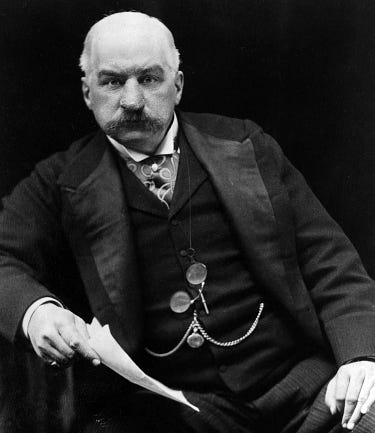
A century later, a second oligarchy emerged, the robber barons. They were men who amassed fortunes through their railroad, steel, oil, and financial empires — men such as J. Pierpont Morgan, John D. Rockefeller, Andrew Carnegie, Cornelius Vanderbilt, and Andrew Mellon. They ushered the nation into an industrial revolution that vastly expanded economic output.
They also corrupted government, brutally suppressed wages, generated unprecedented levels of inequality and urban poverty, pillaged rivals, shut down competitors, and made out like bandits — which is why they earned the sobriquet “robber barons.”
World War I and the Great Depression of the 1930s eroded most of these robber barons’ wealth. And most of their power was eliminated after the elections of Franklin D. Roosevelt in 1932 and Democratic majorities in the House and Senate.
For the next half-century the gains from growth were more widely shared, and democracy became more responsive to the needs and aspirations of average Americans.
Although America created the largest middle class the world had ever seen, there was still much to do — civil rights and voting rights for Black Americans, wider economic opportunities for them and for women and Latinos, protection of the environment. Yet by almost every measure the nation was making progress.
A third American oligarchy emerged starting around 1980. Since then, the share of the nation’s wealth owned by the richest 400 Americans has quadrupled (from 0.8 percent to 3.7 percent).
The richest 130,000 Americans and their immediate families now own as much wealth as the bottom 90 percent — 117 million — combined. The three richest Americans own as much as the entire bottom half of the population.
The only other country with similarly high levels of wealth concentration is Russia.
All this has been accompanied by a dramatic increase in the political power of the super-wealthy and an equally dramatic decline in the political influence of everyone else.
Unlike income or wealth, power is a zero-sum game. The more of it at the top, the less of it anywhere else.
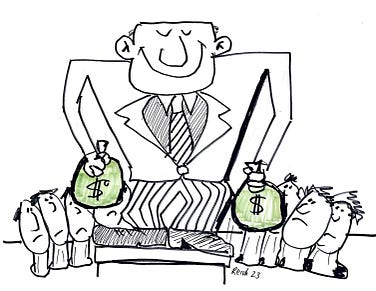
The average American now has little or no effect on public policy. Giant corporations, their CEOs, and a handful of extremely rich people have more influence than any comparable group since the robber barons.
 |
Big Money in Politics
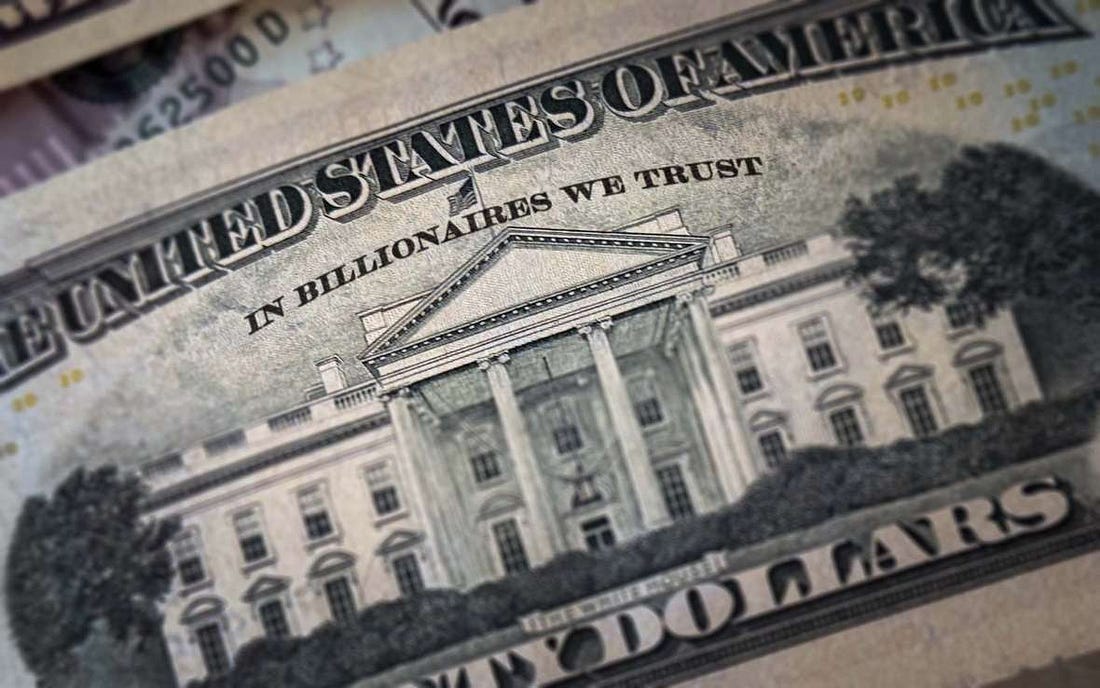
The power shift that’s occurred in America since around 1980 is directly related to a tsunami of big money into politics.
In the 2024 election, just 300 billionaires (and their immediate family members) donated more than $3 billion to candidates — almost 20 percent of all contributions to federal elections in 2024, either directly or through political action committees.
Billionaire families gave an average total of $10 million each in 2024, roughly equal to what 100,000 typical political donors gave, combined. One of them — Elon Musk — devoted a quarter of a billion dollars to Trump’s reelection. (This doesn’t count money that billionaires contributed through dark money groups that do not have to disclose their donors.)
Five presidential elections ago, adjusting for inflation, the share of billionaire spending on elections was almost zero — 0.3 percent, to be precise. That was before the Supreme Court’s 2010 Citizens United ruling that lifted many remaining campaign finance restrictions.
Corporate lobbying has also soared. The voices of average people have been drowned out.
Meanwhile, and largely because of this vast power shift, taxes on the wealthy and on corporations have been slashed. Trump’s so-called Big Beautiful Bill