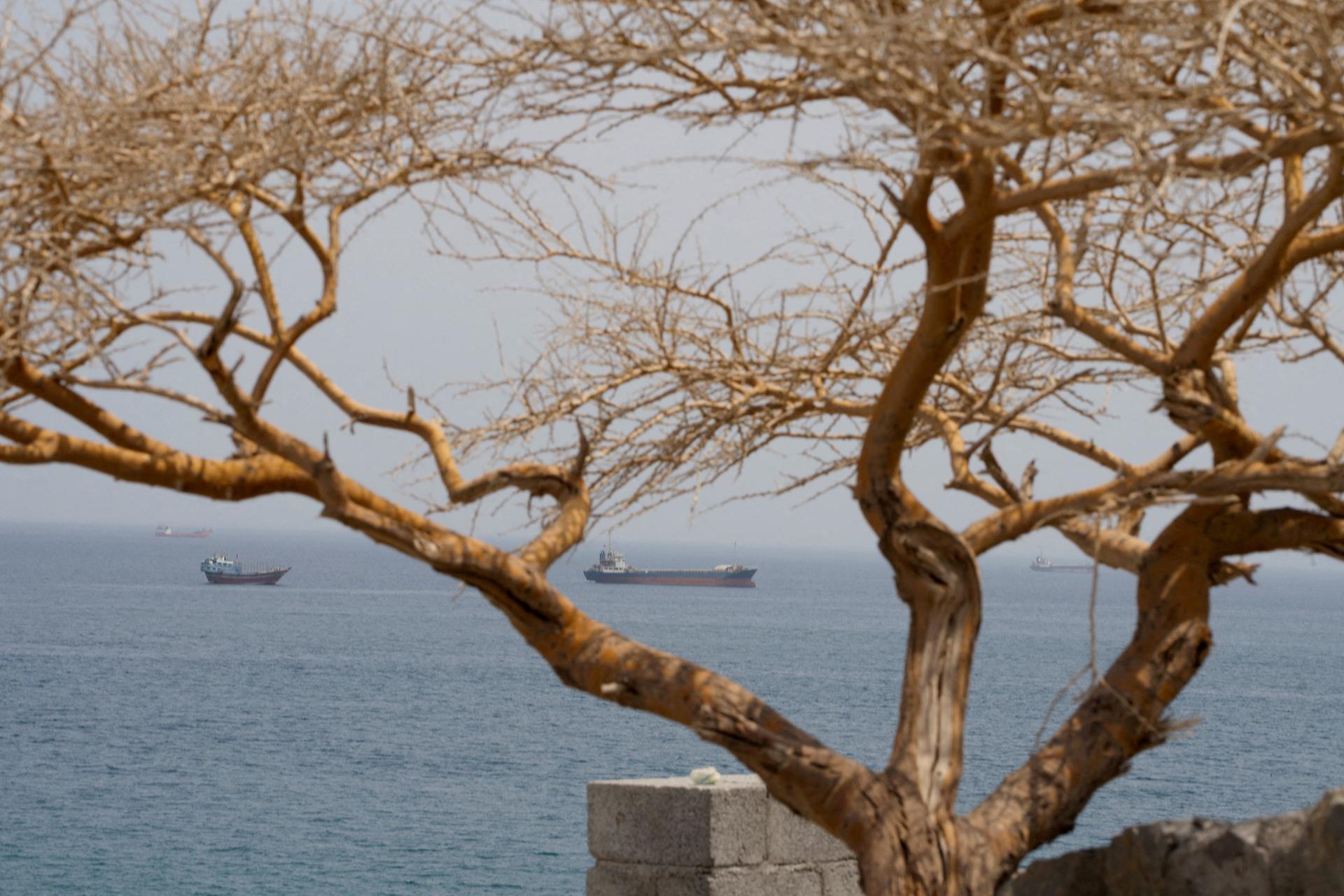
Vessels near the Strait of Hormuz, as seen from Musandam, Oman, August 10, 2026. REUTERS/Stringer |
-
US President Donald Trump responded to Iran's conditions for a peace deal with his own demands that Iran pay compensation for people killed in wars, attacks and protests, in a rhetorical escalation likely to complicate efforts to reopen the Strait of Hormuz.
-
The death toll following a powerful 7.4-magnitude earthquake in western Colombia is expected to rise as rescue efforts carry into the second day. Andean Bureau Chief Julia Symmes Cobb tells the Reuters World News podcast why the quake was so devastating and how the government is responding.
- President Trump took a secret military flight from Turkey last month in an operation that involved him being moved between aircraft in a catering truck, an extraordinary deception prompted by an Iranian assassination threat, the Washington Post reported.
-
The World Health Organization defended the science-based process used to determine childhood immunisation schedules after Trump signed an executive order aimed at reducing the number of recommended childhood vaccinations in the United States.
- Funding to tackle acute malnutrition in parts of Somalia has dropped by more than 80% this year, Médecins Sans Frontières said, even though one in every four children screened in displacement camps in the southwest is severely malnourished.
-
Typhoon Dolphin churned deeper inland to the central Chinese province of Hubei, flooding streets, forcing the closure of tourist areas and halting construction projects, as forecasters warned of extreme rainfall across a broad swath of the country.
-
A Syrian court sentenced ousted leader Bashar al-Assad to death after a trial in absentia, convicting him of crimes including killings, torture, and arbitrary arrest during the country's nearly 14-year war.
|
|
|
|
Instagram, TikTok, Snapchat, YouTube, Facebook, Twitch and Reddit applications are displayed on a mobile phone. REUTERS/Hollie Adams/Illustration |
|
|
|
A man paints walls at a former state-run gas station in Havana, Cuba, July 21, 2026. REUTERS/Norlys Perez |
Gasoline at $38 a gallon sold from cramped apartments. Diesel hawked on Instagram by a celebrity model to a reggaeton soundtrack. Six decades after Fidel Castro’s revolution, all of a sudden, capitalist cracks are appearing in Cuba’s communist energy sector. Under Washington’s crippling oil embargo against Cuba, an exception that allows US firms to export fuel to private Cuban businesses has kickstarted a chaotic black market and pried the lid off an energy sector tightly controlled by the state ever since Dwight Eisenhower was in the White House. |
|
|
|
A lionfish is caught in a trap in the coastal city of Limassol, Cyprus, July 17, 2026. REUTERS/Yiannis Kourtoglou |
Pepis, the bearded skipper of a small fishing boat, deftly picks up two lionfish caught in experimental traps off the coast of Cyprus, cuts off their venomous spines, guts them and tosses them into a bucket.
Around him, the Mediterranean looks like a pane of glass, its calm surface giving little hint of the dramatic transformation unfolding underwater. Pepis' practiced routine is part of a wider effort by scientists to track and control the spread of invasive species such as lionfish in these waters. Here life is changing, caused by a combination of warming sea temperatures and the Suez Canal which has eased access for fish from more tropical climes. |
|
|
|
|