
|
 |
The Booking System That Gets Easier Every Month You Use It
How to build a long-term guest acquisition system on Talks that compounds month after month so that filling your recording calendar requires less effort over time, not more
|

| |||||||||||||||


Most hosts expect podcast booking to get easier as their show grows.
It often doesn’t.
A show with 50 episodes has a larger back catalog, a stronger reputation, and a more defined audience than a show with 5.
But the host is still spending the same hours on outreach, the same time on scheduling, and the same energy on conversations that don’t convert to recordings.
The show got better. The booking system didn’t.
The shows whose booking systems get easier over time aren’t the ones that grew the fastest or accumulated the most downloads.
They’re the ones whose hosts built deliberate compounding mechanisms into the booking process from early on, so that every month of consistent activity made the next month’s booking task smaller rather than equivalent.
That compounding is what this post is about.
What Compounding In a Booking System Actually Looks Like
Compounding in a financial context means that returns generate their own returns. The same principle applies to a guest acquisition system, but the currency is reputation, relationships, and platform signals rather than money.
3 types of compounding run in a well-built Talks booking system.
1. 📈 Profile compounding
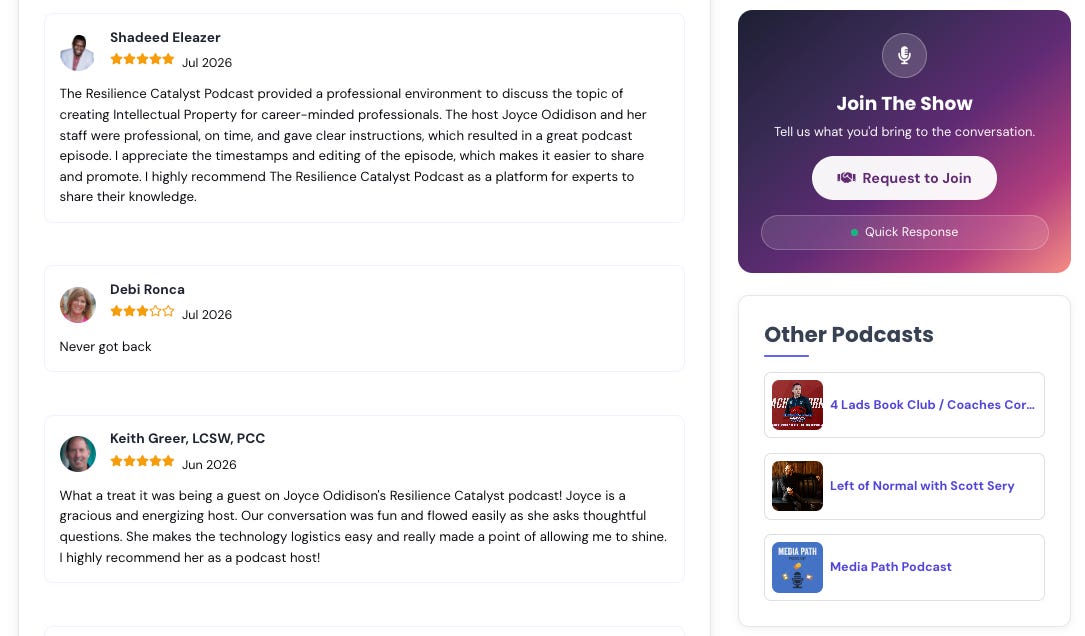 |
Every completed interview, every review received, every quick response to a message adds to the public authority signals on your Talks show profile.
What accumulating authority signals does: Makes your show progressively more attractive to higher-caliber guests without requiring any additional active work; a show profile with 30 completed interviews and 15 strong reviews is a fundamentally different proposition to a potential guest than the same show at 5 completed interviews.
How it compounds: A stronger profile attracts better guests. Better guests produce stronger episodes; stronger episodes attract more listeners and more listeners make the show more attractive to better guests. The cycle accelerates rather than plateaus when the inputs are consistent.
What maintenance looks like: Completing every recording and moving it through the Talks workflow immediately, leaving reviews within 24 hours of every recording, and keeping the profile updated with new episodes as they publish.
2. 🤝 Relationship compounding
 |
Every podcast guest you record with is a node in a network of potential future guests, hosts, and collaborators.
What relationship compounding produces: A referral network that generates inbound guest applications without requiring active outreach. A show with 50 recorded guests who each make one introduction over time has 50 warm referrals feeding the pipeline without a single additional connection request sent.
How it compounds: Referred guests tend to refer other guests. A network effect builds around shows that treat their guests well, follow through consistently, and produce episodes worth sharing. The shows that develop this reputation find that podcast guest acquisition shifts from outbound to increasingly inbound over time.
What builds the relationship capital that produces referrals: Showing up prepared for every recording, following through on every commitment made to the guest, leaving thoughtful reviews promptly, and making introductions proactively before being asked.
3. 🔍 Visibility compounding
Every backlink from an episode show notes page, every social profile that links to your Talks show profile, and every platform mention of your show adds to the search authority that makes your show discoverable to guests who are actively looking for shows to appear on.
What visibility compounding produces: Passive inbound guest discovery from guests who find your show through Google, through AI search results, and through the Talks platform’s own matching algorithm without you having to initiate contact.
How it compounds: More appearances produce more show notes pages that link to your profile, more links strengthen your Google ranking. A stronger Google ranking produces more passive discovery, more passive discovery produces more inbound connection requests, and more inbound connection requests reduce the outbound effort required to keep the pipeline full.
What the visibility looks like at different stages: At 20 episodes the compounding is beginning. At 50 it’s noticeable. At 100 the inbound flow from visibility compounding is substantial enough to meaningfully reduce the outbound effort required to maintain a full calendar.