
|



 |
PN is supported by paid subscribers. Become one ⬇️
Last month, President Trump used a planeload of reporters as an unwitting decoy during a real assassination threat, subpoenaed the journalists who reported that something was amiss, and then stood up at a black-tie dinner and told those same journalists how lucky they are that he tolerates them at all.
The episode highlights the grossly dysfunctional relationship between the president and the media, which puts up with ever-escalating abuses as the price of access, and routinely normalizes Trump’s erratic and even criminal behavior.
The old switcheroo
The saga began on July 8, when Trump was returning home from a NATO summit in Turkey.
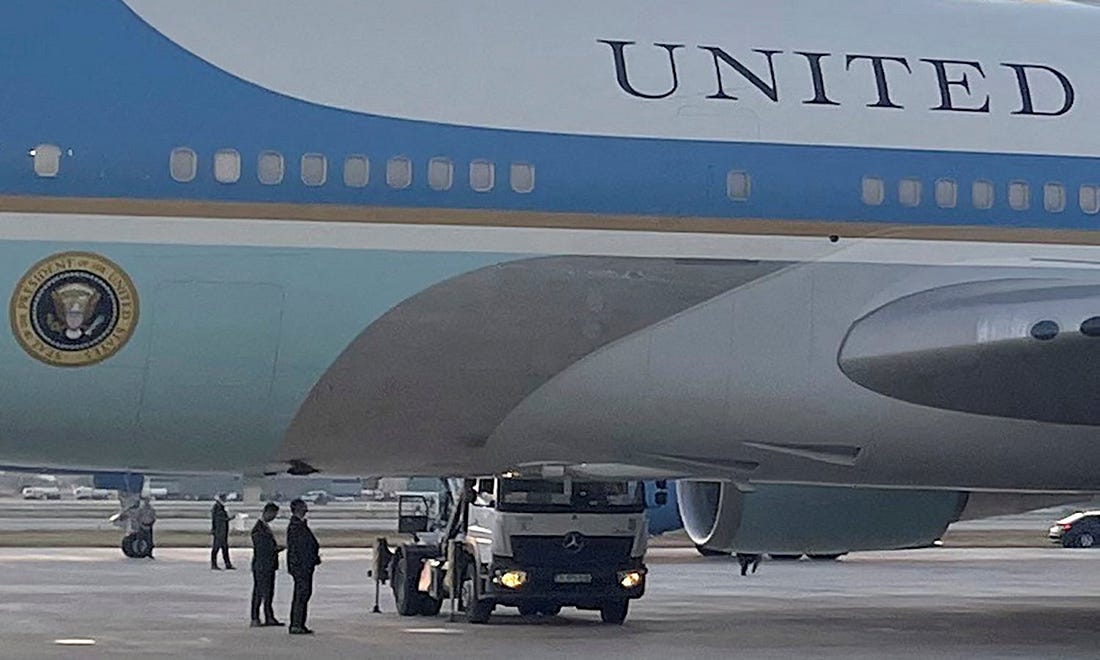
Two days earlier, Trump flew to Ankara on his Qatari bribe jet, newly renovated using billions of tax dollars. But for the return trip home, he initially boarded one of the old blue-and-white Boeing 747s that ferried presidents around for the past four decades, only switching back to the bling jet during a stopover in the UK.


On July 9, the New York Times reported that Trump had taken the old jet “as a security precaution related to the resumption of hostilities with Iran,” which the US had resumed bombing during the summit. (Media reports of the war’s demise turned out to be greatly exaggerated.)
The following day, the paper followed up with a story asserting that the Secret Service had insisted on the swap due to concern that the new plane “lacks the same defensive countermeasures that were security features of the old model, including its advanced antimissile capabilities, according to multiple officials who have been briefed on how the jet was retrofitted.”
This confirmed prior reporting by the AP that the Qatari jet (which Trump plans to take with him in 2029) “is not equipped with at least some of the same missile detection and countermeasure systems as the outgoing Cold War-era jets.” And in fact the Air Force admitted back in June the team that retrofitted the plane made “trades on some of the less commonly used mission sets.”
And yet the White House went berserk.
On the evening of July 10, FBI agents showed up at the homes of Julian Barnes, Eric Lipton, and Eric Schmitt, three of the New York Times journalists bylined on those stories. The agents served subpoenas ordering the three to testify before a grand jury on the 15th about an “alleged violation of federal law.” (Apparently the FBI failed to serve reporters Adam Goldman and Tyler Pager.)
Later it emerged that the DOJ had also subpoenaed phone records for the reporters’ family members. One request sought records going back to January 1 — months before the articles were even published.

This is not a one-off. In January, the FBI raided the home of Washington Post reporter Hannah Natanson, seizing her phone and laptop. In February, the administration subpoenaed Times freelancer Matthew Cole demanding sources for a story about a failed top secret mission in North Korea in 2019. In March, it subpoenaed the Wall Street Journal over reports on the lead-up to the war in Iran.
All of these were challenged in court, and of course the Times moved to quash the July subpoenas as well.
Their motion cited binding Second Circuit precedent and federal regulations requiring the government to exhaust investigative steps before subpoenaing journalists — something which could not possibly have happened in the few hours between the story’s publication and the appearance of armed FBI agents on the reporters’ doorsteps.
The DOJ’s conduct here was beyond inappropriate — they clearly deceived the magistrate judge about the facts and the law. After a tense hearing before Judge Arun Subramanian on July 23, the government agreed to withdraw the subpoenas.