| | In today’s edition: Pakistan returns as a regional mediator, Iran oil exports run dry, and Saudi inv͏ ͏ ͏ ͏ ͏ ͏ |
| |  | Gulf |  |
| |
|
 - Pakistan talks up deal
- Iran economy struggles
- Tourism jobs at risk
- Classroom shakeup in Saudi
- Saudi investments in Syria
 Back-to-school sermons. |
|
Pakistan claims Hormuz deal ‘close’ |
 Ministry of Transport -Republic of Yemen/Reuters Ministry of Transport -Republic of Yemen/ReutersPakistan resumed its regional mediator role, with officials flying into Tehran and its defense minister saying the US and Iran were “close to some sort of arrangement” over the Strait of Hormuz. The reality on the ground — and on the seas — looks more discouraging. Six were killed in a Houthi attack in the Bab el-Mandeb Strait, while the US fired on a ship heading to Iran. Tehran reiterated its demands for extensive US concessions before it lifts its threats to Hormuz shipping. Few vessels appear willing to risk transiting the strait. Although the US energy secretary said almost 9 million barrels a day is getting out, implying a lot more tankers than thought are sailing covertly, analysts cast doubt on that figure, with one saying there was “zero evidence” to support it. |
|
Iran’s export lifeline runs dry |
 Planet Labs PBC/Handout via Reuters Planet Labs PBC/Handout via ReutersUS forces fired missiles at a ship attempting to run its blockade of Iranian ports on Tuesday, according to US Central Command. The embargo is the sharpest edge of a campaign (that also includes sweeping sanctions) to starve Tehran of oil revenue and undermine its economy, with the cost borne largely by ordinary Iranians. The US squeeze is most obvious at Kharg Island, Iran’s main crude export terminal, which has recorded no departures since July 31, according to maritime intelligence company Windward. The US has also “redirected” 55 commercial vessels trying to reach Iranian ports. In its kinetic war, the US has mostly bombed southern Iran, with more than 1,000 targets hit last month alone. Qeshm island, close to the Strait of Hormuz, drew nearly 4 million visitors last year, but its hotels now sit empty and fishing has nearly stopped. |
|
Grim figures come in for tourism |
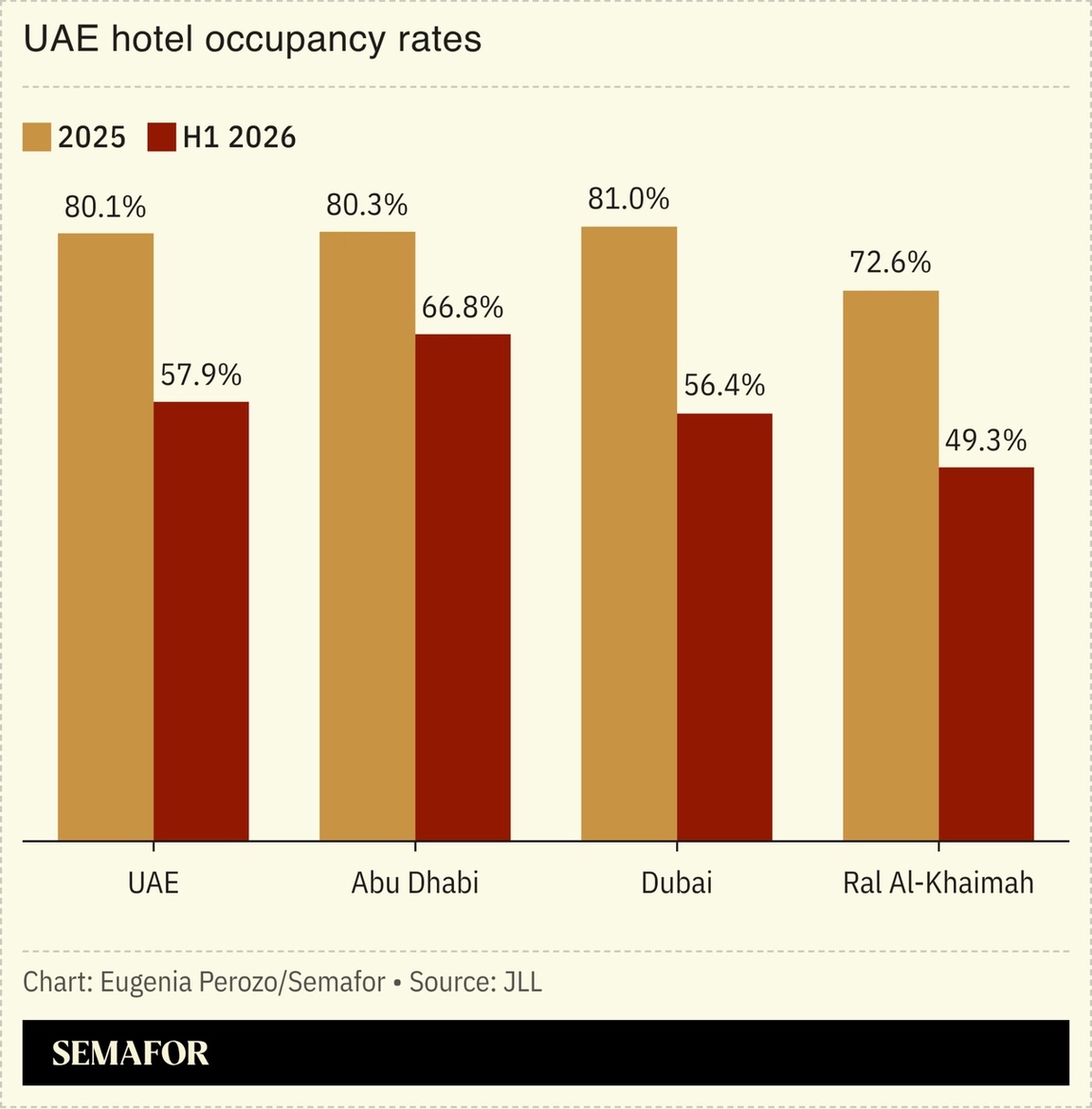 Tourism, beleaguered by lower confidence and fewer air routes, remains one of the hardest-hit sectors in the Gulf as the Iran war grinds on. About 140,000 hospitality jobs are expected to be lost this year, according to the World Travel & Tourism Council. Saudi Arabia is among the worst affected, expected to shed 69,000 jobs. Visitor numbers are down sharply across the region. UAE hotel occupancy rates plunged this year, according to JLL; in Qatar, only about half of the available hotel rooms were booked in the second quarter, according to Valustrat. Still, some market watchers are optimistic that recovery, which hinges on a resolution to the war, will be fast because the disruption is affecting confidence more than the region’s connectivity, AGBI reported. |
|
Israelis commend Saudi textbook changes |
| |  | Manal Albarakati |
| |
 Mohamed Al Hwaity/Reuters, Ahmed Yosri/Reuters, Mohammed Benmansour/Reuters, Faisal Al Nasser/Reuters, Saudi Press Agency via Reuters, IMPACT-se Mohamed Al Hwaity/Reuters, Ahmed Yosri/Reuters, Mohammed Benmansour/Reuters, Faisal Al Nasser/Reuters, Saudi Press Agency via Reuters, IMPACT-seChanges to Saudi Arabia’s school curriculum have addressed most of the “problematic themes” that were seen as intolerant of Christians and Jews, according to a review of schoolbooks by an Israeli think tank. It noted that 11th-grade students learn about coexistence with those of other faiths, while ninth-graders now study Galileo as a lesson in independent thought, and sixth-graders are asked to argue against the idea that kindness is owed only to Muslims. The review by the Institute for Monitoring Peace and Cultural Tolerance in School Education (IMPACT-se) — an organization with prominent critics who question its methodology and conclusions — also noted changes beyond religion, including lessons that encourage compassion toward migrant workers.
|
|
Saudi firms strike more Syria deals |
 Courtesy of UNIFI Communications Courtesy of UNIFI CommunicationsSaudi Arabia’s investment pledges in Syria are moving from broad headline figures into smaller private-sector deals. Al-Harfi Construction recently agreed to build 760 megawatts of solar and battery power projects, while United Feeds is working on an investment covering 30,000 hectares of farmland along with feed-processing facilities. In total, Saudi companies have announced projects worth billions of dollars, joining a rush of deals from Qatar, the UAE, and Türkiye, as governments and businesses compete for influence and commercial opportunities in Syria’s reconstruction. In a rare US deal — one that affects a major Saudi investment — New York-based UNIFI Communications and its partners awarded a contract for a 240-kilometer submarine cable from Cyprus to Tartous on Syria’s Mediterranean coast. The line will connect with an $800 million telecoms network in Syria being implemented by Saudi Arabia’s stc, helping make the country a data transit route between the Gulf and Europe. — Mohammed Sergie |
|
 Semafor has announced the Semafor Innovation Atlas, a new global editorial initiative spotlighting the most effective real-world applications of AI, robotics, and emerging technology. The editorial project will identify proven initiatives already delivering measurable results across healthcare, workforce development, education, responsible AI, and climate and energy. Selected projects will debut at Semafor’s Silicon Valley & The World this November, where leaders will examine what is working and what others can learn from initiatives with the potential to scale. Organizations, governments, universities, schools, nonprofits, and companies are invited to submit active projects for consideration by Friday, August 28, 2026. If your team is using technology to solve real problems and create scalable impact, submit your project for consideration here. |
|
 Aviation- Dubai Aerospace Enterprise, the aircraft lessor controlled by the emirate’s sovereign fund, bought four Boeing 777 freighters and leased them to Saudi national carrier Saudia. The deal follows recent reports that a spat between the countries had impacted financial transfers and trade flows.
- Kuwait tightened its regulations on drones, setting out rules for their registration and use, and penalties for misuse. In April, the country banned the sale of drones in the face of waves of attacks by Iranian unmanned aircraft. — Kuwait Times
Energy- Saudi Arabia’s two biggest drillers saw opposite results in the second quarter, with Ades Holding’s revenue jumping 36% on its overseas expansion while wartime rig suspensions pushed Arabian Drilling to a loss. The latter is much more heavily invested in the Gulf, while Ades has branched out to Africa and Asia. — AGBI
- Abu Dhabi energy company ADNOC has been shuttling Iraqi oil through the Strait of Hormuz, in addition to the UAE’s own output, seemingly helping Baghdad to boost its exports to 2 million barrels a day. — Bloomberg
Real Estate- Qatari Diar launched the first phase of Alam Al-Roum, its $29.7 billion resort city on Egypt’s Mediterranean coast, which is expected to create nearly 30,000 direct and indirect jobs. Qatar Investment Authority’s property arm is seeking partners for what is its largest investment in Egypt. — AGBI
- Moody’s placed Binghatti Holding’s Ba3 corporate rating on review for downgrade, citing a deteriorating liquidity profile and uncertainty over the timing of cash flows over the next 18 months. — Zawya
|
|
 Rula Rouhana/Reuters Rula Rouhana/ReutersIn a few days, the greatest time of year for parents returns: school is back. Across the Gulf, that means back-to-school sales, families returning from summer vacations, and even governments getting into the spirit. UAE leaders traditionally send students messages of encouragement on their first day: Last year, President Sheikh Mohamed bin Zayed’s address was broadcast in schools nationwide. Saudi clerics are coordinating their message. Islamic Affairs Minister Abdullatif Al Alsheikh instructed mosques across the kingdom to dedicate Friday’s sermon to the new school year, emphasizing the value of education and hard work. Sermons should also promote moderation, patriotism, and prayers for King Salman and Crown Prince Mohammed bin Salman, he said. |
|
|


