



Hey guys: If you missed Jasmine’s Triad last week, go back and give it a read. It’s so good.
Her thesis is that while “woke” eventually grew into an amorphous oppressive blob—if you like Thanksgiving or don’t like bike lanes, then you are read out of the movement!—the original ideas behind “staying woke” are pretty valuable. And also turned out to be . . . right. Here’s Jasmine:
Maybe at this point you’re thinking I’m making a True Woke has never been tried! argument. Not quite. My point is that “wokeness”—in an idealized form—is an argument for guardrails against unrestrained domination by the most powerful forces in society. It was in the calls for an end to extrajudicial police killings. It was in the demands for accountability when influential figures parroted harmful racist remarks. It was in the warnings of how easily civil protections for vulnerable groups—trans people or noncitizen immigrants or pregnant women—could be trampled upon.
The best Triads make you think about the world a little differently. This is one of them. If you missed it, read Jasmine here.
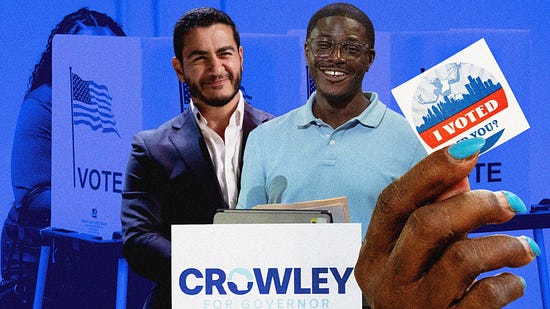 |
1. The Polls
For all the carping about polls, they’re usually correct. Even in the big surprise elections, like 2016, the polling was mostly accurate: Trump’s results were within the margin of error in almost every state.¹
But sometimes there are misses. It’s useful to look at the polling in Wisconsin to understand what happened last night because while the topline result is shocking, the numbers . . . aren’t really?
This isn’t the story of a polling miss so much as voter sentiment moving so fast that the polls were a few days behind it.
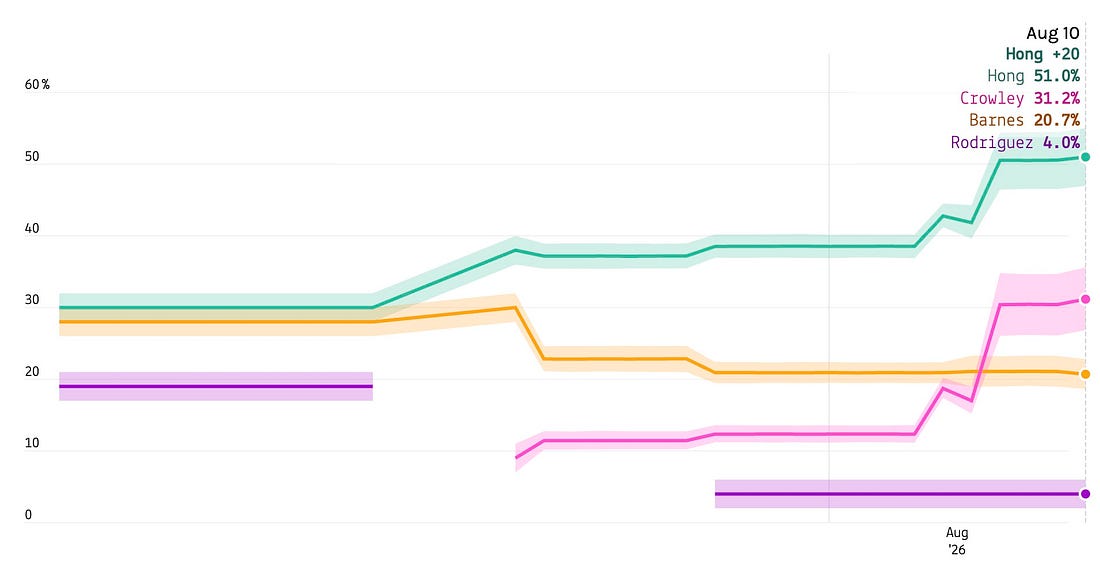
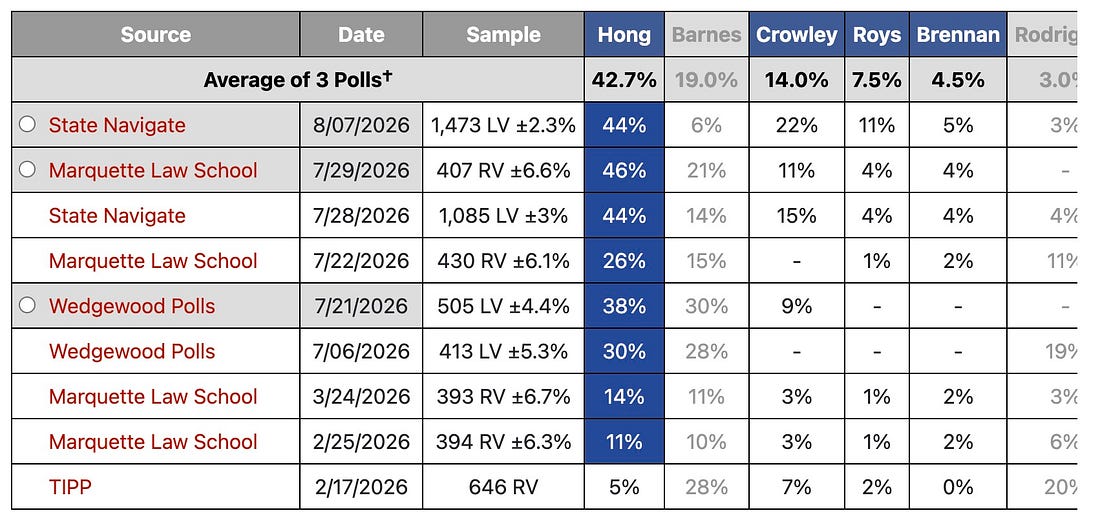
Let’s look at the most recent polls heading into the election:
 |
 |
And what did we get when the actual votes were counted?
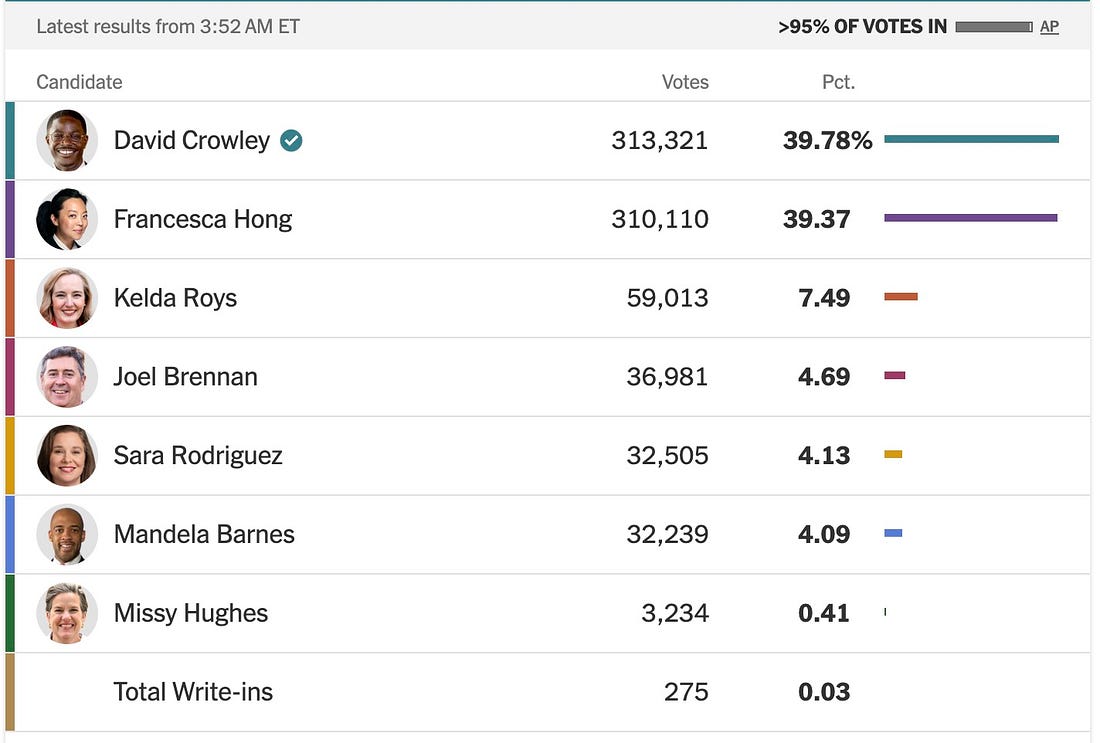 |
So let’s start with Francesca Hong. She underperformed her polling, but not by that much. The average of the last three polls had her at 42.7 percent. She finished with 39.37 percent. Three points is awfully close to the margin of error.
What happened to Hong’s number? She had been sitting at 40 percent since the middle of July. Then there was a little boomlet as Wisconsin Democrats took a closer look at her, so she gained a few points. And then, over the last week or so, she cooled off and settled back to her baseline. This isn’t a collapse. The polls just didn’t capture her reversion during the last week.
The big shock is David Crowley’s 39.78 percent.
That number is a surprise, but there were signs that something was happening. In early July Crowley didn’t even register because he’d dropped out of the race. Last week, after rejoining, he was at 22 percent. Voters were finding their way to him. Mandela Barnes had been sitting on something like 20 percent and he dropped out just two weeks ago. His voters had to go somewhere. It turns out they flowed to Crowley.
The polls captured the beginning of that flow, but polling doesn’t work in real time. There’s latency.
The polls in Wisconsin weren’t wrong so much as a week behind. The environment was more fluid than some of us realized and the movement that we saw in the polls toward Crowley was happening faster than surveys could capture.
Today’s Triad is free because I wanted to make sure it was as widely read as possible. You can read our locked newsletters—and join the conversation—with a Bulwark+ membership:
The reason I’m picking apart the polling is because between Hong in Wisconsin and El-Sayed in Michigan, we’re going to get a narrative about how DSA-branded Democrats always underperform.
And the reality is more complicated than that.
El-Sayed isn’t actually a DSA Democrat. He’s a normal Democrat who, for various reasons, codes as DSA-adjacent. Yet he underperformed much more than Hong. El-Sayed’s polling average had him up by 13; he won by a point.
Francesca Hong is a real-deal DSA-er and she finished within the margin of error of where the polls had her.
So at the broadest possible level, a narrative saying DSA Dems underperform their polls isn’t right.
But there is a lesson in here and it seems important.
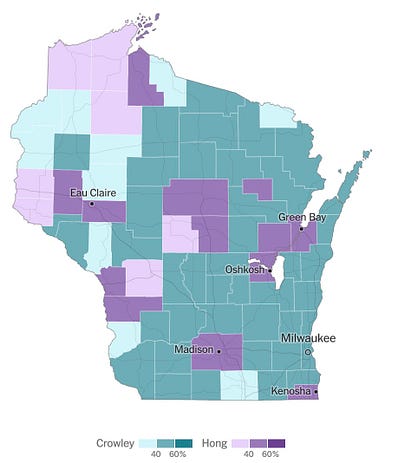
Haley Stevens did well with African-American voters. Abdul El-Sayed did not. Francesca Hong did best in Wisconsin’s college towns. In densely urban Milwaukee she ran behind Crowley, who has been county executive there since 2020.
 |