| | In this edition: Crowley beats Hong, mystery PACs muddy Alaska’s ad waters, and new Iowa polling.͏ ͏ ͏ ͏ ͏ ͏ |
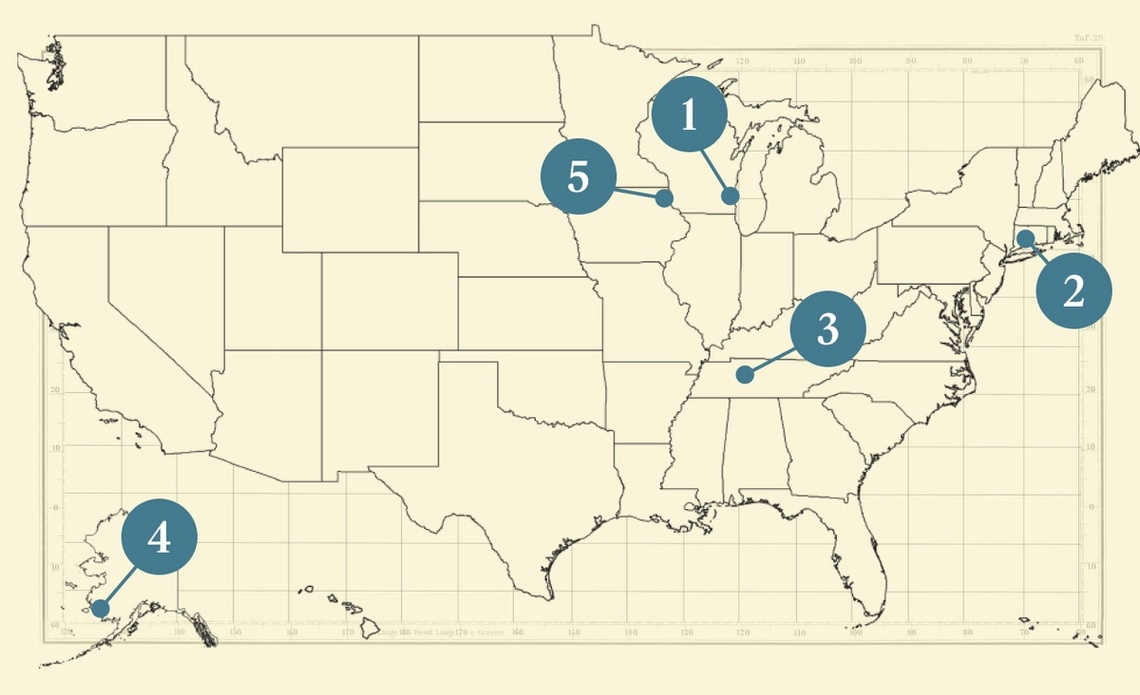
| |  BETHEL, AK BETHEL, AK |  MADISON, WI MADISON, WI | DRESDEN, TN |
 | Americana |  |
| |
|
 - Comeback Crowley
- Larson falls, Flanagan ascends
- Green with revenge
- Mary’s war
- Is Iowa purple?
|
|
 Dave will be taking some time off next week, and this newsletter will not be published on Aug. 19. Regular programming will resume Aug. 26. |
|
 Over the last few days, as Francesca Hong’s Wisconsin gubernatorial campaign came undone over a tweet condemning the colonialist origins of Thanksgiving, I flashed back to September and a debate between two Democratic strategists. On one side of the Persuasion 2025 stage was Sarah Longwell, a former Republican who’s now publisher of The Bulwark. On the other was Anat Shenker-Osorio, a progressive messaging guru who advised the Way to Win donor network — the hosts of the conference — on how to move voters. Longwell argued that Democrats needed to change the way they talk, un-learning the elitism of John Oliver and college-town coffee shops: “When you ask voters about Democrats, one of the things they’ll say is: ‘I don’t know, they sound like aliens.’” Shenker-Osorio countered that Democrats were fighting a fascist threat and needed to say so: “What you need is a message that will make people stop scrolling or sit up and listen in the first place.” It was the post-Biden Democratic dialectic in one room. Did the party go too far left and alienate working class voters? Or did it wimp out and convince those voters that it was too scared of Republicans to fight for them? This is a helpful way to think about the party’s argument about “wokeness” and the legacy of the social justice movements of 2020. The weaker Democratic faction believes the party moved too far to the left then and must convincingly recant to win back votes; the stronger faction believes this argument is a distraction whipped up by Republicans. What the weaker faction figured out, just in time to beat Hong, is that very few Democrats want to own what they said in 2020. Few believe that better social welfare could make police and prison unnecessary, as the left argued six years ago. Very few think that America was truly founded when the first slaves arrived in 1619 and that patriotic holidays are oppressive. The proponents of those ideas believe that spreading them can shift the boundaries of debate — that nothing else will do so in a media environment where conservatives hold enormous power. But many left-wing Democrats have stopped trying to spread them. They’ve become much more skeptical of “woke” language, seeing it as a top-down, elite-driven effort to snuff out economic populism. Meet the progressives who’ve moved on from 2020. → |
|
|
How center-left Democrats pulled it off in Wisconsin |
 Daniel Steinle/Reuters Daniel Steinle/ReutersWisconsin Democrats picked Milwaukee County Executive David Crowley as their gubernatorial nominee for governor on Tuesday after a frenetic three-week primary drama that ended with Crowley’s home city screwing up its vote count. Crowley, who had quit the race before Gov. Tony Evers coaxed him back in, defeated state legislator Francesca Hong by slightly more than 3,000 votes out of nearly 800,000 cast. It was, by far, the highest-turnout Wisconsin Democratic primary of the century, with months of voter confusion about a crowded ballot followed by a race between Evers-backed Crowley in one lane, and Hong on the other. Hong narrowly missed becoming the first member of Democratic Socialists of America to win her party’s nomination for governor in a swing state. She got an 11,000-vote margin out of Madison’s Dane County, her political base, and performed strongly in mid-sized cities and college towns. Her support for a moratorium on new data centers, based on the resistance she saw in small towns, helped her lead polling for most of the summer. But Crowley outran Hong in most of rural Wisconsin, apart from some areas in the Minneapolis media market. Democratic leaders in the state were able to convince their voters that the TV ads they were seeing for Hong — mostly funded by Republicans — were political trickery meant to nominate an unelectable candidate. Read my reporting on how center-left Democrats used the specter of a Republican culture-war campaign to fight the left. → |
|
|
Taking stock of this week’s other big primaries |
 Tim Evans/Reuters Tim Evans/ReutersProgressives and Trump-endorsed Republicans advanced in many of Tuesday’s races, while Connecticut Democrats ousted a septuagenarian House member who sought reelection after suffering a partial seizure during floor debate. Former Hartford Mayor Luke Bronin blew past Rep. John Larson in Connecticut’s most Democratic district. Larson, first elected in 1998, won barely a third of the vote against Bronin and two weaker challengers, whom he had hoped would split the anti-incumbent vote. (In rambling remarks at his election-night party, the incumbent avoided saying Bronin’s name and chided the media for not giving the also-ran candidates more coverage.) Bronin didn’t run to Larson’s left. In Minnesota, progressives had much clearer wins: Lt. Gov. Peggy Flanagan beat Rep. Angie Craig by 20 points, securing the nomination to succeed Democratic Sen. Tina Smith. In Craig’s suburban and exurban House seat, Democrats nominated Matt Little, a progressive who’d served one term in the state senate, over candidates more aligned with Craig — a moderate who apologized for supporting a Trump-backed immigration bill. “It’s mostly about spine,” Little told Semafor before the election. Democrats were looking for more pugnacious and progressive candidates because they saw weakness in DC. “They’re not willing to stand up. They’re not picking the right fights and winning the right fights.” Minnesota was the one place where the president couldn’t get his own “fighter” over the line, as MyPillow CEO Mike Lindell lost his bid for governor and refused to concede. In northwest Wisconsin, southeast Alabama, and South Carolina, Trump-endorsed candidates either won outright or led going into runoffs. Read more takeaways from Tuesday. → |
|
|
The clean energy advocate who helped defeat Ogles |
 Elizabeth Frantz/Reuters Elizabeth Frantz/ReutersTennessee Republicans ousted Rep. Andy Ogles in last Thursday’s primary, nominating former state Agriculture Commissioner Charlie Hatcher instead. Ogles had lost most of his old district in the mid-decade gerrymander that he’d endorsed, but even then few predicted that he’d become the first Trump-endorsed House member to lose reelection. A PAC known as the Invest in Tomorrow Coalition changed that, spending nearly $2 million in the closing weeks of the election to batter Ogles and help Hatcher. Ogles denounced the coalition as a “green energy PAC,” which it is. The group is run by Tom Matzzie, a former president of MoveOn; he launched it to punish Republicans who’d voted to revoke green energy credits in last year’s party-line tax and spending bill. “There’s a demonization of our industry that people are getting tired of,” Matzzie told Semafor. The coalition’s donors, he said, included some Republicans who were succeeding in the renewables industry during Trump’s first term and wanted to stop the administration’s attack on it. Ogles, who’d inflated his resume to win and was beset by scandal, made for a good target, Matzzie said: “I don’t think we made any Republicans angry by taking him out.” But the PAC’s bigger target was the House Freedom Caucus. The goal of spending against Ogles in Tennessee and Rep. Chip Roy in Texas, Matzzie added, was to “make [it] a liability to join the House Freedom Caucus,” shifting the way Republicans view green energy. “If you’re running for president in 2028, it’s something you need to be on the right side of.” |
|
PACs boost the fringe in Alaska open primary |
 Mary Peltola/YouTube Mary Peltola/YouTubeAlaska’s Aug. 18 primary will test its “top four” primary system again, before another effort to scrap the system and return to partisan contests. Elon Musk just donated $1.5 million to the campaign for a repeal. Fourteen candidates are sharing the ballot with Sen. Dan Sullivan, R-Alaska, and former Rep. Mary Peltola, the undisputed Democratic candidate for Senate. Sullivan and Peltola have to compete for eyeballs with some meddling PACs, boosting the fringe candidates. In “Military Mom,” Peltola says she “pushed through the largest pay increase for soldiers in decades, plus more for VA healthcare.” The ad’s title references her two sons, partly in response to GOP criticism of her that (out of context) portrays her votes against Republican spending bills as opposition to a military pay raise. Fringe Democratic candidates are also getting their own backhanded boosts in order to hurt Peltola. The American Democracy Project, the latest pop-up PAC that won’t disclose donors until after the primary, is promoting dancer David Leslie as the real progressive on the ballot, with rainbow trim on his logo and a picture of the candidate waving a LGBTQ pride flag. Fair Deal Alaska, another mystery PAC, is promoting direct mayor Carol Hafner, a perennial candidate who files for races in states where she doesn’t live; her campaign website misidentifies what she’s running for, with a New York City phone number. |
|
Iowa polling doesn’t show a clear Democratic rush |
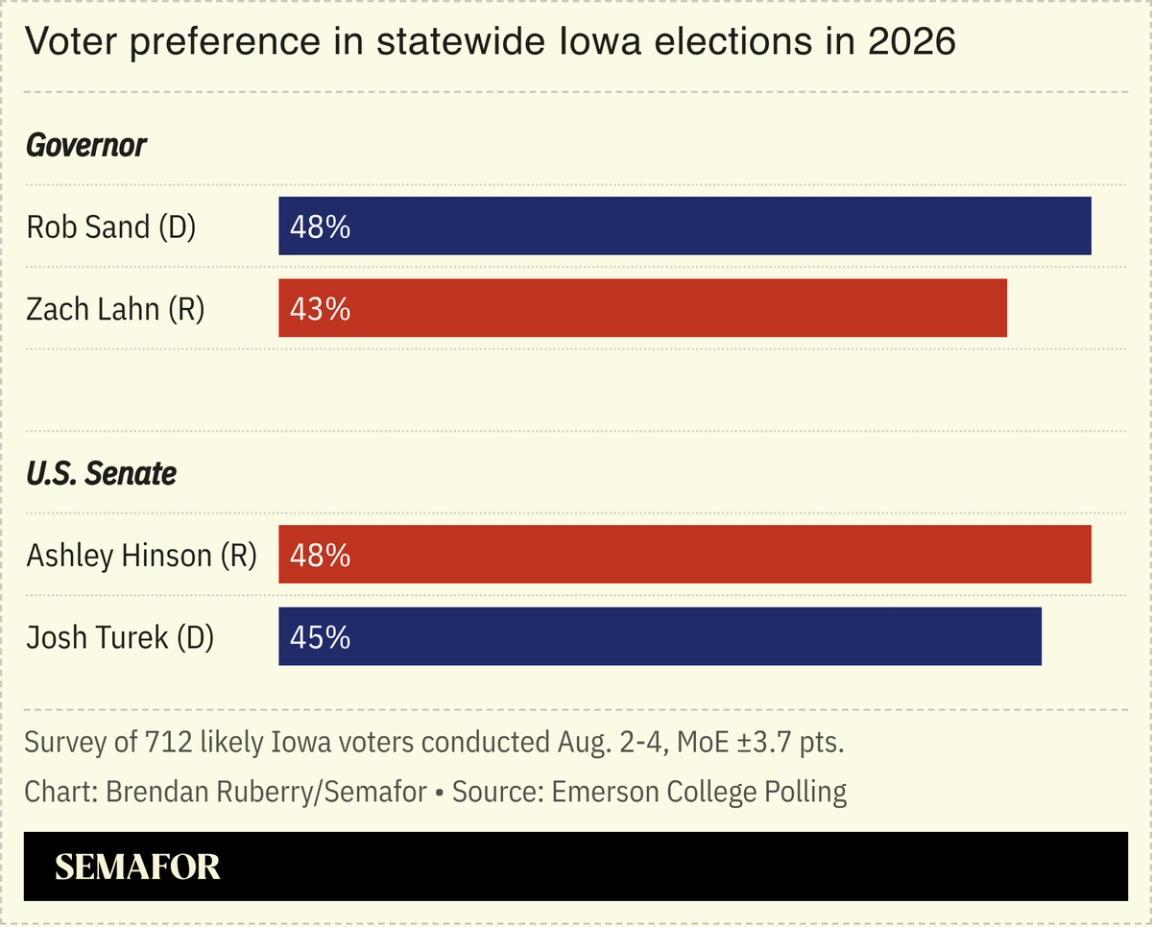 Pollsters have had a rotten few weeks in Democratic primaries, underestimating the center-left vote in Michigan and Wisconsin. It’s not clear yet whether those stumbles will extend to the November electorate. In Iowa, there are signs of fatigue with the Trump administration (a 43% approval rating) but not signs of a responsive rush to Democrats. Sand has a positive favorable rating built over eight years as the last Democratic official elected statewide; his criticism of his party, and a few culturally conservative views, have helped him build a massive lead with independents. Turek is less well-known than Sand, though, and hasn’t made the same inroads in his Senate race. This poll shows Hinson, who’s won three elections in eastern Iowa, keeping most of the Trump coalition together. |
|
 Semafor has announced the Semafor Innovation Atlas, a new global editorial initiative spotlighting the most effective real-world applications of AI, robotics, and emerging technology. The editorial project will identify proven initiatives already delivering measurable results across healthcare, workforce development, education, responsible AI, and climate and energy. Selected projects will debut at Semafor’s Silicon Valley & The World this November, where leaders will examine what is working and what others can learn from initiatives with the potential to scale. Organizations, governments, universities, schools, nonprofits, and companies are invited to submit active projects for consideration by Friday, August 28, 2026. If your team is using technology to solve real problems and create scalable impact, submit your project for consideration here. |
|
 Kylie Cooper/Reuters Kylie Cooper/ReutersMyah Ward’s |
|
|


