| | A Chinese reformer dies, Germany unleashes its spies, and Eli Lilly cracks down on copycats.͏ ͏ ͏ ͏ ͏ ͏ |
| |  SALT LAKE CITY SALT LAKE CITY |  TEHRAN TEHRAN | CHANGSHA |
 | Flagship |  |
| |
|
The World Today | 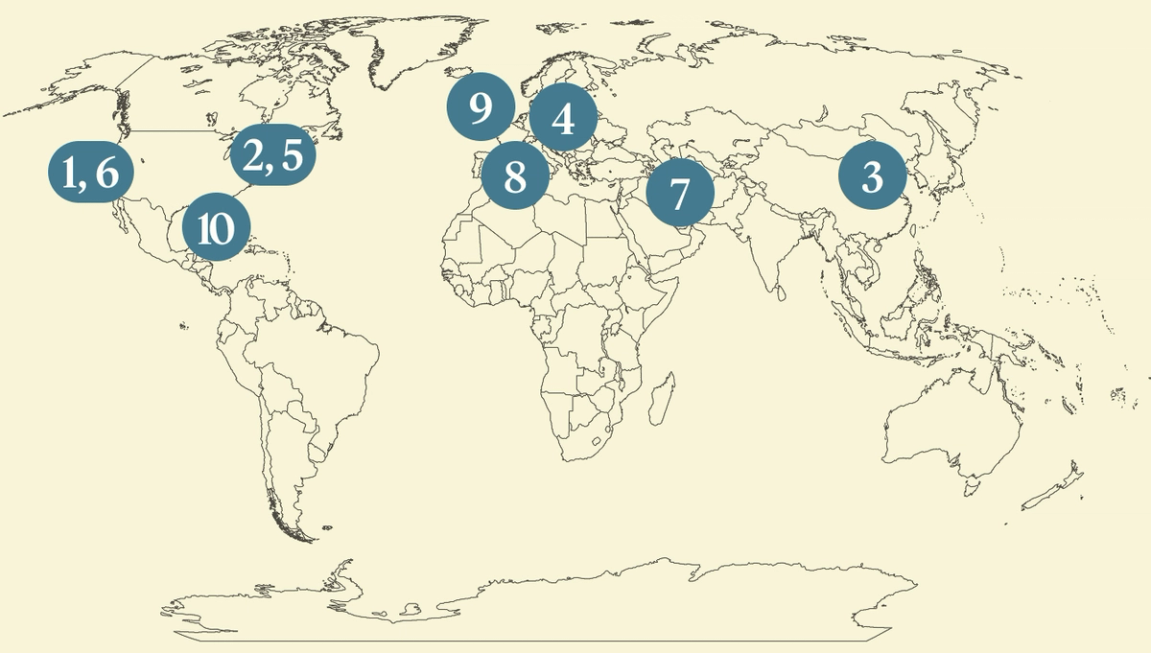 - AI trade surges
- US inflation cools
- Chinese reformer dies
- Germany unleashes spying
- Eli Lilly sues copycats
- Iger, Kushner buy Lakers
- US detains Iranian family
- Faithful are less fertile
- Funding science with lotteries
- Voyager 2 keeps trucking
 An excuse to read ‘600 pages of deep pleasure.’ |
|
AI trade surges on cloud earnings |
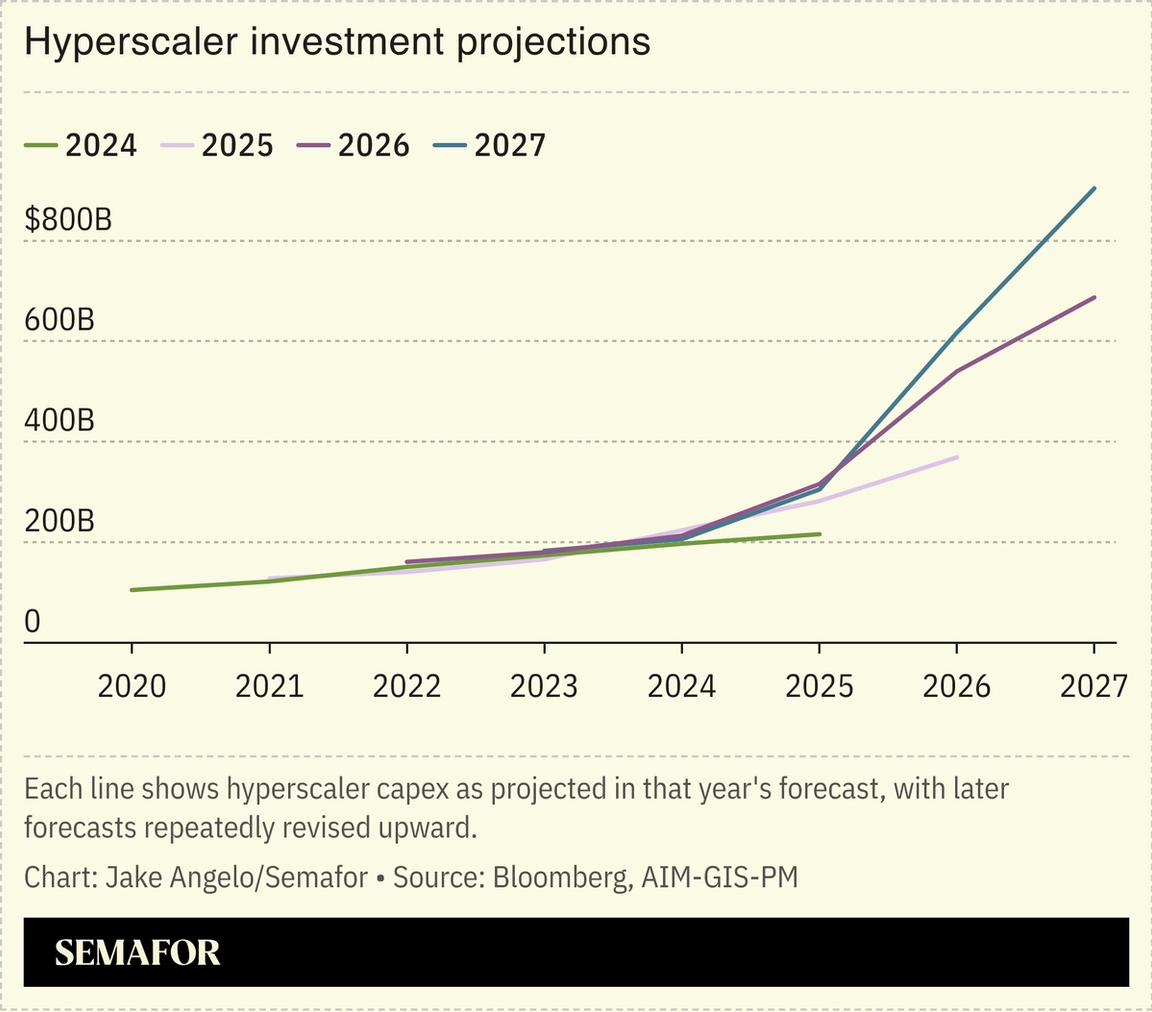 Cloud provider CoreWeave’s stock surged 19% Wednesday, as it joined a parade of firms providing critical AI infrastructure for hyperscalers reporting record demand. Taiwanese electronics maker Foxconn also beat forecasts, with cloud and networking services accounting for more than half of its revenue for the first time. The race to develop ever more sophisticated AI models shows no sign of slowing, prompting Google co-founder Sergey Brin to implore employees at a town hall to “move faster,” Reuters reported Wednesday. Brin, who’s become a more regular presence at the company, has been telling staff “they need to catch up to the frontier.” |
|
Mild US inflation eases Fed pressure |
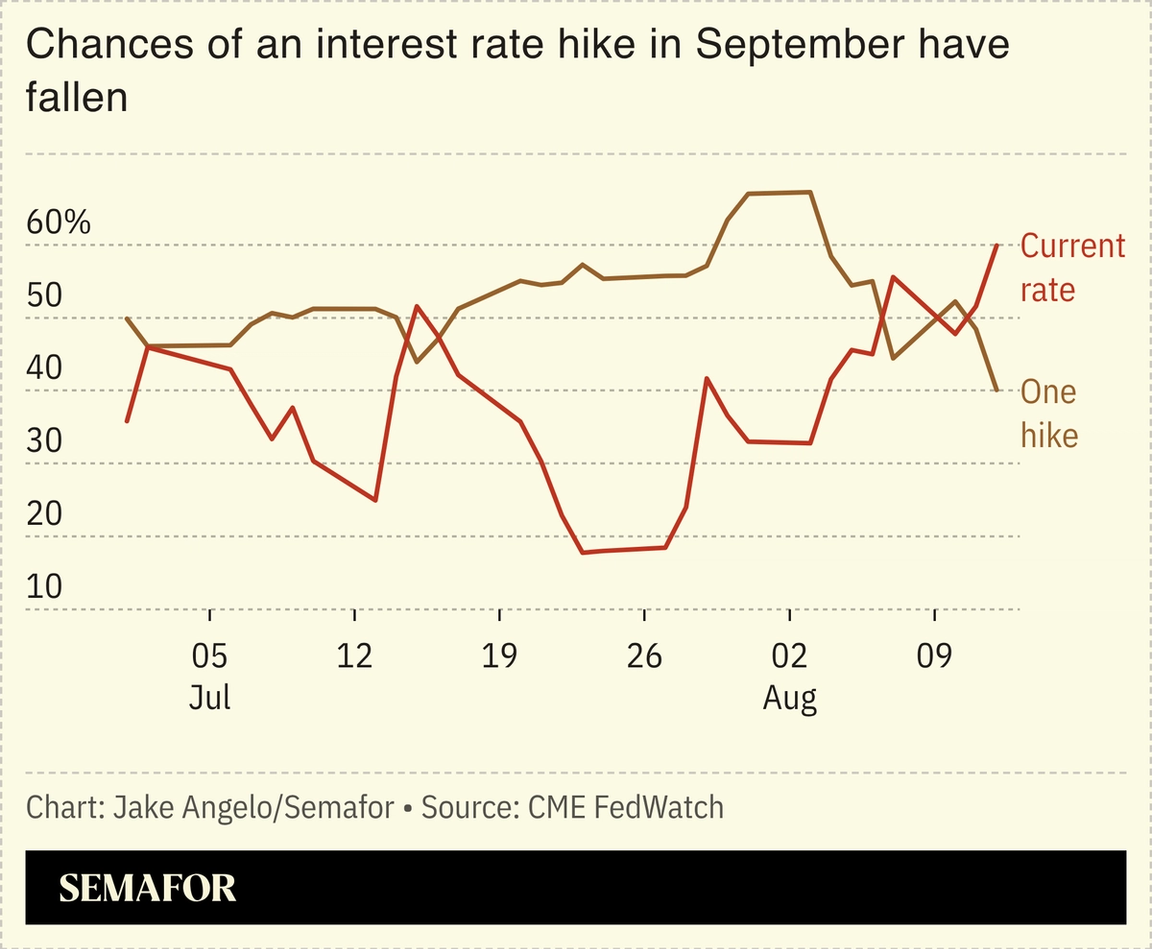 US consumer inflation rose mildly, increasing 0.1% in July, in line with economists’ expectations. The results, which put the annual rate at 3.4%, ease pressures on the Federal Reserve as it weighs an interest rate hike in September. The inflation data, along with a weak July jobs report, bolster the argument for a hold on rates. But the debate is far from over: Another batch of inflation data is due before next month’s meeting, and economists remain split on the best path forward. Odds that the Fed will hold rates steady are now at 60%. “It’s complicated to hold; it’s also complicated to hike, and it’s almost impossible to cut,” a former Fed economist told The New York Times. |
|
China’s economic reformer dies |
 Maxim Shemetov/Reuters Maxim Shemetov/ReutersFormer Chinese Premier Zhu Rongji, a leading architect of the country’s economic rise, has died aged 97. Zhu’s signal accomplishment was steering China into the World Trade Organization in 2001, after laying the groundwork with a host of reforms: overhauling the tax system, commercializing state banks, and smashing the “iron ricebowl” of guaranteed employment by shuttering hundreds of loss-making state enterprises. Up to 30 million workers lost their jobs. Yet Zhu also privatized the housing stock, instantly creating an urban middle class. The US assumed that Zhu’s policies were just the start of a promised Chinese economic opening. In fact, they represented the high point of reform; gigantic state enterprises now dominate the economy, and prospects for foreign investors are narrowing. |
|
German cabinet approves new spy rules |
 Maryam Majd/Reuters Maryam Majd/ReutersGermany’s cabinet approved new rules for its spies Wednesday to lift World War II-era restrictions on offensive cyber operations, sabotage, and espionage. The changes augur a “revolution” in Berlin’s intelligence infrastructure, the German interior minister said, fueled by a growing perception across Europe that the threat of Russian sabotage and influence operations is increasing as Moscow’s battlefield position deteriorates. Sweden is also rolling out a new intelligence agency, as the Russia-Ukraine war escalates: Russian civilian deaths are growing at a rapid clip in the five-year war, The New York Times reported, and Russian President Vladimir Putin threatened on Wednesday to seize European commercial vessels in response to further interceptions of suspected Russian “shadow fleet” tankers. |
|
Lilly tries to stop GLP-1 copycats |
 Mike Blake/Reuters Mike Blake/ReutersEli Lilly said it filed six lawsuits against US companies it accused of selling illicit versions of its experimental obesity drug retatrutide, intensifying the GLP-1-maker’s crackdown on copycat versions of its products. Retatrutide hasn’t gotten sign off from the US Food and Drug Administration, and is “entirely unverified, unapproved and not worth the risk,“Lilly said. Originally explored as a treatment for diabetes, GLP-1 drugs have shown benefits against heart and kidney disease, sleep apnea, and addiction. Drugmakers are now exploring their “newest obsession” with orexins, The Economist wrote — new drugs, based on different hormones from GLP-1, that use wakefulness-causing neurotransmitters to counter depression, addiction, and ADHD. |
|
LA Lakers sold for record $12.5 billion |
 Jayne Kamin-Oncea/Imagn Images via Reuters, Brendan McDermid/Reuters Jayne Kamin-Oncea/Imagn Images via Reuters, Brendan McDermid/ReutersFormer Disney chief Bob Iger and investor Josh Kushner are buying the NBA’s Los Angeles Lakers for a record-setting $12.5 billion, just 14 months after the team sold for $10 billion. Valuations for professional sports franchises have soared to eye-popping levels, as billionaires search for a dwindling number of trophy assets: Last month, the estate of late Microsoft co-founder Paul Allen sold the Seattle Seahawks to venture capitalist Vinod Khosla for nearly $10 billion, while the co-founder of Chinese tech company Xiaomi bought a 1% stake in the Miami Dolphins in a deal that valued the team at $12.5 billion, more than a decade after Time Warner’s former CEO bought it for $1 billion. |
|
US detains relative of Iranian hostage taker |
 Jim Urquhart/Reuters Jim Urquhart/ReutersAn Iranian-American woman alleged she has been held in US immigration custody for more than 120 days because of her family ties to a key figure in the 1979 US embassy hostage crisis. Maryam Tahmasebi, a Los Angeles professor, said she, her child, and husband had been detained because of her mother-in-law’s role as the former spokesperson for the hostage-takers. “Our lives are being upended for something someone else did nearly 50 years ago,” Tahmasebi wrote Wednesday in The Nation. The US ramped up deportations of Iranians before the war began, and has recently attempted to transport some to so-called “third countries.” In July, US President Donald Trump overruled his administration’s guidance to suspend vehicle stops by immigration authorities. |
|
 On Wednesday, September 16, Rep. Suzanne Bonamici (D-Ore.) will join us for the Youth Wellbeing Forum: Building Resilient Generations. As young people are challenged by rising rates of loneliness, anxiety, and depression, we are bringing together experts across technology, healthcare, and policy to examine solutions that can build lasting resilience. Semafor editors will sit down with Jaymes Black, CEO, The Trevor Project; Rep. Kevin Kiley (I-Calif.); Nicole Hockley, Co-Founder & CEO, Sandy Hook Promise; and Dr. Jon Kole, Medical Director and Senior Director of Psychiatry, Headspace, to explore how to build lasting resilience for the next generation. Washington, DC | September 16 | Request Invite |
|
Faith fails to stem fertility drops |
 Stringer/Reuters Stringer/ReutersReligious encouragement for childbirth has been unable to stem the downward trend in fertility, with some of Europe’s most Catholic countries, including Ireland, Italy, Poland, and Spain seeing rapid declines. Utah, famous for large Mormon families, has seen the largest fertility-rate decline of any US state. The state had America’s highest number of births per woman but, since its 2007 peak, has seen fertility rates drop 37% and is now in sixth place. The Mormon church encourages childbirth, but an influx of new residents, people turning away from religion, and Mormon women increasingly putting off starting families have pushed down fertility rates, The New York Times reported. |
|
Science grants turn to lotteries |
Science-funding bodies are increasingly turning to lotteries to hand out grants, arguing that predicting what research projects will work is near-impossible. Swiss, British, and German national funders, as well as some universities and major philanthropic bodies, have made the switch, randomizing allocations between reasonable proposals. Research has shown that reviewers rarely agree what will make good research projects, and moving to a lottery system also removes apparent funding biases: Female and Asian applicants, in particular, did better under the new system, Nature reported. It may also have other benefits: Randomization creates natural experiments, meaning future researchers could have a source of data on what proposals do and do not do well when funded. |
|
 NASA/JPL/Handout via Reuters NASA/JPL/Handout via ReutersVoyager 2 will keep all three of its remaining scientific instruments running for another year after NASA engineers freed up more power. The probes, launched in 1977, are nuclear-powered; their plutonium power sources are slowly dying. Voyager 1 is down to just two out of 10 instruments. The remaining tools, though, are doing vital work, mapping magnetic fields, cosmic rays, and plasma density. It is humanity’s source of direct evidence from the solar system’s edge, and no successors are funded. In particular, solar winds which sweep past Earth a few days after leaving the sun take years to reach the Voyagers; Voyager 2 may just about survive long enough for some major perturbations to catch up to it around 2030. |
|
|


