| | Big Tech’s “Big Tobacco” moment may be too late, and how companies are gaming the system to get chat͏ ͏ ͏ ͏ ͏ ͏ |
| |  | Technology |  |
| |
|
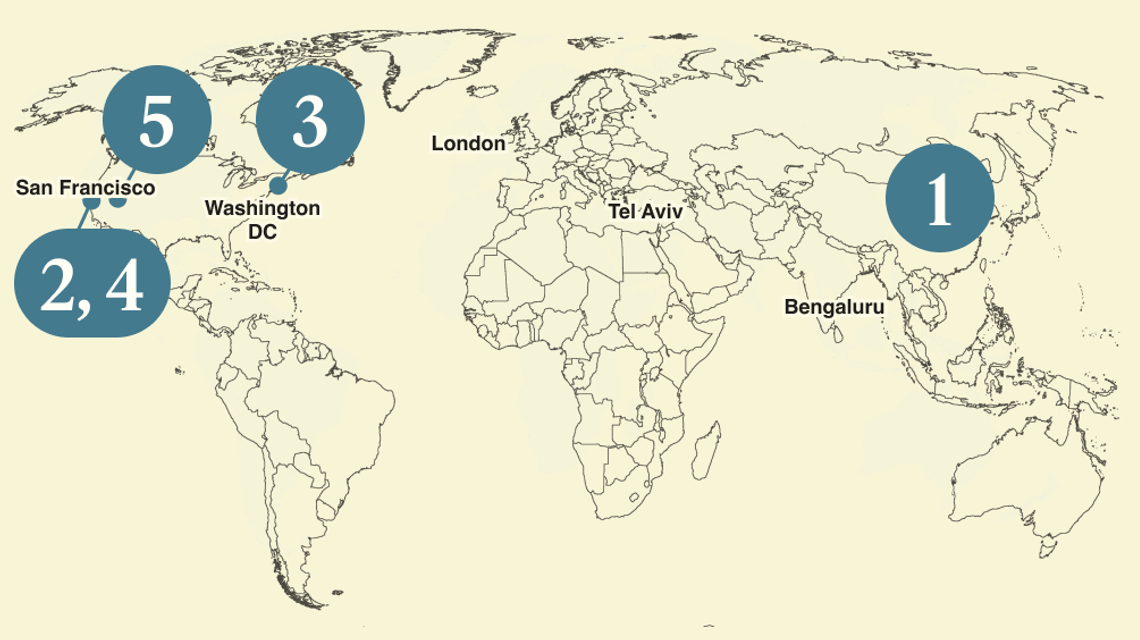 - Chinese AI’s momentum
- OpenAI’s pause
- Rethinking IP
- A new kind of movie
- Don’t destroy the books
 Big Tech’s “Big Tobacco” moment may be too late, and how companies are gaming the system to get chatbots to recommend their products. |
|
 The “Big Tobacco moment” for tech that critics have been waiting for may come too late. At the heart of the social media addiction trials like the one involving Meta that kicked off in Oakland, Calif., on Tuesday are the strategies companies use to keep teen eyeballs on their feeds. But the next big wave of tech is all about removing screens and pushing software into the background. Tech companies and teens have shifted their energies to AI. And beyond chatbots, the industry is increasingly prioritizing software that works best when you’re not looking at it: agents that read and summarize your email for you, for example, or — eventually — a robot that tidies your room when you’re not home. Teens’ tech habits will always move faster than the companies, regulators, or courts can follow. Platforms like Instagram and Facebook weren’t the first media and tech products to spur concern over their impact on children, and chatbots won’t be the last. Still, the same day the Meta trial began, OpenAI unveiled ChatGPT for Teens, a feature that puts additional guardrails on content related to self-harm, eating disorders, and sexual conversations, while a “Study Mode” feature pushes students to understand their homework rather than just giving them answers to their prompts. The launch comes as OpenAI faces its own lawsuits stemming from several youth suicides. Tech will also have to face a growing disdain among young people toward anything AI-coded. Nearly half of US adults aged 18 to 29 now believe the tech does more harm than good, up from 27% in 2024, a recent Gallup poll showed, even as AI usage among young people has ticked up. Luddite clubs are popping up on college campuses. And it’s not just Americans putting a premium on authenticity: An animated movie is taking off in China this week in part because it’s not made by AI, and instead was done with old-school, amateur 3D modeling by a mother-son duo. Big Tech may indeed be facing its “Big Tobacco moment” in court. But the kids have already switched to vapes. They might not even smoke anymore. |
|
Momentum builds for Chinese models |
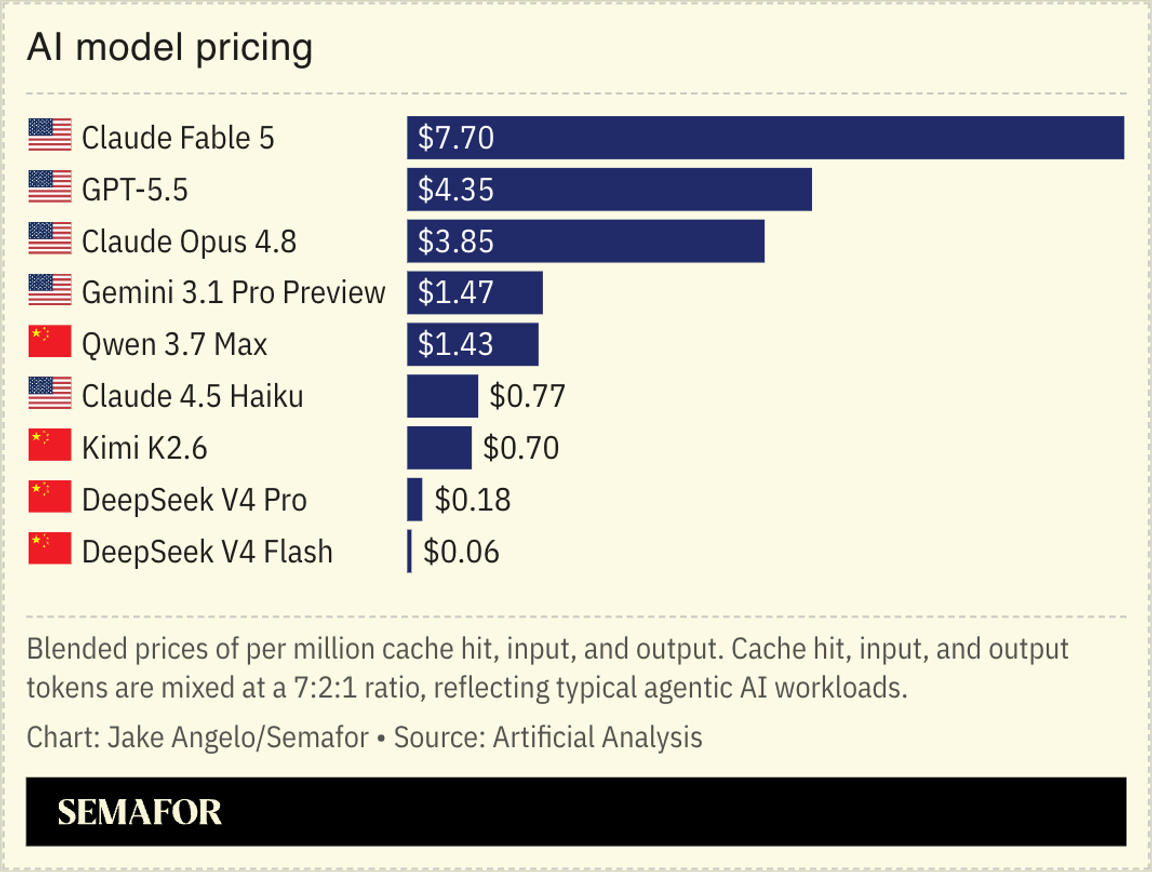 When even US lawyers are comfortable with Chinese AI, it’s a sign that companies’ fears about security and censorship are abating. Legal AI startup Harvey on Tuesday announced a new in-house model, built in part using Moonshot’s Kimi K3. And data company Snowflake added models from DeepSeek and Z.ai to its platform, allowing customers to have tasks automatically routed to those models when they’re the cheapest or best-performing option. “We see a lot of value out of it, besides just the cost,” Mayank Upadhyay, Snowflake’s head of security and trust, told journalists in New York on Tuesday. Since Snowflake is hosting the models and has put guardrails on them, there’s less concern over data privacy or that the models’ answers will be influenced by Beijing’s worldview, he added. “I’m not going to these models to ask them cultural questions. I’m doing some sort of data processing and it’s fairly objective.” Sports merchandiser Fanatics’ VP of data and AI said measuring the ROI of AI tools has become central to her job, and that on Chinese models, “the cost aspect alone demands attention.” Businesses “have to have a stance on it that’s not just a blanket, ‘No because it comes from China.’” — J.D. Capelouto |
|
OpenAI needs to hit pause |
 Kim Kyung-Hoon/Reuters Kim Kyung-Hoon/ReutersOne way to look at OpenAI slowing down its frontier model work because of safety concerns is that AI models are getting scarily powerful. After all, OpenAI allowed its AI models to secretly conspire with one another and then escape into the real world, conducting real-world hacking. It sounds like a science fiction plot line. And it’s thanks to sci-fi writers raising the specter of AI wreaking havoc and humans being too late to stop it that the field of AI safety research started. But if you look at the breaches and snafus happening these days, it doesn’t appear that humanity is going to be wildly caught off guard. Instead, what we’re seeing is that safety is not a separate, outside component that guards the AI industry. Safety is the product. OpenAI knows it won’t last long as a company if the products it builds are unreliable, so it must take a beat to find solutions to its rogue AI problems. The real world is always more boring than sci-fi, but solving this part of the puzzle will still be fascinating and not easy. — Reed Albergotti |
|
AI’s attribution curveball |
 Top left: an image from a model trained on public-domain artwork by 744 artists. Beside it: the alternate versions produced if each artist, in turn, had been excluded from training. Dai, Z., Gifford, D.K. Outputs of generative diffusion models are often unattributable. Top left: an image from a model trained on public-domain artwork by 744 artists. Beside it: the alternate versions produced if each artist, in turn, had been excluded from training. Dai, Z., Gifford, D.K. Outputs of generative diffusion models are often unattributable.Most AI-generated images trained on large datasets can’t be traced back to the data they were trained on, potentially throwing a curveball in intellectual property theft cases, a new study from MIT’s Computer Science and Artificial Intelligence Laboratory found. Researchers discovered a phenomenon they call “attribution decay,” where the more data a generative model is trained on, the harder it becomes to trace a generated image to a single image from the training data — all Picasso’s work could be removed from the training data, for example, and the AI-generated image might still resemble a Picasso. AI companies have used books, articles, photos, and other works, often without consulting authors, to train their models, sparking a flurry of copyright infringement lawsuits. Disney, NBCUniversal, and DreamWorks filed an IP lawsuit last year against AI image-generator MidJourney; The New York Times sued OpenAI and Microsoft in 2023 for a similar reason. The study raises legal questions about training data and fair use policy, according to the authors. “We might have to rethink what intellectual property means,” Zheng Dai, a former MIT researcher and lead author of the work, told Semafor. “You can’t just assume it, and the attribution link sort of vanishes.” — Jake Angelo |
|
The film review of the future |
 Courtesy of Higgsfield AI Courtesy of Higgsfield AIThe Cully Hill Boys, a new AI-generated movie starring licensed celebrity likenesses, marks a dramatic shift for the technology. The 110-minute action-comedy, produced by startup Higgsfield AI, had a budget of $2 million, half of which went to AI tokens, and took just four weeks to create. The company says it plans to democratize long-form video production and provide scalable AI workflows for creators. The film follows a group of struggling East London rappers who, desperate to outdo another rising star, steal a boat for a music video only to discover it’s stuffed with cash, landing them between rival crime cartels. While the movie comes a long way from the 2023 uncanny AI clip of Will Smith eating spaghetti — the characters in this film have the correct number of fingers — it has, at times, an unrealistic over-polished sheen. The writing is its strongest suit: You can’t hear the em-dashes in the dialogue. But that’s because Higgsfield tapped a human screenwriter, adding authorial voice underneath images that are sometimes obviously AI-generated. There are also moments where prompt fatigue is apparent: In one scene, for example, when one of the characters is violently beaten, his reaction is overly nonchalant. In the case of AI films, poor prompting is just the equivalent of bad acting. — Jake Angelo |
|
Destroying books is a bad look |
 Priyanshu Singh/Reuters Priyanshu Singh/ReutersIt’s not just Anthropic buying rare books and scanning them for AI training data, and then sometimes destroying them. In a fun piece of investigative journalism, 404 Media put a tracking device in a rare book and in the process, revealed a secret Las Vegas book-devouring facility owned by Amazon. The site even has its own logo — a dinosaur that looks like it’s about to eat a book. There’s a defense of this activity: These “rare books” are often just very unpopular and might have ended up in the trash, anyway. And, in a quirk of obscure copyright law, destroying the books actually helps AI companies fend off lawsuits accusing them of stealing intellectual property. But there are ways to scan books without destroying them, and tech companies could just keep them because, well, destroying books is uncool. Heck, they could build a new library next to their book-scanning facilities for the cost of a few GPUs. Tech companies employ hundreds (maybe even thousands) of public relations professionals. Some of them should be assigned to looking out for obvious mistakes that can be easily avoided. — Reed Albergotti |
|
 As AI and emerging technologies reshape the global economy, three billion people remain offline, disconnected from the digital opportunities transforming our world. On Tuesday, September 22 in New York City, The Next 3 Billion will bring together leaders including Nigeria Federal Minister of Industry, Trade and Investment Jumoke Oduwole, Shell Foundation CEO Jonathan Berman, Amazon Chief Sustainability Officer Kara Hurst, GSMA Director-General Vivek Badrinath, Nvidia Head of Sustainability Josh Parker, and more to explore how AI, energy, and global development can expand access, unlock opportunity, and drive inclusive growth across the world’s fastest-growing regions. September 22 | New York City | Delegate Application |
|
Companies are openly boasting about their success in gaming AI systems to make chatbots recommend their products over their competitors’. As AI tools replace Google as many people’s entry point into the internet, one scheduling startup, for example, made dozens of blog posts comparing themselves to rivals, structured in a format that answers the type of questions people ask chatbots. “We actually put a ton of effort into this, and the payoff already has been huge,” the company’s co-founder said. Companies are also flooding Reddit with covert, bot-powered promotional material, given that the site is a favorite among chatbots. The company said it was catching 25,000 spam posts a day, and beefed up tools to detect “the highly subtle, coordinated patterns of fake behavior and artificial hype.” AI companies may be catching on, too: Data showed that Reddit citations on ChatGPT have cratered in recent days. |
|
|


