|
|
|
|
Morning. Today in Canada’s trade clash with the United States, we’re winning fans in China, seeking out more in the European Union and adding up the bill on countertariffs. |
|
|
|
|
|
|
|
|
|
|
|
|
|
|
|
|
|
|
|
|
|
|
Investing: Mining and energy stocks lift the TSX past trade-war fears. |
|
|
|
|
|
|
|
|
|
|
|
|
|
|
|
|
|
|
|
|
|
|
|
|
|
|
|
The sun sets over Lake Ontario earlier this week in Olcott, New York, after Trump threatened to rename the body of water. The President can order federal agencies to do that in official documents, but it's kind of like me buying a star from one of those websites: I'll have a certificate, but no one else has to acknowledge it. Adrian Kraus/The Associated Press
|
|
|
|
|
|
|
|
|
|
|
Tracking the trade news – and tallying Canada’s response |
|
|
|
|
|
|
|
|
|
|
- Alberta and Saskatchewan rejected any suggestion that Ottawa apply export levies on natural resources like oil and potash in retaliation for the U.S. applying new tariffs on Canadian products.
-
Mark Carney will address the European Union Parliament next month in Strasbourg, France, as the Prime Minister makes efforts to expand Canada’s ties with other partners.
- Canada’s tough response to Trump’s trade war is winning fans
in China, Asia correspondent James Griffiths reports. “In an editorial this week,
the state-run Global Times said Canada and China ‘are the only countries daring to respond to U.S. pressure with reciprocal measures.’”
- To First Nations that named Lake Ontario, whose name originates from the Iroquois word meaning “beautiful lake” or “sparkling water,” Trump’s threat this week to rename it is an affront.
-
Canadians can boycott U.S. travel and alcohol. But investments are a different story.
|
|
|
|
|
|
|
|
|
|
|
|
|
|
|
|
|
|
|
|
|
From Globe reporter Jason Kirby and data editor Dexter McMillan, here are four things to know about Canada’s countertariffs – set to go into effect on Sept. 8. |
|
|
|
|
|
|
|
|
|
|
|
|
From the outset, Carney said Canada would respond dollar-for-dollar to U.S. President Donald Trump’s 50-per-cent tariffs on $27.6-billion worth of exports from Canada. |
|
|
|
|
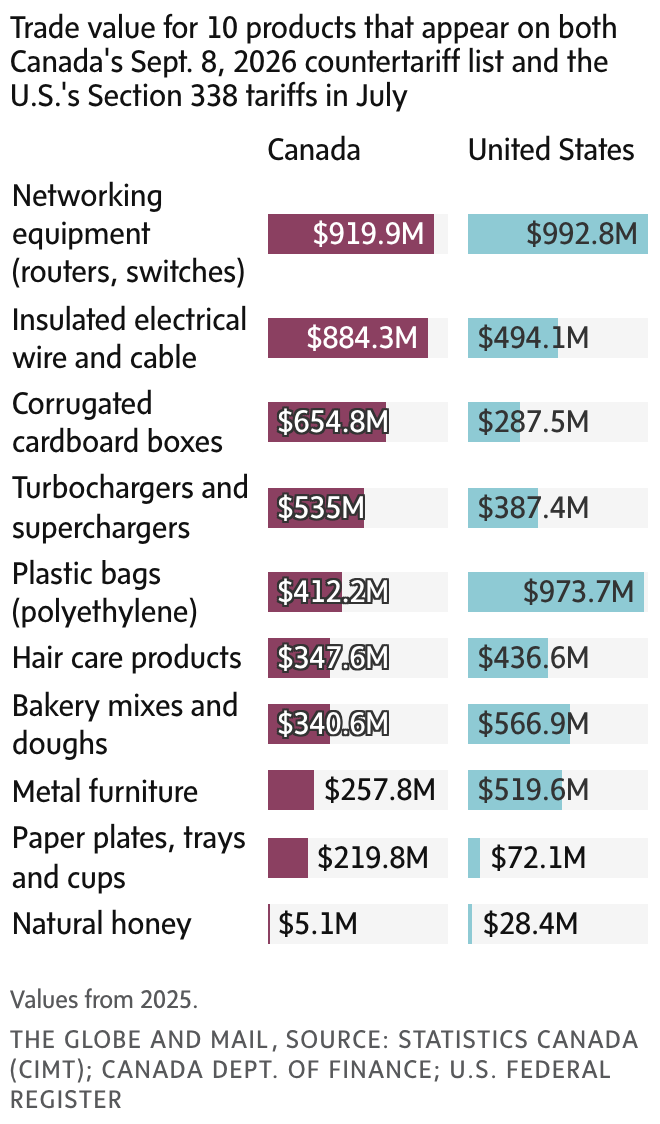
Many of the items on Canada’s list appear to be lifted directly from Trump’s own tariff playbook, including honey, hair-care products and metal furniture. |
|
|
|
|
But while the flow of some tariffed items such as networking equipment between the two countries is similar in scale, that’s not true of most. Canada shipped much more insulated electric wire and cable to the U.S. than it bought. The same goes for honey: Canadian producers face a bigger hit than their U.S. counterparts. |
|
|
|
|
|
|
|
|
|
|
|
|
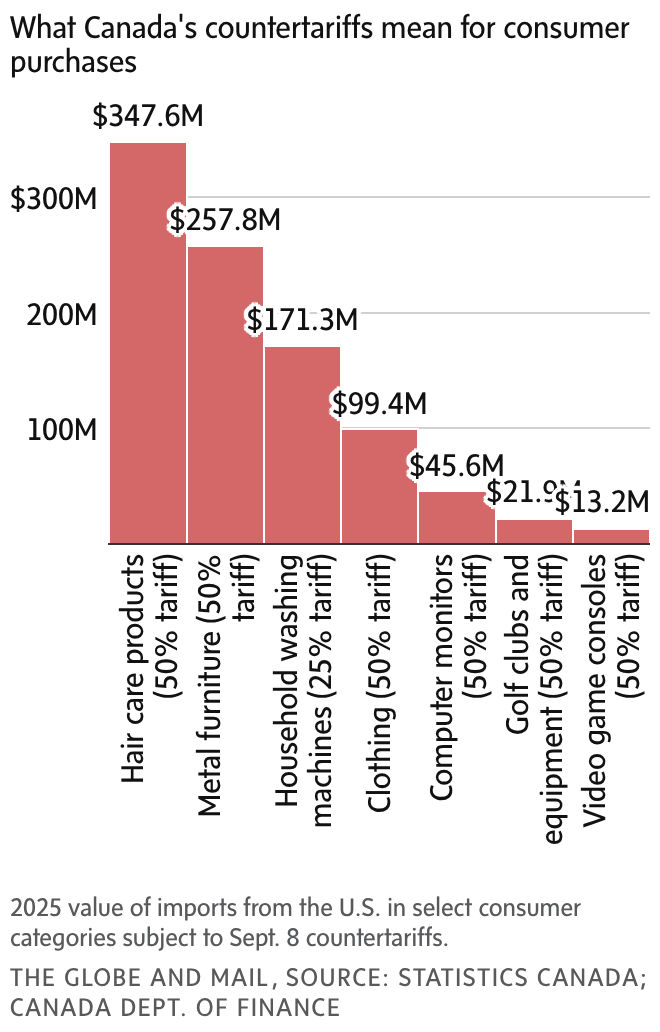
Despite the announcement of a $7.5-billion support package for businesses and workers, there’s little question that Canadian consumers will feel the impacts of the countertariffs. Importers will inevitably pass some of their tariff costs on to their customers. |
|
|
|
|
At the same time, the tariffs will lower U.S. imports, and that reduced competition will give domestic companies more pricing power. |
|
|
|
|
While countertariffs on industrial products such as steel and networking equipment account for the largest dollar values, duties on consumer items such as golf clubs, hair-care products, video-game consoles, clothing and furniture will all hit Canadians more directly. |
|
|
|
|
|
|
|
|
|
|
|
|
|
|
|
|
Canada’s retaliation list targets both products covered by existing tariffs – albeit now with higher levies – and goods that currently enter Canada duty-free. |
|
|
|
|
For instance, a key element of Canada’s retaliation, and one that carries the largest dollar value, was the move by Ottawa to hike existing tariffs on steel and aluminum and derivative products to 50 per cent from the current 25 per cent. |
|
|
|
|
But many other items are being hit by duties for the first time, and the tariff costs are significant. Canada’s 2025 imports of $920-million worth of networking equipment, such as routers and switches, would incur a $460-million duty charge. |
|
|
|
|
|
|
|
|
|