
|
 |
Judge Talwani’s Most Recent Order On Voting By Mail
It’s Long, It’s Complicated, And It’s Definitely Worth Your Time
|

| |||||||||||||||


As a friend wrote to me this morning, “I need a break.” On top of everything else, I’ve been working you overtime, writing about the legal challenges to Trump’s executive order on voting, along with everything else. We’ve talked not just about standing, but about ripeness. We’ve discussed the legal standard for getting an injunction and the distinction between a court that rules on purely procedural grounds and one that decides the substance of the matter before it. None of this is easy (even for lawyers), but I continue to believe this is one of the issues that is the most essential for the future of democracy, and I’m grateful to those of you who agree and have stuck with it.
This is a rare Friday morning post. It’s long—I’d encourage you to read it in bits and be kind to yourself; take a break. But Judge Talwani’s decision on the most recent developments in this matter is so important that we need to get to it straight away. And I want to give you the context and basis for understanding the language she uses in this opinion, which is going to be in front of the Supreme Court, one way or another, before long. So thank you for making the effort and going the extra mile here.
After the Supreme Court made a (purely procedural) decision about Trump’s executive order on mail-in voting, rejecting judicial action in the case brought by blue state AGs because it wasn’t “ripe” for a decision yet, Judge Indira Talwani did the logical thing. She gave the plaintiffs in that case and in the case brought by the League of Women Voters a push toward updating their lawsuits. The government showed off the final rule it wants to use to implement the executive order. The ripeness argument is now moot. The administration zeroed it out when the Postal Service announced its final rule was ready to publish. The rule was published on Wednesday.
Both groups of plaintiffs with cases before Judge Talwani refiled and asked for preliminary injunctive relief, also requesting that the court issue a temporary restraining order (TRO) to stay the government defendants’ implementation of the Final Rule. Quick reminder: a TRO is the shorter, emergency type of injunction. A preliminary injunction stays in place for a longer period of time, while litigation is happening. (Plaintiffs in related cases in the District of Columbia took steps to update their cases too.)
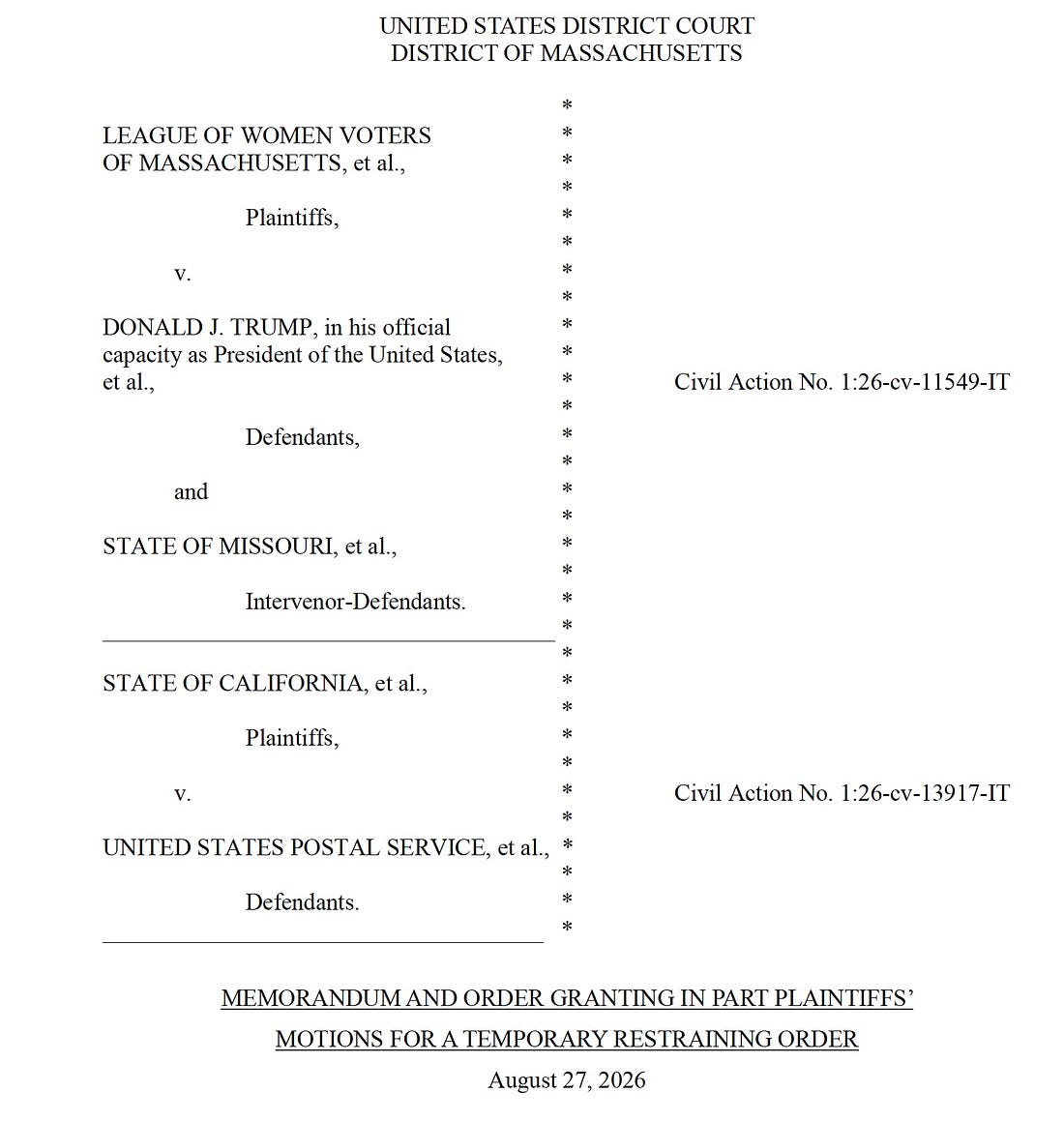 |
Thursday night, Judge Talwani granted a 14-day temporary restraining order in both of the cases before her, “staying the United States Postal Service (‘USPS’) from implementing certain sections of its final rule, Ballot Mail for Federal Elections.” She explained that “On emergency review, on August 24, 2026, the United States Supreme Court concluded that this court lacked jurisdiction to review challenges to the EO’s constitutionality where it was speculative as to whether the USPS would (1) propose a rule; (2) weigh the comments; and (3) issue a final rule consistent with the EO’s directives”—that’s the “ripeness” argument we’ve been discussing for weeks now. In essence, the Supreme Court directed her that the government hadn’t taken enough steps toward implementing Trump’s EO for the court to know what that implementation would look like and whether it was lawful. Too soon, the Supreme Court told Judge Talwani. You need to wait for the government to do more.
Now, the government has done more.
As we all know by now, the footnotes are frequently where the action is. This decision was no exception. In Footnote 4, Judge Talwani takes on a perplexing omission from the Supreme Court’s opinion: Their failure to discuss or even acknowledge that the Postal Service had announced its final rule. Judge Talwani explained it for them like this, which has the not-so-coincidental benefit of further strengthening her decision to reimpose an injunction against the executive order, because she’s set up a situation where they didn’t have all of the facts she had when they ruled:
The Supreme Court gave no indication that it was aware of the Final Rule when the Order was issued. Defendants nonetheless insist, without citation, that “publication of a Final Rule” was “already known to the Supreme Court” at the time of the Court’s Order … Although the government’s Supplemental Brief regarding the Final Rule was docketed at the Supreme Court a few hours before the Court’s per curiam Order was entered on August 24, 2026 … this court cannot assume that the Justices received the brief prior to the issuance of the per curiam Order a few hours later. In any event, that Order found a lack of standing based on the events at the time the complaint was filed and did not purport to take into account events that occurred during the months that the litigation was pending.
Judge Talwani also strengthens her order for when it heads back to the Supreme Court by pointing to the purely procedural nature of the Court’s decision last week. Their decision was limited to timing; it was not about whether the executive order itself is lawful. By setting it up this way, the Judge clarifies that she is free, now, to take up the substantive issue. She wrote, “The Supreme Court explicitly noted, however, that the disposition of the government’s emergency application ‘does not mean that any measure taken by the Government to implement the Order will necessarily be lawful.’” By pointing out that the Supreme Court itself left that issue open, she positions the new TRO as the next step in the case, not a decision contrary to the Court’s dictates (although we should expect the government to try to play it that way).
Judge Talwani also took a gentle, but satisfying slap at the Court, pointing out that the Trump administration isn’t exactly playing by the rules when it comes to court orders: “Although the Supreme Court expressed concern that this court’s injunction ‘prevent[ed] the Postal Service from so much as initiating a rulemaking that could yield a rule applicable to these States[,]’ … no such delay occurred, as the USPS had gone ahead and noticed a proposed rule, solicited and reviewed comments, and issued a Final Rule.” The Roberts Court has largely ignored the Trump administration’s efforts to challenge the authority of the courts, but occasionally, it bristles and summons some backbone when the administration goes too far—think last term’s decision on birthright citizenship or firing a Fed Governor. This opinion is a signal to the Court that this case too is one where the government must be reined in, lest the Court lose all authority to act as a check and balance on an out of control executive.
With the background laid out, we hit a critical juncture in the Judge’s decision. Here’s the most important thing to understand: the government defendants, who just days ago were arguing that the plaintiffs’ case wasn’t ripe for the court to decide, are now arguing that it’s too late for the court to intervene. Yes, you read that right. Too early has now become too late, with no Goldilocks spot in the middle. So much for the “justice” in Justice Department.
Here’s how Judge Talwani explains it. It’s worth reading her full layout:
“Two weeks before the Final Rule issued, Defendants’ counsel represented to the court that: when the final rule is implemented, if it affects an individual voter’s ability to vote, then they certainly have standing to challenge that final rule. And courts are able to work in an expedited basis. It would only take a very short amount of time for a temporary restraining order or a preliminary injunction to issue.”
“And two days ago, when Defendants asked the court to vacate the preliminary injunction entered in LWVM prior to the Supreme Court’s Order, Defendants represented that Plaintiffs were not without a remedy, for where the Rule had now issued, they could ‘simply amend their complaint’ and challenge the Final Rule directly.”
“Defendants [the Trump administration] now claim that Plaintiffs are too late ‘because appellate review in the ordinary course would come too late for the 2026 midterms.’”
The Judge goes on to explain the technical reason the government is wrong on that last point. It’s because “the question is not when appellate review will be completed. The issue before the court is whether Plaintiffs have met the traditional standards for emergency relief.” But the thing that really matters here is that the courts should not permit the Trump law firm formerly known as the Justice Department to play gotcha when it comes to something as important as Americans’ right to vote. DOJ’s position is nothing short of appalling. And predictable, unfortunately, for this administration.
Temporary restraining orders preserve the status quo until courts reach a decision on the substance of cases before them. Judge Talwani’s order preserves the pre-executive order status quo, for now. To issue a TRO, she has to find in the movants’ favor on the elements courts have established for entering an injunction: a strong chance of success on the merits, irreparable injury in the absence of the remedy, and public interest/a balance of the equities favoring the injunctive relief. So for starters, she has to be persuaded that the plaintiffs have a good chance of succeeding with their claims. They now argue that the newly issued final rule “is unconstitutional, contrary to statute, and ultra vires,” and that it “violates both the separation of powers doctrine and the USPS’s governing statutes.” The government responds that it’s just doing what is necessary to implement the executive order and the final rule “merely imposes modest conditions on the sending of mail.” Seriously. That’s what they say. They add in an argument that none of the plaintiffs have standing.
The Judge pushes the weak standing argument aside. As to the government’s claim it’s taking innocuous action to support the president’s order, she reminds them that “As to the substantive merits, the Constitution charges the States with election administration … the court is unaware of, and no party has proffer