





 |
IMMIGRATION WASN’T JUST ONE of the issues that secured a second term for Donald Trump—it was virtually the issue that launched his electoral career back in 2016. He said that Mexican immigrants were criminals and rapists, and he never looked back. But now he might want to. A recent Reuters/Ipsos poll shows just 37 percent of Americans approve of Trump’s handling of immigration, against 56 percent who disapprove. That’s a major opening for Democrats heading into the midterms—if they can exploit it without alienating the working-class voters they’re desperate to win back from Trump’s coalition.
As Republicans prepare to dust off their rickety anti-immigration talking points ahead of the midterms, a memo from the Democratic-aligned group Winning Jobs Narrative Action, obtained exclusively by The Bulwark, argues that Democrats can message loudly on immigration and win in November—as long as their message is cast within a pro-worker, pro-immigrant narrative that avoids certain pitfalls Democrats regularly stumble into.
One finding spelled out in the memo: As uncomfortable as it might be to hear, some of the messages and messengers that are most cathartic to Democratic voters—and familiar to regular readers of this newsletter—aren’t the most persuasive to former Trump voters. A good example of a losing message would be an immigration attorney and activist demanding an end to deportations in absolutist language, calling Donald Trump and his policies “un-American” and “unlawful,” according to the memo.
A better message/messenger combination would be a faith leader who calls immigrants our neighbors; who talks about how immigrants take care of our children and heal our sick; and who highlights how, when American farmers can’t find the labor they need, it’s immigrants who keep their farms running. It is, the memo says, a message that rests on “immigrants’ contributions and economic interdependence, showing how their work is embedded in and essential to the functioning of local jobs, services, and community life.”
Join the side you’re already on: Support our independent journalism and come be part of our growing community by signing up for a Bulwark+ membership today.
The memo is the result of nine months of research, according to the nonprofit group Winning Jobs Narrative Education. Then WJN Action, the outfit’s political arm, tested political messages via a pair of robust online surveys to find the most effective arguments for Democrats to use ahead of the midterms.
Steve Pierce, the executive director of both WJN Education and WJN Action, told me that working-class voters were turned off by ICE violence, but that their dislike of ICE wasn’t enough to swing them to vote for Democrats.
“They think it’s extreme. They don’t want to see masked police taking people in the streets and killing American citizens. They’re not in favor of that,” he said. “But what was also consistent is you can’t offer nothing as an alternative. It can’t just be, ‘Well, we’re going to have the status quo and let that continue.’”
Democrats know Republicans will attack them on immigration. Pierce says their attacks will try to “force the party’s candidates into a false choice: defend immigrants and appear inattentive to American workers, or adopt Republican enforcement language and reinforce the premise that immigrants are the problem.”
So Democrats instead need to offer something concrete. “The one thing the research said was we have to have a proactive commonsense way forward,” Pierce continued. “For working-class people, for an immigration skeptic, the extreme stuff pushes them towards us, but we have to offer an alternative.”
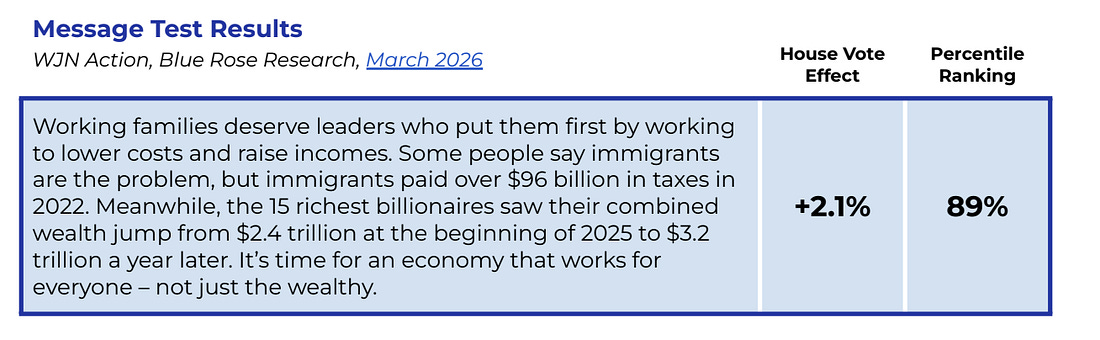
The alternative suggested in the memo is to emphasize that, contrary to nativists like JD Vance, immigrants are not only critical to the local and national economy but beneficial to working-class Americans, too. Two especially strong messages suggested in the memo each boosted support for Democrats by about 2 percentage points. The first message emphasized that immigrants pay taxes and highlighted billionaires’ wealth gains under the second Trump administration. That message was in the 89th percentile of messages tested in the online surveys, out of the thousands of messages they tested.
 |
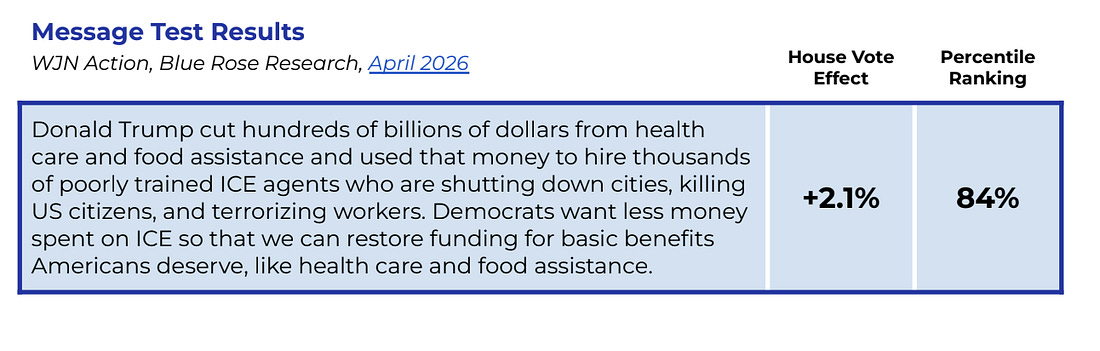
The second-strongest performer noted that Trump cut staggering amounts from food and health care assistance and repurposed that money to hire thousands of poorly trained ICE agents. Critically, this message said Democrats want less money spent on ICE and more spent on basic benefits. It was in the 84th percentile of messages tested in the surveys.
 |
Andrea Flores, who served as the director of border management on the National Security Council under President Joe Biden, described the memo as helpful for the party because Democrats have still not landed on an affirmative immigration message of their own.
“So much [of what] Democrats say is in response to what President Trump is doing, which creates a gap. Americans don’t see an alternative to what he’s doing or they hear all of the harms, without the solutions,” she told me.
She said the urgency of the moment reminds her of 2018 and 2019, a time when Democrats were outraged by Trump’s policies and character but were unable to turn it into an affirmative governing agenda. “When they took power, they didn’t understand what they were fighting for or how Americans could benefit from a reformed immigration system.”
Flores suggested another possible arrow for Democrats’ immigration-messaging quiver: the fact that, in this economy, so much of Trump’s budget is going to ICE—in many cases to purchase extravagant equipment, much of which shocks our consciences.
“Why are we building new detention centers to detain children when health care premiums are at their highest? Why are we cutting food stamps to build prisons for kids?” she asked. “Is your community better off because you have untrained ICE agents in your communities, or would it be better if you could afford health care? Immigration is an affordability issue; you just need to explain the costs to the American public.”
To make sure Democrats don’t unintentionally reinforce Republicans’ negative framing of immigration with their messaging choices, the memo identifies four traps Dems should avoid.
First, a head-in-the-sand approach that doesn’t talk about immigration at all. Everyone knows immigration is a key issue. In the recent Reuters/Ipsos poll, it ranked as the fourth-most important iss