




Before we get to Dolly (RIP, Queen), I just want to highlight this week’s Bulwark Goes to Hollywood. I talked to Eriq Gardner from Puck about a pretty crazy story involving companies using spurious copyright claims to try and squelch speech. It’s . . . bad! A bad thing. And something we should definitely be wary of as challenges to free speech proliferate. I hope you’ll give it a listen.

 |
IF YOU HAVE NOT READ Jill Lawrence’s remembrance of Dolly Parton, you really should: It’s the best kind of obit, not just a catalogue of a career but a personal reflection on how the performer influenced the life of the writer. Our relationship to great art and artists is inevitably personal—we remember where we were when we heard their songs for the first time or who gave us the novel that changed our life or whom we were sitting next to during their big, Oscar-worthy moments—and Jill captures that sentiment perfectly.
Parton was an interesting, maybe unique, figure in our moment because even those who didn’t love her on a personal level admired her and respected her. This is the camp I fall into: I’m not really a music guy and her songs don’t do that much for me. But she always came off as warm, genuine, and quietly shrewd, even while she was poking fun at herself and her image. As it happens, a couple months back I interviewed Peter Hoffman, the lawyer/accountant who, before he was president for Carolco, helped extricate Parton from her deal with original manager Porter Wagoner that set her on the path to becoming the Potentate of Pigeon Forge; we didn’t really discuss that deal, but he writes fondly of her in his book. Pointedly, no one has ever written unfondly of Dolly Parton, it seems.
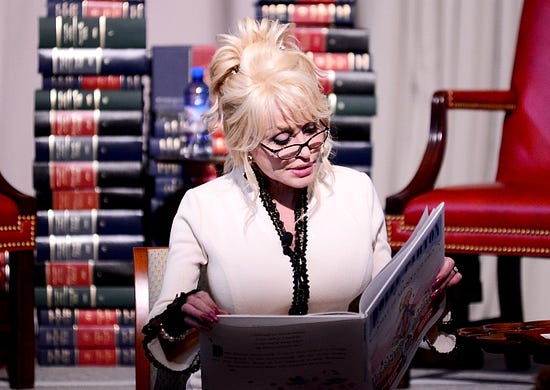
One of the reasons for such fond feelings is that her primary philanthropic effort is about as uncontroversial as it gets: Dolly Parton’s Imagination Library, partnering with local charities around the country, has provided more than 332 million books to nearly 3.2 million children over the years. Parton understood the importance of literacy, growing up quite literally dirt poor and with a father who could not read or write. It’s a charity after my own heart: There’s nothing I enjoy more than taking my kids to Half Price Books or the local library and letting them grab a handful. The idea that there are kids out there who do not have access to reading material—either because their parents cannot afford it or because they live too far from a library—is genuinely distressing.
Parton could not fund the program entirely herself (she didn’t have AI money, after all), often partnering with states for funding grants that increased access. But as the New York Times noted this week after her death, in times of budget crunches, books for kids aren’t the priority:
In Indiana last year, Governor Mike Braun cut state funding for the program entirely, prompting the state’s first lady, Maureen Braun, to launch a fund-raising campaign to keep it afloat. Kentucky lawmakers proposed a budget reduction this year that would have effectively shut down the program in about half of Kentucky’s poorest counties before restoring the state’s 50 percent funding match after public outcry.
In Maine, the program ended in June after losing state funding, according to WAGM, a local television station, leaving United Way scrambling to fill in the gaps by starting another initiative to provide books to newborns. And Missouri slashed $4 million in funding for the nonprofit in its 2027 budget, effectively freezing new enrollment.
Some of those gaps were filled by private foundations, but government grants remain one of the biggest sources of funding for the charity. We’re in the midst of a midterm election and this seems like an easy win for any politician with a lick of sense: Campaign on increasing funding for partnerships with Dolly Parton’s Imagination Library. And if you, fair reader, are so inclined, you can find partner organizations near you to donate to through this page on the Imagination Library’s website.
Support our growing coverage of movies, books, arts, ideas, and culture—become a Bulwark+ member today.
RIP, Tim Curry
 |