





Six months in, the war in Iran is suddenly hot again. The U.S. military said Sunday it had bombarded Iranian troops on Larak Island who were trying to launch mines into the Strait of Hormuz, killing several people. Iran responded by firing at bases hosting U.S. personnel in Jordan and the United Arab Emirates. Oil prices rose on the news, although they remain below their wartime peak this spring. Meanwhile, the Washington Post reports that senior military leaders are warning Defense Secretary Pete Hegseth that large-scale attacks on Iran are becoming “unsustainable.” Happy Monday.
Join Will Sommer and Sam Stein for MAGA Mondays today at 10:00 a.m. EDT on Substack and YouTube.
 |
Springfield ‘Under Seige’
by Jim Swift
Springfield, Ohio
When I was last inside Greater Grace Temple in late July, faith leaders from Springfield’s G92 coalition—a faith-based association dedicated to protecting the city’s Haitian community—were praying that ICE, which had not yet established a presence in the city, would treat its Haitian residents humanely.
Perhaps God heard their prayers. But ICE certainly did not. In the month between that visit and my return last week, the agency has arrested thirty-four Haitians, including two pastors. Organizers believe one has already been deported. Pastor Carl Ruby of Central Christian Church describes the city as “under siege.”
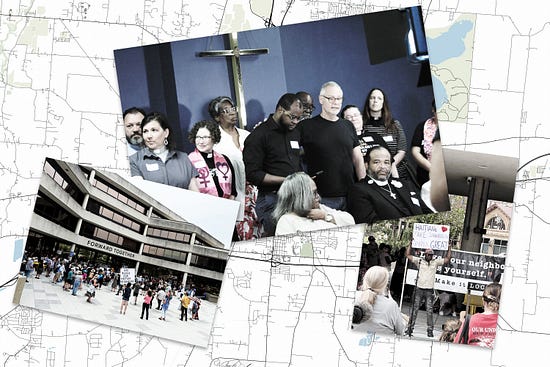
The first time I visited Greater Grace, the church was mostly empty, save the reporters and clergy. On Friday, the entire church was humming with activity. While other churches and businesses around town were emptying because people were afraid to leave home, Greater Grace had become an activism factory, the headquarters of a five-day regional mobilization, with each room serving a different purpose.
In one room, volunteers used Google Translate to write letters in Haitian Creole to detainees and packed boxes of food for local families. The pantry and donation space doubled as a check-in area for volunteers.
Another room served as an impromptu phone bank. Volunteers raised money for the Haitian Support Center and called Gov. Mike DeWine and Sens. Jon Husted and Bernie Moreno (all Republicans), urging them to act. Elsewhere, organizers prepared transportation and assignments for volunteers. A group behind me planned Sunday’s finale, “Unshackle Springfield,” a potluck and public faith witness at City Hall Plaza.
All the volunteers were sustained by food catered by Keket Bongou Caribbean Restaurant. Ruby said it had taken in only $24 the previous week as Haitian customers stayed home. The folks at Greater Grace Temple, in addition to buying hundreds of dollars worth of food, also had a donation box replete with $20 bills.
One organizer said a volunteer from the other side of Cleveland had told her he got up at 4 a.m. to make the trip. Some are coming for multi-day trips to work and bear witness.
This is what Trump is doing to our towns and cities. In the name of cracking down on immigration, he has ripped our social fabric apart. And it is small acts of decent human beings—people who don’t want to live in a society in which the state terrorizes families, schools, and churches—that is keeping it together.
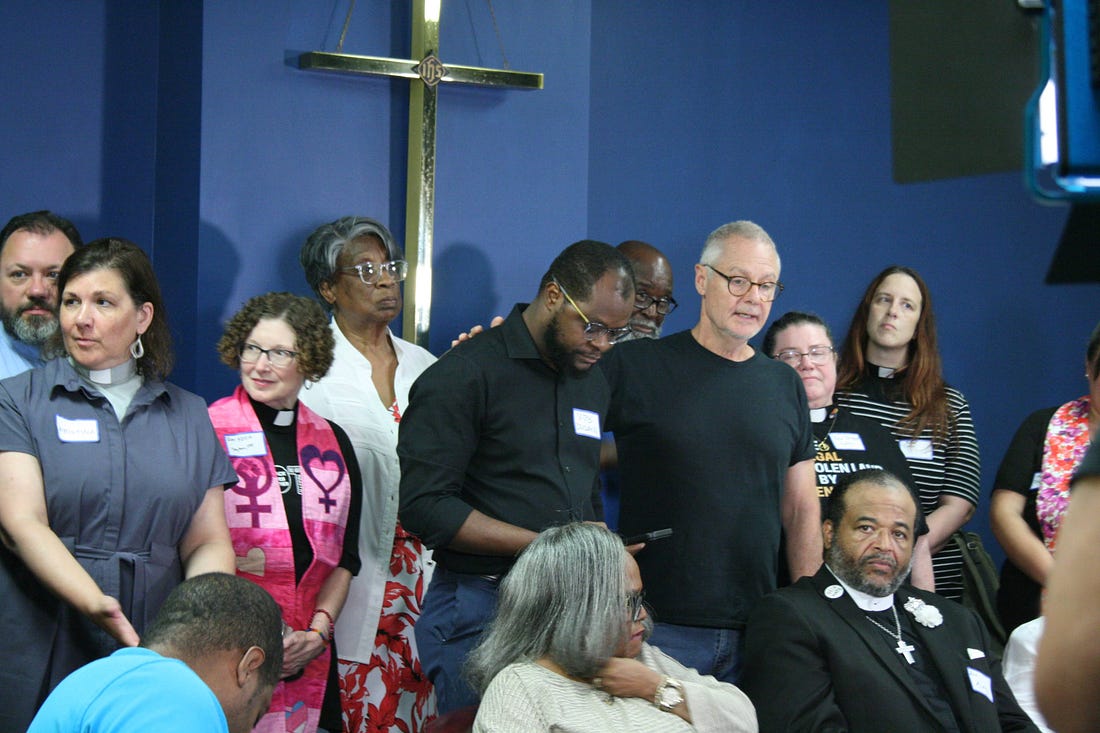
The media crowded into a small, stuffy prayer room at the side of the church. Ruby opened with a story: While this mobilization was being organized, he was in Canada helping a Haitian family he knew relocate there. Returning to Haiti was not an option. Before coming to America, their children had survived kidnapping attempts, and the family’s car had been shot at as they fled. Canada was available only because they had an immediate relative there.
Ruby has been working pretty much non-stop, and a small documentary crew now follows him during what will surely be a defining chapter of his life.
A few weeks earlier, Ruby had accompanied a parishioner to an appointment at the ICE office in Blue Ash, outside Cincinnati. As they walked inside, the man told Ruby what had happened to his brother in Haiti.
“He leaned over and said, ‘My brother was just kidnapped in Haiti,’” Ruby recalled.
“And I said, ‘What happened to him?’ And he said, ‘They burned him.’” Ruby initially misunderstood. “I said, ‘Is he okay?’” he continued.
“And he said, ‘No, they burned him alive.’” Ruby paused before adding: “That’s happening in Haiti.”
When ICE summons Springfield Haitians to Blue Ash, it presents them with a choice: deportation, or an ankle monitor.
The Haitians being fitted with monitors are not fugitives hiding from the government. They are showing up when the government tells them to.
“They are not hiding,” said Vilès Dorsainvil of the Haitian Support Center. “They know where they live. They know where they work.” If immigrants are summoned before a judge, he said, they appear. “You ask them to go for ICE checking, they do that. And they arrest them.”
Dorsainvil said seven Haitians had reported for ICE check-ins last Thursday. One was a woman who had given birth twenty days earlier and lost the baby. “She came to the office. She could not even walk,” he said. “But they put the shackle on her.”
She also described a man on North Limestone Street who had received notice of a court appearance in Dayton but was afraid even to leave his home to retrieve the letter from his mailbox. “Everything is still going on,” Dorsainvil said. “How do you want the person to go for his biometric if you know that they cannot go on the streets?”
“She came to the office. She could not even walk. But they put a shackle on her.”
At one point, Ruby turned toward Dorsainvil, holding up a yellow legal pad to hide his mouth like an NFL offensive coordinator with a play sheet. Dorsainvil is himself a TPS holder with a pending asylum case. By speaking publicly and helping others navigate ICE, he was putting himself at risk. Ruby was seemingly asking permission to speak about his friend in this way:
“Vilès is one of the bravest people I’ve ever seen,” Ruby said. He recalled sitting in a meeting with Dorsainvil and ICE officials who, according to Ruby, told him: “Even though you have asylum pending, we will pick you up, and we will put you in jail and leave you there.” Ruby appealed to the clergy surrounding them: “We need to protect this man.”
 |