
|
 |



I suppose the title for this piece is a purely rhetorical question at this point. But the Court’s inability to tell Trump no may end up being the most concerning feature of his two terms in office. It’s as if the Justices, or five to seven of them, depending on the case, can’t summon a collective recollection of the constitutional system of checks and balances that is the foundation for the legal system they sit at the apex of. It’s another important night of opinion reading here at Civil Discourse. Tonight, we’re back to the Supreme Court.
Today, oops, they did it again. Five justices told Donald Trump all was forgiven for tearing down the historic East Wing of the White House, and he could carry on with his ballroom project while litigation about its legality proceeded. Justices Kagan, Sotomayor, and Jackson joined a dissent written by the Chief Justice.
Tonight, I planned to play legal catch-up. Since early last week, I’ve been running a list of cases and developments we must cover, but that I haven’t been able to get to with everything else going on. I had planned to write about all of them tonight and get us up to speed. Most importantly, I planned to write about Liam Ramos, the five-year-old seized by ICE as he left school with his Spider-Man backpack and blue bunny-ears hat. Liam and his dad have now been deported to Mexico. He should be at home with his mom, in Columbia Heights, Minnesota, getting ready for the start of school. He should not have spent months in the horrible conditions at a detention facility in Dilley, Texas. But Donald Trump’s government saw fit to use the resources of the United States to cut off his future here. Don’t you feel safer knowing that? They told us they would be deporting the “worst of the worst.”
There will be a time, this week, I hope, for all of these topics. But tonight, we’re going to turn our attention to the Supreme Court’s decision this afternoon about Trump’s ballroom. Before we review the opinions, let’s remember how we got here:
On March 31, 2026, Judge Richard Leon granted the plaintiffs’ motion for a preliminary injunction, which enjoined any further construction of the ballroom above ground, but permitted work to continue on what the court was told was a “new below-ground military installation.” Any work “strictly necessary” to protect the White House or the President and his staff could take place as well. Judge Leon held that the president is the “steward” of the White House and not the “owner,” and that Trump had no statutory authority to proceed, absent authorization from Congress.
On April 17, 2026, the Court of Appeals for the District of Columbia stayed the district court’s injunction, permitting work to resume, while it considered the matter.
On August 7, 2026, the Court of Appeals ruled that the district court’s injunction would remain in place. Construction was stopped again on the above-ground part of the project.
The government ran lickety-split to the Supreme Court for a stay of the district court’s injunction, so it could get back to work on the ballroom. It’s important to understand the posture here: This is not a case that has been briefed and orally argued on the merits. It’s a shadow docket ruling on whether an injunction should be in place to keep the government from building Trump’s ballroom while the litigation moves forward.
The opinion we read tonight is not a decision on the substance of the matter; the Court isn’t considering whether what Trump did violates the law. This is just about whether he can keep doing it while the Court considers the matter. As the majority wrote in their opinion tonight, they are still waiting on “a forthcoming petition for a writ of certiorari [from the government] and any further proceedings in this Court.”
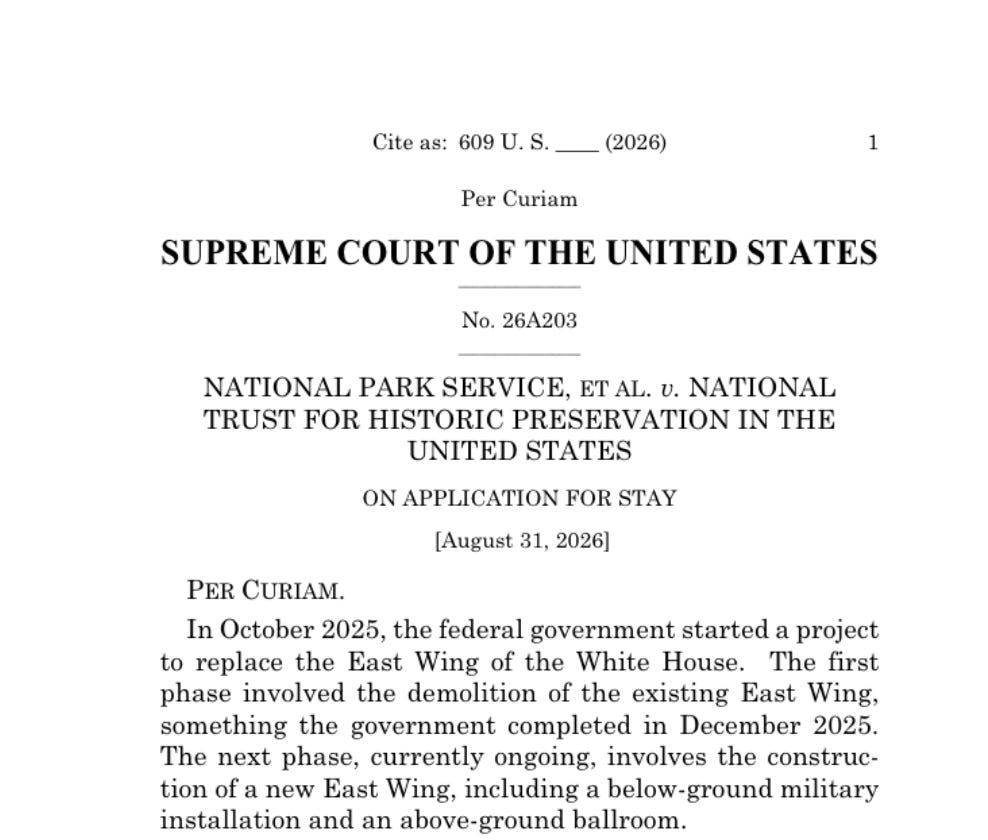 |
The majority opinion is per curiam—Latin for by the court—which means it’s unsigned by any one justice. They “grant the requested stay” of the district court’s injunction, which means work can proceed on the ballroom while the case moves forward. The Court uses the now-familiar formula for deciding whether to grant an injunction, finding that “The government has established that it is likely to succeed on the merits of a significant legal question, that it would likely suffer irreparable harm without a stay, and that the balance of equities tips in its favor.”
Why is the Court talking about the government succeeding, when I’ve just told you this isn’t a decision about the legality of what Trump is doing? It’s because the Court is considering the government’s chance of success on a threshold argument—whether the plaintiffs have standing to bring the case. We had an extensive conversation about standing when Trump brought Fight Club to the White House, so we understand that it’s an important legal doctrine. If you don’t have it, you can’t sue.
Here, one would expect the Court to preserve the status quo while litigation proceeds to determine whether it existed, but that is not the case, and permitting construction to continue essentially prejudges the outcome of the case because what is the Court going to do? Order it all torn down in three years when the case is over if Trump loses?
The Court concludes with this rationalization: “Today, we do not pass upon the legality of the government’s East Wing project. We conclude only that, based on the submissions before us, the government is likely to prevail in showing that the Trust lacks Article III standing to challenge the project in federal court and that the remaining stay factors favor relief.” The stay will remain in place until the Court either denies certiorari or, if it grants it and hears the case, until it hands down judgment. Sounds like we’re going to have a ballroom.
But it’s the Court’s analysis of irreparable injury that feels most disingenuous. The Court accepts at face value most of the government’s arguments that it will be irreparably injured if it can’t build Trump’s gilt ballroom. They do that even though Judge Leon didn’t stop work on the supposed national security facilities beneath the ballroom. The list of claims the per curiam accepts includes: “every day during which construction is delayed impairs the Secret Service’s ‘protective operations,’ … the contemplated ballroom would enhance security for Presidents and their visitors who in the past have had to meet in soft tents or offsite when gathering in large numbers, … a prolonged construction period increases the risk of foreign actors ‘gathering intelligence on’ the project.” [Ed note: I thought they could just go to Mar-a-Lago dinners to do that?] The Court makes light of the plaintiffs’ concerns about the damage to a historic site and the ecological impact. When it balances the equities, it finds they are with Donald Trump based on these rather transparent grounds.
The dissent starts with the proposition that what Trump is doing is “likely unlawful.”
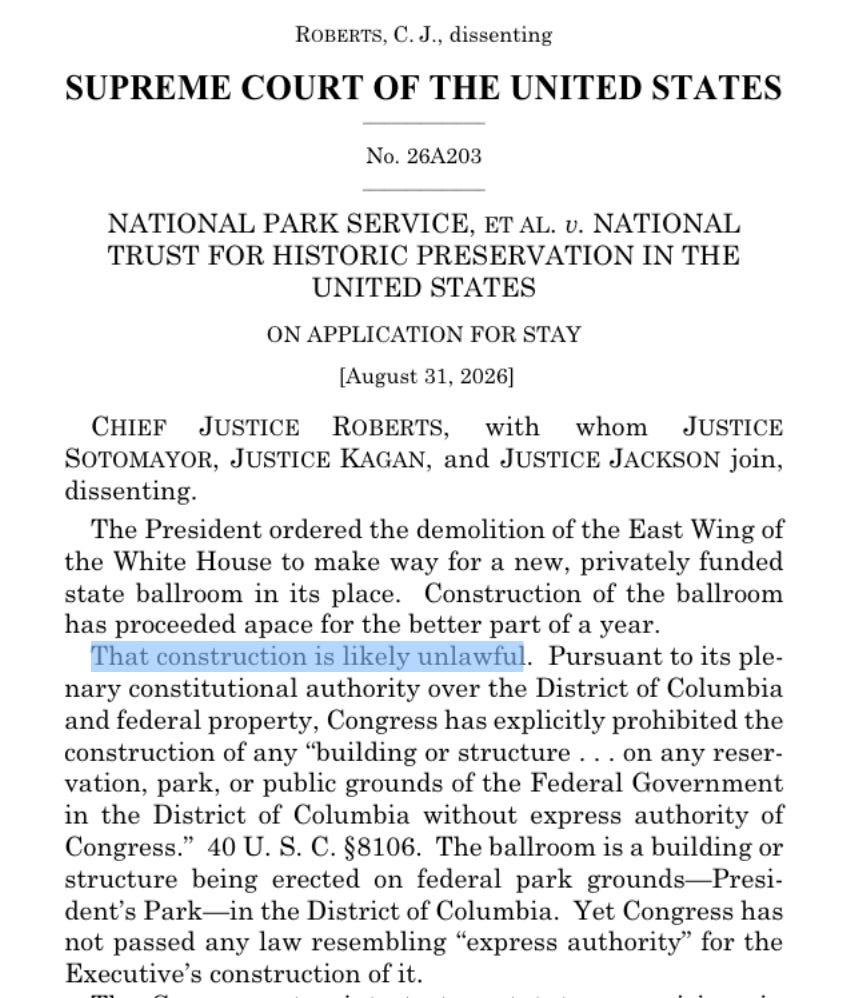 |
They explain that conclusion like this: “Congress has explicitly prohibited the construction of any ‘building or structure … on any reservation, park, or public grounds of the Federal Government in the District of Columbia without express authority of Congress.” They continue, “Congress has not passed any law resembling ‘express authority’ for the Executive’s construction.”
The dissent also addresses the standing issue, explaining that “To have standing to sue as the representative of its members, an organization such as the Trust must show, among other things, that one of its members would have standing to sue in her own right. The [National] Trust argued one of its members suffered ‘aesthetic injury’ from the ballroom’s construction. The dissent correctly states that ‘To serve as the basis for her standing … aesthetic injury must be ‘concrete’ and ‘particularized’ … ‘real, and not abstract.’” The dissenting Justices conclude that “Given the distinctive nature of the White House and Hoagland’s [the individual member’s] focused and substantiated interest in viewing it in its traditional form, her aesthetic injury from the construction of the ballroom is concrete and particularized.” They find that there is standing.
The majority seems to act like this is just an ordinary case, not one about a president tearing down the East Wing of the White House. The majority seems to have forgotten that it’s the people’s house and that standing needs to match that moment. The notion that American citizens don’t have standing to challenge what Trump is doing to a property that is ours, not his, is ludicrous. No matter how much precedent the majority cites, they can’t erase the fundamental nature of why the Trump administration is being sued here. But the dissent gets it and they say what the majority should have said and what all Americans, regardless of party, should be saying about this:
“The White House is an iconic American building whose symbolism and history are wrapped up in its architecture. As President Theodore Roosevelt once remarked while thanking Congress for expressly appropriating funds for the construction of the East and West Wings: ‘The stately simplicity of [the White House’s] architecture is an expression of the character of the period in which it was built, and is in accord with the purposes it was designed to serve. It is a good thing to preserve such buildings as historic monuments which keep alive our sense of continuity with the Nation’s past.’”