| | In tonight’s edition: The Treasury secretary battles his press corps, and a legal development in Hon͏ ͏ ͏ ͏ ͏ ͏ |
| |  Dallas Dallas | Washington |  Hong Kong Hong Kong |
 | Media |  |
| |
|
 - Bessent’s media war
- SF’s AI anxiety
- Coke and Pepsi
- Mixed Signals
- News from Hong Kong
- 25 years of change
|
|
 The politics of AI are getting strange: Last week in Dallas, I listened to a conservative anti-AI activist compare data centers (unfavorably) to mosques for an anti-Muslim audience — and then warn that “algorithmic immigrants” pose a bigger threat than humans. And yet, those of us who covered the long social media wars learned one major lesson: No matter how many times you interview Sen. Amy Klobuchar, Congress will never do anything. The “techlash” that began in earnest in 2017 produced endless media chatter, zillions of tweets, and no meaningful (federal) government action. Journalism notoriously over-learns lessons and re-fights the last war. The AI story has much of the same outlines as efforts to regulate social media — including many of the same lobbyists, politicians, and journalists making many of the same motions. Companies are expressing sober support for regulation in theory, for instance; politicians have learned to make it all about the children. But the media’s learned cynicism may be masking major differences: Last time around, “there was a sense it was too late for major regulations,” my colleague Ashley Gold notes. Now, “people may think they still have a chance to change the future and want lawmakers to act before that window is closed.” Equally important in hyperpartisan Washington, social media was a zero-sum political terrain in which each party had an eye to its electoral advantage. The partisan politics of AI are less clear. And so as the AI story escapes containment, I’m ready to be surprised. Also today: The Treasury secretary battles his press corps, and a legal development in Hong Kong. |
|
Bessent squares off with the Treasury press corps |
 Brian Snyder/Reuters Brian Snyder/ReutersScott Bessent was once a regular on Bloomberg’s TV programming and on its terminals — first as the founder of a hedge fund, and now as President Donald Trump’s Treasury secretary. But last September, he was furious with Bloomberg reporters Anthony Cormier and Zachary Mider. The two were reporting that Bessent had agreed to simultaneously occupy two different houses as his “principal residence,” two people familiar with the exchange told Semafor — just as Trump was trying to use the same rationale to justify firing Federal Reserve Governor Lisa Cook. Bessent called Bloomberg’s editor-in-chief, John Micklethwait, and warned him that if Bloomberg went ahead with the piece, the financial news giant could expect different treatment from the Treasury Department — including no more appearances by the Treasury secretary, a coveted TV guest. Bloomberg published the article anyway. And in the year since, Bessent has followed through on his threats, as his relationships with other top business news outlets that cover Treasury have come under similar strain. |
|
Is the AI panic a media story? |
 Jonathan Drake/Reuters Jonathan Drake/ReutersThe intense concern about an AI-driven apocalypse is itself a kind of media story. The concern developed on insular message boards like LessWrong (you can read today about all the ways AI could kill us) and is now the subject of discussion primarily on a platform designed to promote extreme views, X. The other surface is AI company Slack servers, which can, at their worst, become a kind of internal X, only with more groupthink. Semafor’s Reed Albergotti made the case Saturday that the topic of AI safety “escaped containment in the laboratory that is San Francisco, spread by a breathless media for whom mass extinction is — let’s face it — an incredibly fun story. Now that it’s infected the networks of Washington and Brussels, the biggest risk may be that hysteria replaces thoughtful debate.” |
|
 Stefan Wermuth/Reuters Stefan Wermuth/ReutersThe cutthroat competition between big ad agencies escalated last week when the giant PepsiCo abruptly handed its advertising business to the French holding company Publicis. Then, Publicis dropped out of a competition for the Coca-Cola account. The move was a glimpse at the strange dynamics of a very consolidated industry: The Omnicom-IPG merger left three dominant holding companies in the space. Coca-Cola had just decided to replace Omnicom, and is now left negotiating exclusively with the third, WPP. The entire episode shocked the industry in part because it happened without the usual elaborate pitch process, and it’s a coup for Publicis, which remains the hot hand among the big three. |
|
Salman Rushdie on ‘Mixed Signals’ |
 Fabrizio Bensch/Reuters Fabrizio Bensch/ReutersAn attack nearly killed him. Now, Sir Salman Rushdie has made a documentary about it. On this week’s episode of Mixed Signals, Rushdie joins Max and Ben to talk about why he’s ambivalent about his documentary, how he divided authorship with director Alex Gibney, what he felt watching footage of the attack for the first time, and what he’s learned from decades of being both subject and strategist in his own media coverage. Plus, why he’s trying very hard to pretend AI doesn’t exist. |
|
A press verdict in Hong Kong |
 Joyce Zhou/Reuters Joyce Zhou/ReutersIn Hong Kong, once a great hub of global journalism, tightening Chinese control of the special administrative region has seen speech restricted and the media squeezed. In the highest-stakes case, the publisher Jimmy Lai remains in prison. But last week, in a modestly heartening sign, lawyers for journalist Selina Cheng won a closely watched labor case against The Wall Street Journal, which she’d accused of retaliating against her for seeking the presidency of a journalism association in a kind of self-censorship. I asked Cheng about the situation of journalists in Hong Kong broadly: “Considering that press freedom is in decline globally, there are very few places in the world where journalism is entirely free of risk. If that’s the bar for publishers to consider posting correspondents or opening a bureau, it’s unrealistic,” she said. “On the balance is also the outsized influence of China in the world, so I believe Hong Kong’s still a relatively safe place to report from, compared to, say, Gaza, Myanmar, or Belarus.” A Journal spokesperson said the paper disagrees with the verdict and is considering options. |
|
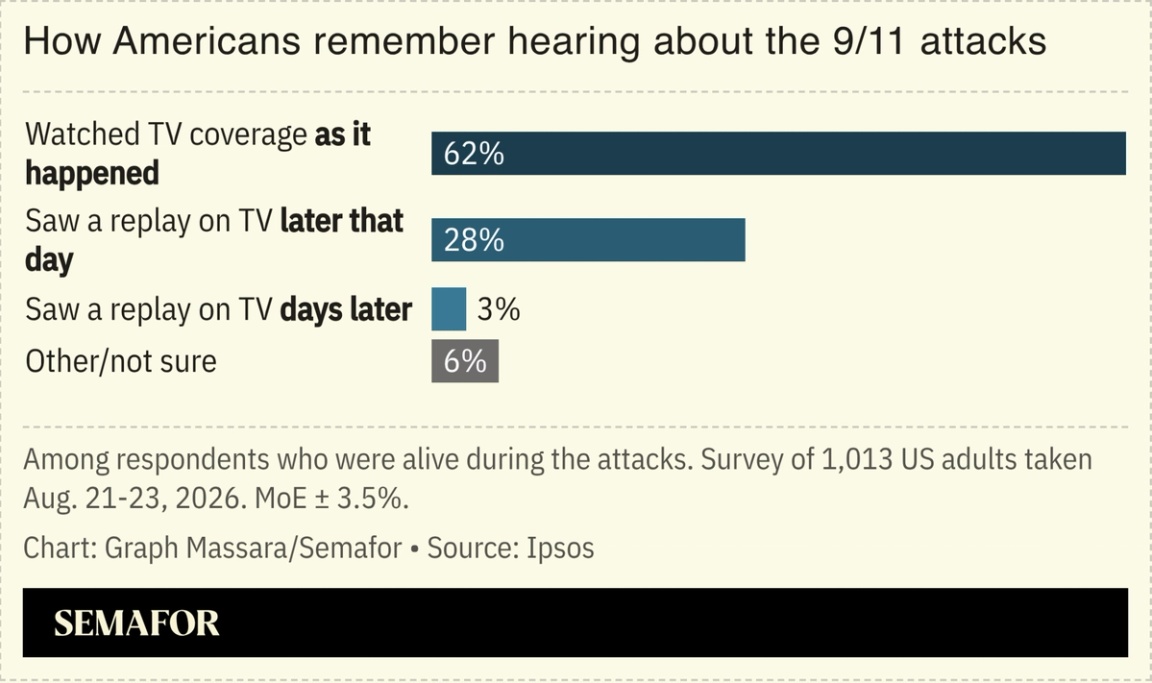 The divide between Americans who witnessed the 9/11 terror attacks and those too young to remember is symbolic too of how much media has changed in the intervening quarter-century. Nine in 10 US adults were alive on Sept. 11, 2001, and almost all of them (93%) said they watched the attacks on television, either as they were happening (62%) or shortly afterwards (31%), according to an Ipsos poll out last week. Fast-forward 25 years, and millions have lived through that day only second- or thirdhand, through “nostalgia influencers” or the remarkably persistent online universe of 9/11 conspiracy theories. Only 8% of Gen Z Americans remember 9/11, but 84% say it affected their country. — Graph Massara |
|
 Semafor is expanding its coverage of healthcare with a new weekly briefing led by veteran healthcare journalist David Lim. At the intersection of politics, policy, and business, Semafor Healthcare will bring clarity to the forces shaping the industry, explaining how decisions in government affect the private sector and global economy. The briefing will go beyond the headlines to show what is really driving health policy in the US and around the world. Each week, readers will get original reporting, scoops, and analysis on the people and institutions driving change across healthcare, from policymakers and major companies to scientists, investors, and technology leaders. |
|
CNN: Defense Secretary Pete Hegseth pushed US airmen extracted from Iran in a dramatic rescue earlier this year to participate in tonight’s season debut of 60 Minutes, Zachary Cohen and Brian Stelter report. Vanity Fair: MS NOW’s Ayman Mohyeldin, an Egyptian-born Muslim, reflects on how 9/11 pushed him into the “unusual space between the United States and the region it was trying to understand while simultaneously bombing.” A Media Operator: Venerable Guardian columnist Marina Hyde is leaving after 26 years, Bron Maher reports. Poynter: McClatchy’s slashing of 90 jobs across 13 newspapers marks its deepest local news cuts in years, Angela Fu writes. Bloomberg: Jason Schreier gets into the backstory behind video game auteur Hideo Kojima’s divorce from longtime publisher Sony. Puck: Jimmy Kimmel’s show hasn’t been canceled yet, contrary to some reporting this week, but his network is asking for budget cuts, Matt Belloni writes. |
|
|


