| | In today’s edition: Lawmakers struggle to find consensus on AI amid increasing warnings, and Warsh t͏ ͏ ͏ ͏ ͏ ͏ |
| |  | Washington, DC |  |
| |
|
 - Congress’ AI muddle
- Senate returns
- Push for global AI rules
- Warsh’s Trump storm
- Bessent’s media feuds
- RFK deputy hearings
- Trump pokes UK
- Working-class battle
PDB: Intelligence agency’s overhaul  Vance in Kansas … G20 energy ministers meet in Houston … Nasdaq futures ▼ 1.8% on AI slowdown calls |
|
AI warnings belie lack of Hill consensus |
 Jonathan Drake/Reuters Jonathan Drake/ReutersThe sudden appearance of alignment among AI CEOs about industry regulation over the weekend masks an inconvenient reality for Congress: There is no consensus. In the House, Speaker Mike Johnson is downplaying his own role in favor of a “partnership” with AI companies, as he told CNN on Sunday. Across the Capitol, OpenAI remains most supportive of bipartisan Senate Commerce Committee talks that could advance this week, despite skepticism from Anthropic, Democrats, and AI safety groups, who say those negotiations risk letting the industry self-police. But Saturday’s three-CEO agreement that frontier models are accelerating too fast centered on Anthropic’s plan to do “things every AI lab needs to do anyway,” as our colleague Reed Albergotti wrote — which amounts to self-regulation, with labs likely choosing their own independent evaluators. “The time to act is now, before it’s too late,” Rep. Lori Trahan, D-Mass., told Semafor. — Ashley Gold and Nicholas Wu |
|
Republicans race to beat time crunch |
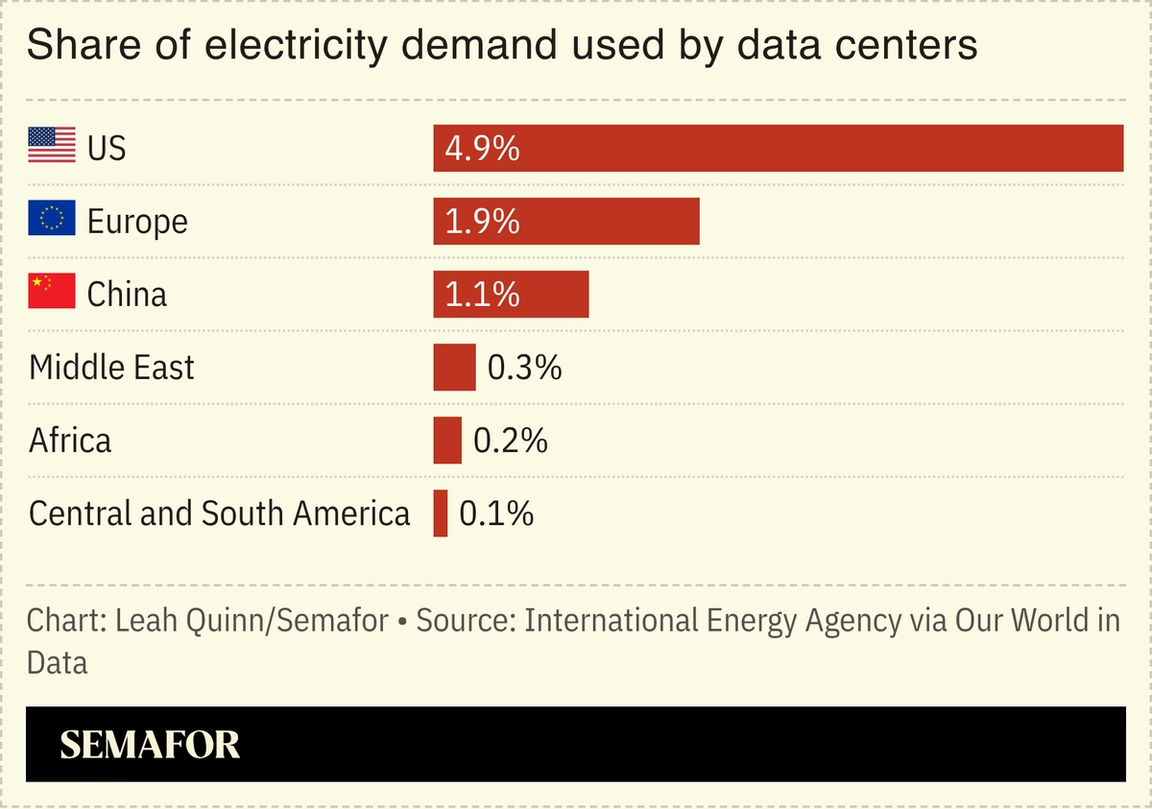 Some Republicans are hoping they can address voters’ affordability concerns before the election — potentially by passing a data center power bill to demonstrate the party is listening to souring popular sentiment surrounding AI infrastructure. The House is set to take up the bill, called the Ratepayer Protection Act, this week, which will help vulnerable incumbents answer voters’ concerns about data centers. If the Senate takes it up, the bill would help endangered Sen. Jon Husted, R-Ohio. But the body has other priorities: The Senate is scheduled to take up the crypto market structure bill and a huge bipartisan college sports bill as soon as this week. There’s a faction of Republicans who’d rather concentrate on deregulatory rollbacks and addressing AI’s impact on utility bills; the GOP will try and sort it out this week in party meetings. — Burgess Everett and Nicholas Wu |
|
Dem pushes global effort on AI rules |
 Marco Bello/Reuters Marco Bello/ReutersHouse Democrats are circulating a letter imploring President Donald Trump to lead an international effort to set global AI rules, according to a copy shared with Semafor. “We strongly urge your administration to lead a coordinated international effort to establish a global framework to guide the development of this technology and a shared vision for AI end-use — engaging our strongest allies, such as the European Union, as well as formidable global competitors, particularly the People’s Republic of China,” Rep. Yassamin Ansari, D-Ariz., writes in the draft of the letter to be sent later this week. The push precedes Trump’s meeting with Chinese leader Xi Jinping, which will touch on AI. It’s unlikely that the Trump administration would play any role in international policy decisions about AI that would involve ceding competitive ground. Yesterday, Trump rejected calls by tech leaders for a slowdown in AI development. — Ashley Gold |
|
Fed poised to clash with Trump |
 Evelyn Hockstein/Reuters Evelyn Hockstein/ReutersAs the Federal Reserve weighs whether to raise interest rates this week, Chair Kevin Warsh must choose between breaking markets’ trust and triggering Trump’s ire. Vice President JD Vance and Treasury Secretary Scott Bessent recently joined the president in arguing for lower interest rates. But investors overwhelmingly expect Warsh to deliver on his hawkish speech in Jackson Hole last month. Disappointing them would hurt his credibility, particularly after the government said that prices beyond food and energy rose more in August than expected. The damage could be severe enough to boost borrowing costs even in the absence of a hike. “Warsh’s Jackson Hole speech led the market to expect a hike if the inflation news was imperfect, and while the [consumer price index] was not concerning, it was imperfect,” Goldman Sachs analysts wrote. Officials “might worry about the consequences of not hiking for market perceptions.” — Eleanor Mueller |
|
Bessent vs. the Treasury press corps |
 Brian Snyder/Reuters Brian Snyder/ReutersScott Bessent was once a regular on Bloomberg TV and in its reporting — first as the founder of a hedge fund, and then as Treasury secretary. But last September, he was furious with Bloomberg. The outlet was getting ready to report that Bessent had agreed to simultaneously occupy two different houses as his “principal residence,” two people familiar with the exchange told Semafor’s Max Tani, just as Trump was trying to use the same rationale to justify firing Federal Reserve Governor Lisa Cook. Bessent called Bloomberg’s editor-in-chief and warned him that if Bloomberg went ahead with the piece, the financial news giant could expect no more TV appearances by the Treasury secretary. Bloomberg published the article anyway. In the year since, Bessent has followed through on his threats. Now, with Treasury under pressure, his relationships with top business news outlets are strained. |
|
Klomp faces Senate health gauntlet |
 Kylie Cooper/Reuters Kylie Cooper/ReutersDemocrats want to cast Chris Klomp as anything but a moderating force within Robert F. Kennedy Jr.’s Department of Health and Human Services this week during two Senate hearings on his nomination to become Kennedy’s No. 2. But the genial official — who won the trust of the White House negotiating Trump’s drug pricing deals and playing a key role reshaping leadership teams across HHS — has quietly met with nearly 35 senators ahead of his confirmation hearings before the Senate finance and health panels, according to a person familiar with the outreach. A Democratic aide said that progressives would try to use the hearings to dispel what they see as a false narrative that Klomp is a bridge-builder. But while Klomp is unlikely to draw public support from Democrats, behind closed doors many lawmakers view him as one of Trump’s most competent health officials. — David Lim |
|
Trump pokes allies, risks US isolation |
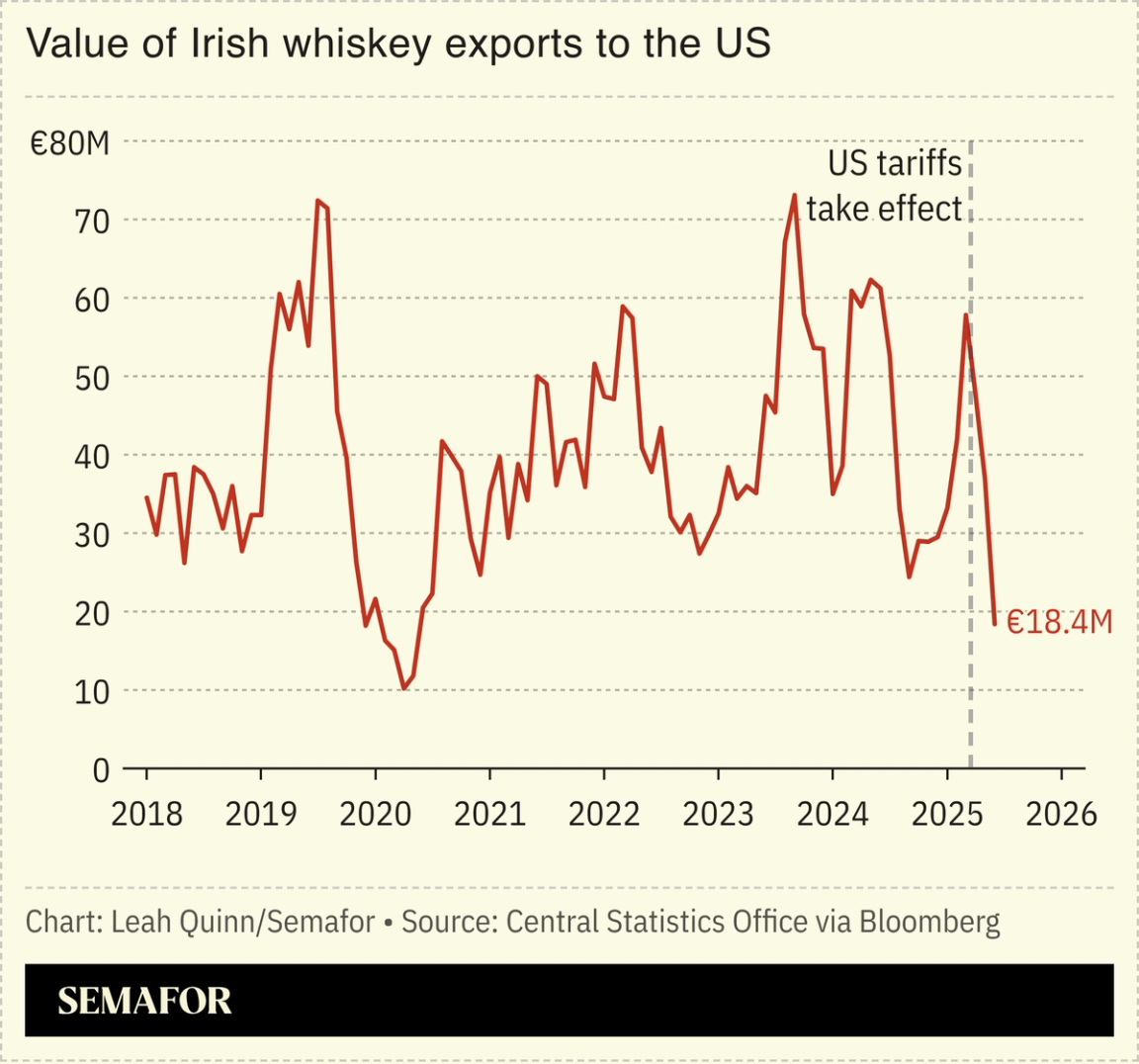 Trump is once again testing America’s allies in a way that could leave the US to face complex global challenges — from AI to the Iran war to an aggressive China — increasingly on its own. Trump touched a nerve in the UK this weekend by expressing support for a united Ireland, breaking with decades of neutrality on the issue by past presidential administrations. Trump also put pressure on Ukraine to halt its attacks on Russian oil refineries, blaming Kyiv for a shortage of diesel that’s caused prices to spike globally (the average price of diesel hit $6.20 in the US yesterday, a rise partly attributable to the Iran war). And Trump’s trade war with Canada, with little resolution in sight, is also driving Ottawa to forge deeper partnerships with Europe. But at least one European product is getting a tariff reprieve: Irish whiskey. |
|
Can Democrats win the working class? |
 Tim Evans/Reuters Tim Evans/ReutersDemocrats need to employ more populist rhetoric, run candidates perceived as non-elite, and steer away from progressive rhetoric like “abolish ICE” if they want to capture more working-class voters in future elections, according to new data shared first with Semafor. Researchers at the Center for Working-Class Politics talked to 40,000 adults from April to June to determine how Democrats can win more working-class voters without compromising other support. The strategy should also include leading with “working-class economics” and explicitly prioritizing members of the working class, the research found. Working-class voters moved away from Democrats if the candidates endorsed defunding police (by 5.7 points), letting transgender girls play girls sports (by 5.6 points), or gun control (by 4 points). — David Weigel |
|
Blindspot: Planes and data centers |
 Stories that are being largely ignored by either left-leaning or right-leaning outlets. What the Left isn’t reading: Wisconsin Republican gubernatorial candidate Rep. Tom Tiffany, R-Wis., swam to safety after surviving an emergency plane landing in a lake. What the Right isn’t reading: Former EPA officials said the data center boom poses a public health threat. |
|
 Image credit: Reuters/Fabrizio Bensch Image credit: Reuters/Fabrizio BenschAn attack nearly killed him. Now, Sir Salman Rushdie has made a documentary about it. On this week’s episode of Mixed Signals, Rushdie joins Max and Ben to talk about why he’s ambivalent about his documentary, how he divided authorship with director Alex Gibney, what he felt watching footage of the attack for the first time, and what he’s learned from decades of being both subject and strategist in his own media coverage. Plus, why he’s trying very hard to pretend AI doesn’t exist. Watch the latest episode of Mixed Signals now. |
|
|


