| | In today’s edition: Gulf-Iran talks on Hormuz canceled, UAE hardens its infrastructure, and Gulf cou͏ ͏ ͏ ͏ ͏ ͏ |
| |  | Gulf |  |
| |
|
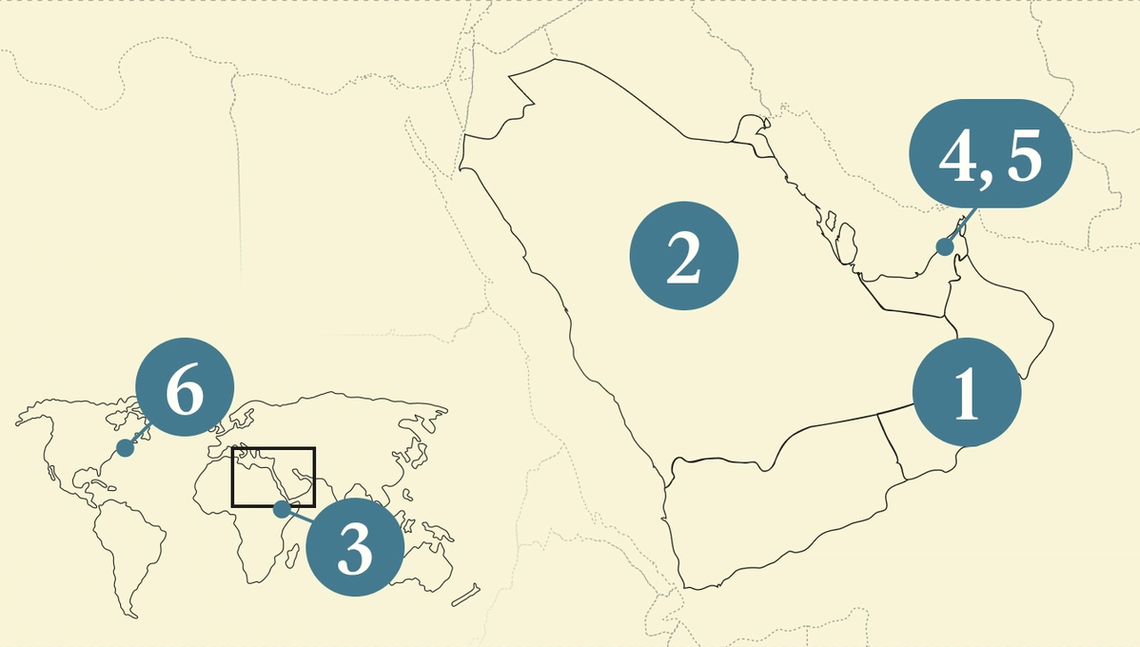 - Hormuz talks, on and off
- Citi’s $40B Saudi push
- DP World expands in Kenya
- Lanyard season in Dubai
- Infra goes underground
- Gulf hedges on AI
 Riyadh’s robot fight club. |
|
Oil surges as conflict widens |
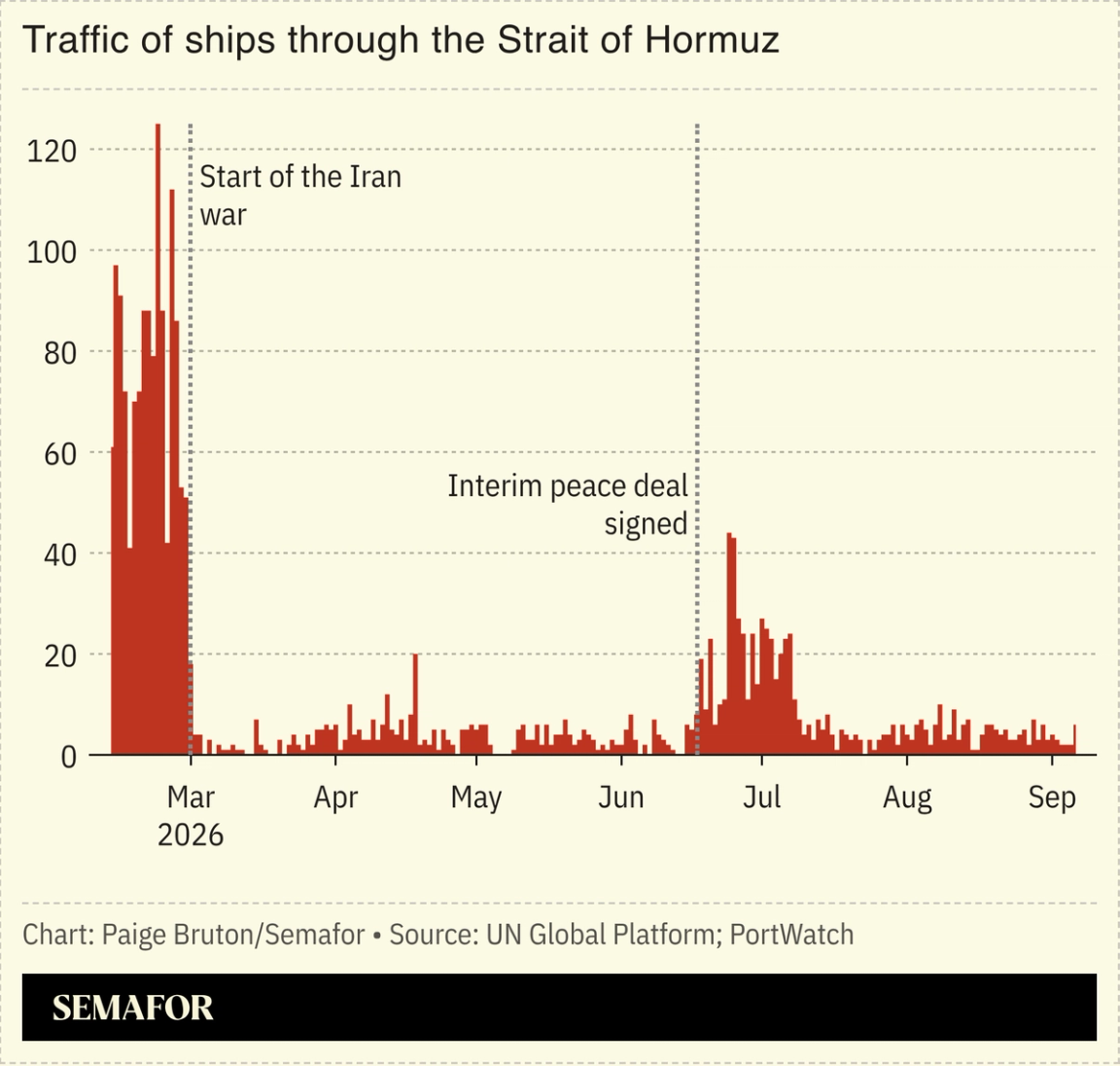 Oil rose above $108 a barrel as fears mounted of further disruption to the region’s energy flows. Scheduled talks between Gulf states and Iran on Monday were called off, fighting in Yemen intensified — raising fears over curbs to trade via Bab el-Mandeb in addition to the Strait of Hormuz — and Saudi Arabia halted its East-West Pipeline over drone attacks blamed on Iran-backed militias in Iraq. The kingdom warned residents in southern cities bordering Yemen of potential missile and drone attacks. Though Iranian and Emirati leaders met on the sidelines of a BRICS summit in India, Tehran and its proxies have sought to “upend any minimal sense of stability in the region,” The New York Times reported. The paper separately reported that Iranian President Masoud Pezeshkian was surprised when factions in Iran’s armed forces attacked three commercial ships in Hormuz in July, unraveling an agreement struck with Washington weeks earlier. Such autonomous action was possible because the new supreme leader, who has final authority on matters of national security, “has been a phantom since taking office in March.”  Abu Dhabi Media Office. Abu Dhabi Media Office.At the BRICS summit in New Delhi, Pezeshkian met Abu Dhabi Crown Prince Sheikh Khaled bin Mohamed and said they agreed to “turn the page, look to the future and build it together.” Hours later, the Oman meeting was canceled. |
|
Citi arranges $40B in Saudi financing |
 Arlyn McAdorey/Reuters Arlyn McAdorey/ReutersCitigroup has raised more than $40 billion for Saudi clients this year and increased its direct exposure to the kingdom since the start of the US-Iran war, the company’s chief country officer Fahad Aldeweesh told Semafor. The bank lifted internal exposure limits after judging Saudi Arabia to have shown economic and financial resilience through six months of regional conflict and Iran’s attempts to close the Strait of Hormuz. Citi has been working on boosting its Saudi footprint for several years. Although it first entered the kingdom in 1955 when it was the first US bank to operate there, it sold a stake in one of Saudi’s largest banks in 2004, ending its on-the-ground presence. Under CEO Jane Fraser, Citi has made Saudi Arabia a key part of its growth plans, establishing a regional headquarters in Riyadh last year and aggressively pursuing mandates on deals across initial public offerings, merger and acquisitions, and debt financings. — Matthew Martin |
|
DP World deepens Africa push |
 Ahmed Jadallah/Reuters Ahmed Jadallah/ReutersDP World is investing in its African network — even as its flagship port in the Gulf sits idle. The Dubai port operator formalized plans for a 222-hectare industrial park at Mombasa, signing a joint-venture agreement with Kenya’s GulfCap Africa in Nairobi last week. More than 60 companies have expressed interest in the special economic zone, which the partners expect to support over 20,000 direct and indirect jobs. DP World has spent two decades building across the continent and operates in at least nine African territories, from Algeria and Angola to Senegal, Somaliland, and Tanzania. That constellation has kept the company profitable despite the disruption caused by the Iran war. |
|
Dubai crams a year into autumn |
 Abdel Hadi Ramahi/Reuters Abdel Hadi Ramahi/ReutersDubai’s exhibition industry is heading into its busiest stretch ever, with more than 100 shows packed into the final four months of the year after the war pushed the spring calendar into autumn. The twice-rescheduled Arabian Travel Market finally opens this week, while GITEX will bring 200,000 tech visitors in December. Dubai’s two convention centers offer a combined 200,000 square meters of space — roughly as much as McCormick Place in Chicago, the largest exhibition venue in the US, and almost half as much as the world’s biggest, Shanghai’s NECC. A 10-billion-dirham ($2.7 billion) expansion is set to make the Expo City venue the Middle East’s largest indoor exhibition center by 2031, with its next phase due to finish construction this time next year. — Manal Albarakati |
|
Data centers, fuel tanks move below |
 Courtesy Coop Himmelb(l)au Courtesy Coop Himmelb(l)auThe UAE is considering moving parts of two of its largest infrastructure projects underground to guard against future attacks. One is the 5-gigawatt AI data center project underway with US technology partners, Reuters reported. Originally planned as a 10-square-mile campus in Abu Dhabi, the project is now likely to be a network of facilities dispersed across the country, with air defense systems and some underground construction among the modifications under consideration, according to the outlet. Dubai Airports CEO Paul Griffiths told the Financial Times that the multibillion-dollar project to relocate Dubai’s main airport south of the city may include underground fuel storage tanks. The changes will not shrink the plan to ferry 250 million passengers a year through the new hub, he said.
— Kelsey Warner |
|
View: The Gulf can straddle the AI divide |
 Dado Ruvic/ Hamad I Mohammed/ Illustration/ Reuters Dado Ruvic/ Hamad I Mohammed/ Illustration/ ReutersSaudi Arabia and the UAE aren’t trying to replicate either the US or Chinese tech ecosystem from top to bottom. They don’t need to, Judah Taub, founder and managing partner of Israeli venture capital firm Hetz Ventures, writes in a column for Semafor. The Gulf’s two biggest economies sit outside both superpowers’ control: “Their value may lie in being among the few places where both can operate at once.” Saudi Arabia doesn’t have to lead in innovation, Taub argues. “The kingdom can own a growing share of the infrastructure everyone else’s models runs on, and use access to that infrastructure to extract investment, localization commitments, and technology transfer.” |
|
 Automotive- Saudi Arabia’s first homegrown carmaker Ceer will unveil its first electric sedan and SUV on Sept. 21, four years after PIF and Foxconn founded the company. The venture has grown from 20 employees to 2,300 and is expected to add $8 billion to the kingdom’s economy as Riyadh builds a domestic EV industry. — Arab News
Deals- Following UAE President Sheikh Mohamed bin Zayed’s visit to Germany, the UAE plans to invest €40 billion ($46.3 billion) in Europe’s largest economy across industry, AI, digital infrastructure, and energy. As part of the commitment, German state-backed energy company SEFE Securing Energy for Europe signed a preliminary agreement with ADNOC and XRG to expand LNG and natural gas supply to Europe.
- Dubai-based Zamanat aims to facilitate a $100 million tokenized private credit fund to meet what it sees as a massive financing gap for small- to medium-sized companies in the Gulf, where only 11% of SMEs have access to outside capital.
Tunnels- Dubai money is helping dig Elon Musk’s tunnels: Vy Capital, a low-profile Dubai firm that is SpaceX’s fifth-largest shareholder, joined Boring Co.’s $3 billion round alongside Shamal Holding, which invests for Dubai’s crown prince. The raise values the tunneling venture at $23 billion. — Bloomberg
|
|
 Courtesy of Hero Esports Courtesy of Hero EsportsOn an otherwise quiet Wednesday evening at Riyadh Boulevard, a sort of Times Square-meets-seaside-funfair, a bizarre experiment in the future of Gen Alpha entertainment was underway. Two blue and yellow humanoid robots attempted to beat each other up with punches twice as hard as Mike Tyson’s. Sponsored by Hero Esports, the brainchild of Chinese billionaire Dino Ying, the event was the first of its kind outside China and a blueprint for a global sports league envisioned as Monster Trucks for the Terminator era. Saudi royals, investors, tech nerds, influencers — and a Semafor journalist, who is none of those — watched robots struggle to face each other, occasionally falling over and sometimes breaking bits off their opponent. But it wasn’t all slapstick fun: one robot leapt through the air with a Street Fighter-style flying kick and, surprisingly, didn’t topple over. While not yet proof that Saudi Arabia’s roughly $250 million investment into Hero Esports will pay off, the event was a reminder that the kingdom can still create spectacles and stick the landing. |
|
|


