
|
 |


Mea culpa for the long post on a Saturday night, but read on and see if you don’t agree that it’s essential. Thanks for being here with me at Civil Discourse and for caring about the future of our democracy.
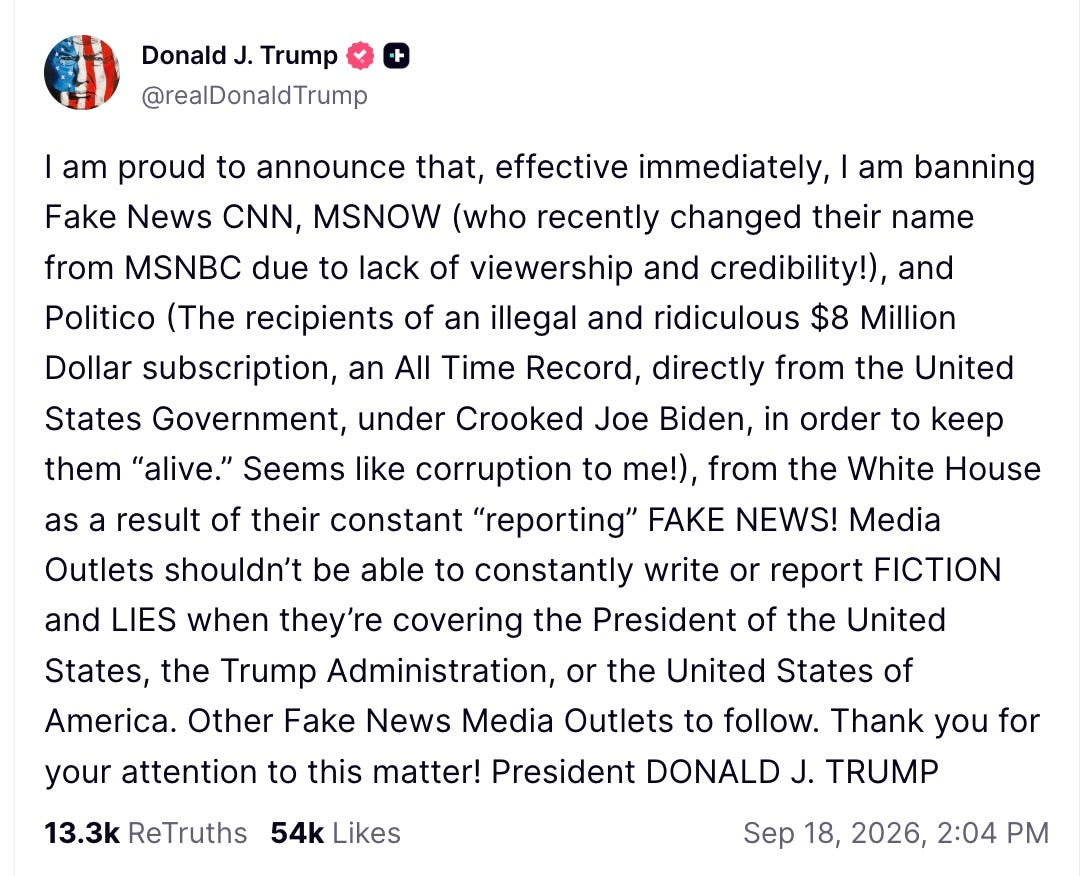
By now you’ve likely seen the news: Donald Trump banned, via Truth Social post, MS NOW, CNN, and Politico from the White House. Journalists from those outlets were denied access to the White House when they came to work today, Saturday.
Almost certainly, the first thought that crosses your mind is, “That has to violate the First Amendment.” You would not be wrong.
 |
What Trump has done is a fundamental violation of the First Amendment and the Fifth Amendment’s guarantee of due process. George Lehner, the White House Correspondents’ Association (WHCA) counsel for 18 years, assessed the same basic issue in November 2018, after the Trump administration suspended CNN Chief White House Correspondent Jim Acosta’s credentials when he pressed Trump for answers about disappearing “caravans” of migrants after the midterm elections. In its amicus brief, the WHCA argued that “the First Amendment requires a compelling government interest—not whim, prejudice, or dislike—for the President to strip a journalist of his or her ability to report from the White House.” It took a judge less than two weeks to restore Acosta’s credentials.
Tonight, Jim Acosta told me, “I think Trump is almost certain to lose this case. During his comments Friday he didn’t even cite a specific reason for banning these outlets. I can’t imagine a scenario in which a judge allows this irrational, desperate ban to become permanent.”
Trump even lost Jonathan Turley, the conservative lawyer who testified on his behalf during his first impeachment and went on Fox News to criticize both the second impeachment and criminal charges that were brought against Trump. On Friday, Turley tweeted that a ban on CNN, Politico, and MS NOW by Trump “would be an assault on long-honored principles of a free press.” He continued, “Barring disfavored media from the White House is a terrible precedent and practice. Such a move would raise serious constitutional questions.”
Authoritarian governments use press access to keep reporters in line and prevent negative coverage. Denying access threatens a reporter’s ability to do their job and, ultimately, their livelihood. Trump’s “ban” is a tactic to silence voices that report the news as it happens. No American president should ban “disfavored outlets” from the access that is essential to covering our government. Even a more modest restriction, the 2009 effort by the Obama White House to block Fox News from a round of interviews with the executive-pay czar Kenneth R. Feinberg, provoked outrage from news outlets, as it should have. The White House said Fox News was blurring the distinction between news and “anti-Obama advocacy.” CNN, ABC, CBS, and NBC, who were also part of the pool doing the interview, refused to go forward unless Fox was included. The White House backed down.
So far, the Associated Press, The New York Times, and The Washington Post have joined ranks with MS NOW, CNN, and Politico. The WHCA has taken an uncompromising stance in support of the banned news organizations. Will more outlets support the First Amendment in this extraordinarily dangerous moment for democracy? I suspect that legitimate news organizations will; in fact, this may well be a moment that separates professional journalists from sycophantic so-called members of the press.
Brit Hume, chief political analyst at Fox News, also retweeted Turley’s criticism. Hume commented that Trump is dreaming, “If he thinks this will lead to more favorable coverage.”
That assessment seems right. Journalists will push back. They will double down on their efforts to report the truth about this administration, wherever that takes them. This reads more as a stunt, perhaps something Trump did off the cuff in an effort to distract from other matters like his disastrous war in Iran, the affordability crisis, the Kennedy Center, and his dangerous effort to seize power and end the American experiment in democracy, than a serious plan his administration believes will succeed. Chris Lu, who served as White House Cabinet Secretary during the Obama Administration, told me that “Most White Houses spend their time trying to get more coverage, not less. If you have a good story to tell, you’d want as many reporters as possible covering what you’re doing.”
So now, there will be lawsuits. Trump will lose, but it will take some time. He hopes we’ll take our eyes off the ball in the meantime, that we’ll pay attention to the free press story—which we must do—but that it will distract us from the others—which we cannot permit. And for Trump, annoying news outlets and forcing them to absorb the time and expense involved in litigation is probably just chef’s kiss.
In its 1977 decision in Sherrill v. Knight, a unanimous panel of the Court of Appeals for the District of Columbia Circuit held: “Although the White House is not required to open its doors to the news media, once it establishes press facilities for credentialed journalists, it cannot deny access based on the content of a journalist’s coverage.” Trump’s social media post makes it clear that is precisely what he is doing.
Sherrill, a journalist, was denied a press pass because the Secret Service objected. He had been the Washington Correspondant for The Nation since 1965. When he asked Secret Service personnel why the pass was denied, he was told, “we can't tell you the reasons.” Sherrill reapplied and asked for the reason when a pass was denied again. White House Counsel John Dean replied, “for reasons of security.”
The Court of Appeals explained it was presented with a situation “where the White House has voluntarily decided to establish press facilities for correspondents who need to report therefrom. These press facilities are perceived as being open to all bona fide Washington-based journalists, whereas most of the White House itself, and press facilities in particular, have not been made available to the general public. White House press facilities having been made publicly available as a source of information for newsmen the protection afforded newsgathering under the first amendment guarantee of freedom of the press … requires that this access not be denied arbitrarily or for less than compelling reasons.” That’s the same situation we’re seeing today.
The Court of Appeals concluded that “arbitrary or content-based criteria for press pass issuance are prohibited under the first amendment” and that “notice, opportunity to rebut, and a written decision are required because the denial of a pass potentially infringes upon first amendment guarantees.” In other words, what Trump has done is illegal. It violates the First Amendment. It violates the Fifth Amendment. The courts will soon say so.
Trump would have done well to heed the words of Teddy Roosevelt:
“To announce that there must be no criticism of the President, or that we are to stand by the President, right or wrong, is not only unpatriotic and servile, but is morally treasonable