Good morning. This week, a judge blocked the Department of Homeland Security from taking action against a man over a harsh email he sent to an Immigration and Customs Enforcement official, the House held billionaire Leon Black in contempt of Congress over the Jeffrey Epstein investigation, and the Latin Recording Academy announced the nominees for the 27th annual Latin Grammys.
Witnessing climate change in real time
by Rebecca Hersher, correspondent on NPR’s Investigations team
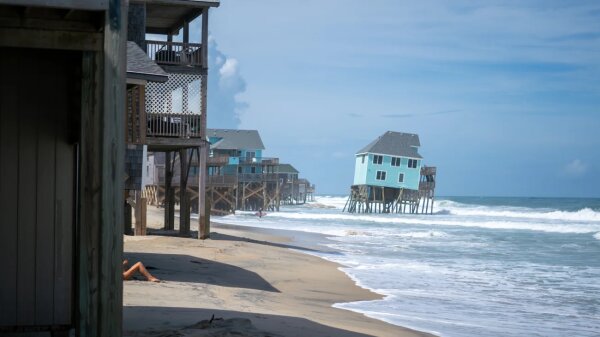
I first saw photos of a house that had fallen into the ocean in 2020. It was deep in the pandemic, and my work as a climate change reporter for NPR had collapsed in on itself. Instead of interviewing people in their homes and businesses, I was calling them on Zoom. My equipment for gathering the sounds of the environment sat unused. Unsure how to cover a global story from my bedroom, I scrolled the Internet in a way I never had (and hopefully never will again).
That was how I came across those first photos. They showed the remains of a collapsed house on a beach in Cape Hatteras, N.C. They were creepy. The home had fallen in the night, and debris was strewn across the sand, lit by flashlights.
Ryan Kellman/NPR
I’ve covered a lot of hurricanes, and the footage looked like hurricane damage. But there hadn’t been a storm. It wasn’t even hurricane season yet in the Atlantic.
I wasn’t sure what to make of it. Was this a one-off disaster for the owners of this one house? Or the kernel of a larger story about coastal homes and sea level rise? I saved a couple of local news stories about the collapse, and filed them away in my “stories I’ll probably never get around to” folder.
But I did get around to it, because that home collapse was not a one-off disaster. Since 2020, 32 homes in Dare County, N.C. have fallen into the ocean because of erosion exacerbated by sea level rise. Similar things are happening in half a dozen other states. And if the initial debris photos were creepy, the video footage of houses collapsing has been downright haunting.
I couldn’t look away, so I got to work. These homes were clearly threatened by the rising water. Why weren’t they removed, or at least cleaned out, before they fell?
The first step was talking to homeowners, which meant digging into property records, which is usually dull work. Not this time. Each record was a microcosm of the profound loss and economic weirdness that comes with climate-related disasters.
For example, the official photo accompanying one record showed a lone roof sitting on the sand. You can see that image here.
Another property record photo showed pilings jutting into the air, the house itself entirely washed away. Others showed sunny, intact beach houses, although in reality the homes were already gone.
Also in those records, I could watch people’s fortunes melting away. A house worth a million dollars one year was worth nothing the next. Even the land value disappeared in many cases — the lot itself listed as “washed out” in the record. Sometimes home values lagged behind the rising water. A house could be condemned, days away from collapse, and still be worth hundreds of thousands of dollars on paper.
Sifting through the records was like witnessing climate change, and all its destructive tensions, in real time.
As for why the homes were falling, my reporting led to an unexpected answer: a government program that incentivizes many owners to let their homes collapse. It also led to a solution that Congress has known about for decades.
Check out more great reads from the NPR network you may have missed:
➡️ As states that are concerned about the potential dangers AI chatpots pose to children push for regulation, some tech companies are stepping in to help write safety rules that exempt their key products. In the absence of federal laws governing AI systems and their developers, several states have introduced chatbot safety bills. Many of them received significant input from the tech industry and contain language that could provide loopholes for the companies with the most widely used chatbots on the market. Cynthia Montoya, who discovered her daughter had been introduced to sexual content by a chatbot before she died by suicide, calls these loopholes a "get-out-of-jail-free card" for the tech industry.
➡️ Millions of federal student loan borrowers are falling behind on their payments, and new federal data may explain why. Many of these borrowers attended private, for-profit colleges that depend heavily on federal financial aid for revenue. These colleges often target low-income students. As the federal government aims to boost repayment rates, it has introduced a new measure through the Republicans' One Big Beautiful Bill Act that would revoke a program's access to federal loans if its graduates earn less than those who never attended college.
➡️ Pediatricians are sounding the alarm about a troubling consequence of the Trump administration's federal immigration crackdown: undocumented and mixed-status families are avoiding necessary medical care due to fear. A new national survey by the American Academy of Pediatrics, conducted between April and June 2026, found that 40% of pediatricians notice families avoiding care. Some pediatricians also report that these families have been hesitant to apply for public health services like Medicaid, and many are not sending their children to school. Health officials warn that delaying care can lead to serious, long-term effects.
➡️ Discrimination remains one of the biggest obstacles to ending AIDS as a public health threat in Brazil, which has nearly 1.1 million people living with HIV — the highest number in Latin America. Although Brazil's public healthcare system offers free access to HIV medications that allow individuals to live normally, many still face stigma. Research from UNAIDS Brazil reveals that more than half of HIV positive individuals experience some form of discrimination, partly due to the public's lack of knowledge about the virus and the modern medications available for prevention and control. Despite the stigma, Brazil has been a major leader in innovations that could help end the HIV epidemic.
Newsletter continues after sponsor message
Support the stories you love and empower the journalism you depend on. In return, enjoy perks like sponsor-free listening, bonus episodes, early-access, and more.
You can listen in whatever podcast app you prefer, but the NPR app just added a new NPR+ tab to the home menu that makes it more convenient than ever before to explore all the shows with NPR+ benefits. So get the app and try it out!
Thanks for tuning in last week to the Throughlineepisode about a renewed interest in Luddites amid the rise of AI. The original Luddites were workers fighting to save their jobs from being replaced by machines. NPR listener Alossa Makar said people can use them to relearn “to investigate, ask questions" and "make decisions based on personal and community well-being, rather than swallowing whatever is thrown in our face at whatever peril.”
Today, we’re listening to an episode of It's Been a Minuteabout a new study revealing that at least 25% of NFL players who died between 2016 and 2021 had the brain condition CTE. The data raise important questions for football players, fans and doctors about whether the thrill of the game is worth the risks involved. This episode explores whether cultural perceptions of football create blind spots. Listen to the episode or read the transcript.
Love podcasts? For handpicked episode recommendations every week, check out Pod Club — a newsletter written FOR podcast fans BY podcast fans. Subscribe here!
And, on this week's episode of The Sunday Story from Up First, a new series by NPR and the BBC investigates one of the biggest missing-person cases of our time. It has been 14 years since American journalist Austin Tice disappeared in Syria, and there's still little known about what happened to him. The series hopes to change that.
Roadway anagrams
NPR
It's time for the Sunday Puzzle! For this week’s on-air challenge, NPR Puzzlemaster Will Shortz will provide anagrams for some common highway and street signs. For example, if you are given the clue “OPT + S,” the answer would be “STOP.” Test your skills here. Check the page later to hear the answers, or catch them live on Weekend Edition at 8:41 a.m. ET.
This week's online challenge also comes from Alan Hochbaum, of Duluth, Ga. There are two neighboring countries whose names have anagrams that rhyme with each other. What are the countries and their anagrams? Submit your answer here, and you could win a chance to play next Sunday's on-air puzzle.
Listen to your local NPR station.
Visit NPR.org to hear live radio from WAMU 88.5 (edit station).
You received this message because you're subscribed to Up First emails. This email was sent by National Public Radio, Inc., 1111 North Capitol Street NE, Washington, DC 20002