Every day, forecasters make predictions based on the same old tools: economic fundamentals, valuation models, polls and so on. And every day, many of those predictions miss—sometimes spectacularly. The point isn’t that traditional analysts aren’t well-educated; it’s that just MAYBE what they learned is wrong. When the same methods keep producing “misses,” “unexpecteds,” and “surprises,” it's fair to wonder whether there's a better way to understand markets, politics and social trends. Elliott Wave International has spent decades exploring exactly that possibility. |
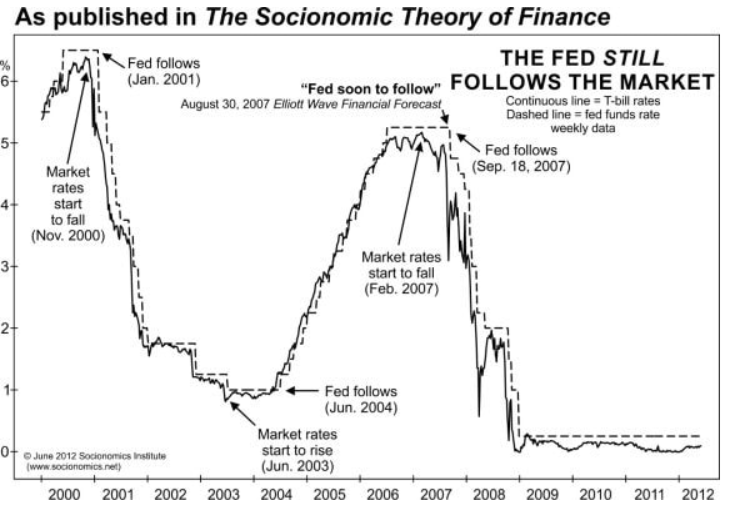
Hi Elliott Waver, Before every Fed meeting, investors and pundits wait in a state of high alert. Will the Fed raise rates? Cut them? Do nothing? They are wasting their time. The Fed doesn’t control interest rates; it’s the other way around. History shows that the T-bill market moves first – and the Fed follows. On August 30, 2007, we used this reliable relationship to forecast a dramatic rate cut. Three weeks later, the Fed fulfilled our prediction. And they kept doing so until T-bill rates bottomed. This chart shows how the Fed’s rate constantly lags the T-bill rate. |
This relationship has held true for decades. And not just in the U.S. – but in Europe, the U.K., and Australia, too. Chapter 3 of The Socionomic Theory of Finance tells the full story of markets’ global dominance of interest rate policy. Read it -- FREE -- for a limited time. Or, get on the right side of the markets ahead of time by subscribing right now. |
Sincerely,  Derek Bruce
Elliott Wave International
|