





|

 |
WITH JUST OVER SIX WEEKS TO GO until Election Day, things couldn’t be going better for the Democrats. Polls show voters favoring the party over Republicans—by increasingly substantial margins. Forecasters are convinced Democrats will retake the House and some even see them winning the Senate. Donald Trump seems to be spiraling in real time.
Yet amid all the optimism the party is feeling, there remains a nagging concern: Could it all get washed away by the Republican party’s sizable war chest?
It’s hard to quantify the money disparity that currently exists between the Republicans and Democrats, because it’s hard to know what actual money is out there. But evidence of a serious financial advantage is everywhere you look. The national GOP committees raised roughly $100 million more than their Democratic counterparts through the end of July. NPR recently reported that “Republican candidates and groups have pledged to spend more than $557 million to Democrats’ $343 million in the nine most competitive Senate races this fall.” And House Republicans announced this past week that they were entering the election’s final stretch with a $13 million cash advantage.
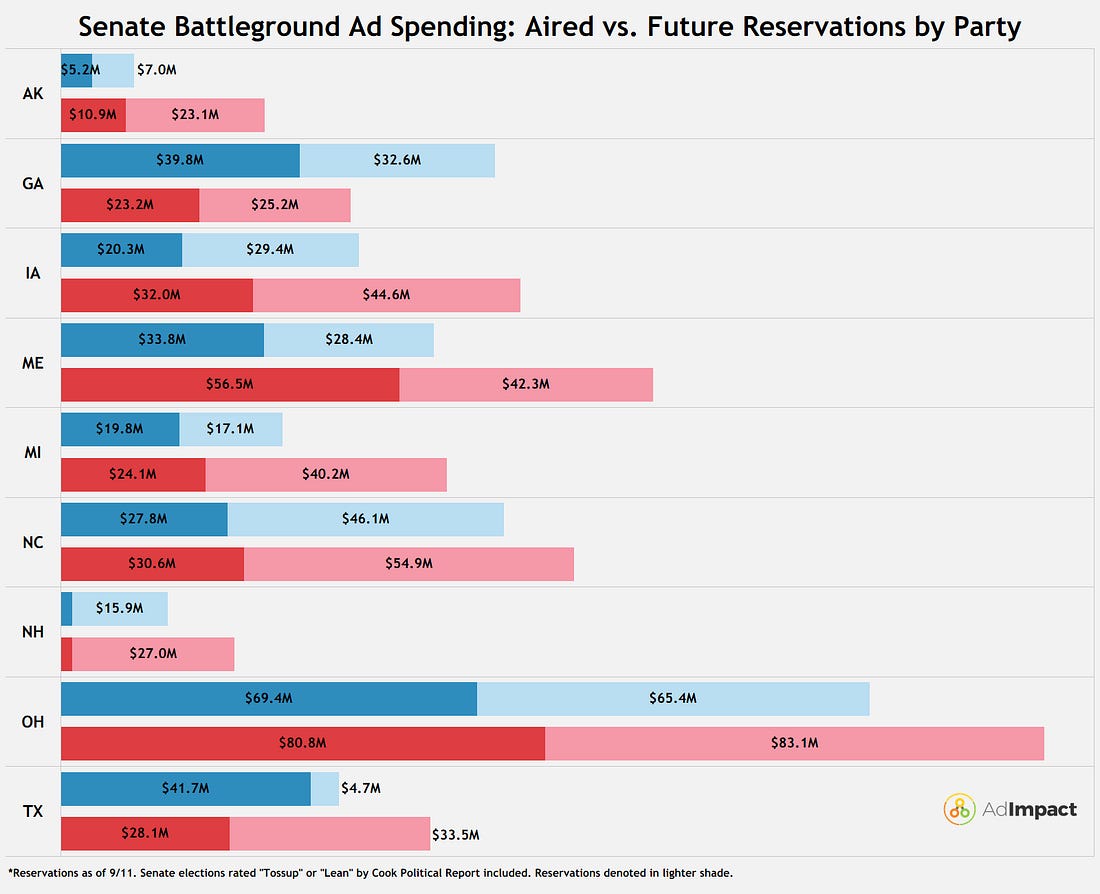
Last week, AdImpact, a media tracking service, released charts and data sets showing a post-Labor Day spending spree by Republicans, who had reserved millions of dollars more in TV ads than Democrats in battleground races.
 |
In Democratic campaign group chats I was shown, party staffers expressed concern, asking themselves: Just how much trouble is the party actually in?
I spent last week talking to top Democratic campaign officials and party strategists trying to get an answer to that question. What they told me was that they had moderate concern—certainly less than the public freakout taking place among Democrats online.
First, they argued that they’ve been preparing to have less money than Republicans since the start of the cycle and have strategized accordingly. Democratic super PACs reserved ad time back in the early spring, when ad buys were much cheaper than they are today. The ad industry evaluates TV ad buys using gross rating points (GRP), a metric of how much exposure an ad campaign will likely receive among a target audience. For example, it is very expensive to air ads during big sporting events because so many people are watching—more eyeballs means the cost per GRP skyrockets.
Both parties made strategic ad reservations during the spring in an effort to lock in cheaper rates. But the extra money flowing into GOP coffers now has missed the window for relatively cheaper GRPs. It will cost much more for the groups doing the booking now than it would have earlier in the year. And beyond that, Democratic officials noted that those same groups would have less programming inventory to choose from (there were only so many ads that could be aired during the Texas vs. Ohio State game last weekend).
According to internal party data that a Democratic campaign official shared with me, since May the cost per GRP in the Anchorage market has increased by 500 percent and by 1,250 percent in Fairbanks, which means Republicans dropping cash to halt Mary Peltola in Alaska, for example, will be paying over the odds. In Des Moines, Iowa—where competitive races for the Senate, House, and the governorship are jacking up ad prices—the cost per GRP has gone up by 98 percent. In Lansing, Michigan it’s increased by 138 percent; Greenville, North Carolina by 43 percent; and Columbus, Ohio by 73 percent. You get the picture.
As Addisu Demissie, a Democratic strategist who ran Cory Booker’s 2020 presidential campaign, explained it to me: “You cannot compare $10 million to $60 million and just say that means they’re doing six times more [ads].”
The other bright spot for Democrats is that while GOP super PACs have a big money advantage, Democratic candidates have been outraising their individual Republican opponents. That might seem like a distinction without a difference, but federal law requires broadcasters to offer candidates the lowest rates for TV ads—meaning that $100 in a candidate’s bank account is more valuable than $100 in super PAC money. Take a look, for example, at this Sunday’s game between the Washington Commanders and the Dallas Cowboys. According to the ad-buying firm Medium Buying, the cost for a single 30-second spot on a Houston Fox affiliate during the game is $35,000 for a candidate and $125,000 for non-candidates.
But the good news for Democrats stops there.
Democratic officials told me that while their money disadvantage is manageable right now, they fear it will get far worse in the closing few weeks of the election. A Republican super PAC may have to pay 3.5 times more for an ad during a football game, but it still has the money to pay for that ad, while their Democratic counterparts are triaging.
But the big concern for Dems is how the Supreme Court’s recent decision to lift limits on coordinated spending between candidates and political parties will play out as October nears. That ruling allows political parties to spend unlimited amounts in coordination with candidates, enabling those coordinated campaigns to buy TV ads at the lowest prices. While this has already started to happen in some races, Democratic operatives told me that they expect the Republican National Committee and other GOP campaign committees to largely sit on their war chests until October.¹
“That ruling was fifty times more scary to me than MAGA Inc. spending $50 million, or whatever it is, in Texas,” said Demissie. “And the beauty of [getting the lowest unit rate] is you don’t have time pressure. You can sneak up on people. . . . You don’t want to show your hand too soon.”