
|
 |


What does the Justice Department's top leadership do when the boss is demanding that it bring “voter fraud” cases—before the election even occurs and regardless of whether any actual crimes take place? After the 2020 election, the acting Attorney General refused to play ball with Trump when he told DOJ to announce it was opening investigations. But apparently, it’s different in 2026, and not in a good way.
There has been a lot of speculation about what the administration will turn to now that the Supreme Court has rejected its plan to use USPS to keep mail ballots out of the hands of Democratic voters. Carol Leonnig and Ken Dilanian of MSNOW reported on Friday that in a call with managers in offices across the country, “Aakash Singh, the top lieutenant to the deputy attorney general, warned that Department of Justice lawyers must pursue election fraud cases that FBI or Department of Homeland Security agents present to them, or risk termination, according to the people, who sought anonymity to avoid reprisals for sharing internal discussion.” Homeland Security Investigations (HSI) is the criminal investigative component of ICE.
This probably means at least two things. First, the administration will use word of this to try and intimidate people from voting out of fear of prosecution and make election officials and workers fear prosecution as well. Second, it suggests they will try to invalidate the results of key elections that they lose. As bad as the administration’s plan is, we are far better for knowing about it; we can prepare. And the only reason we know about it is because two reporters got the story.
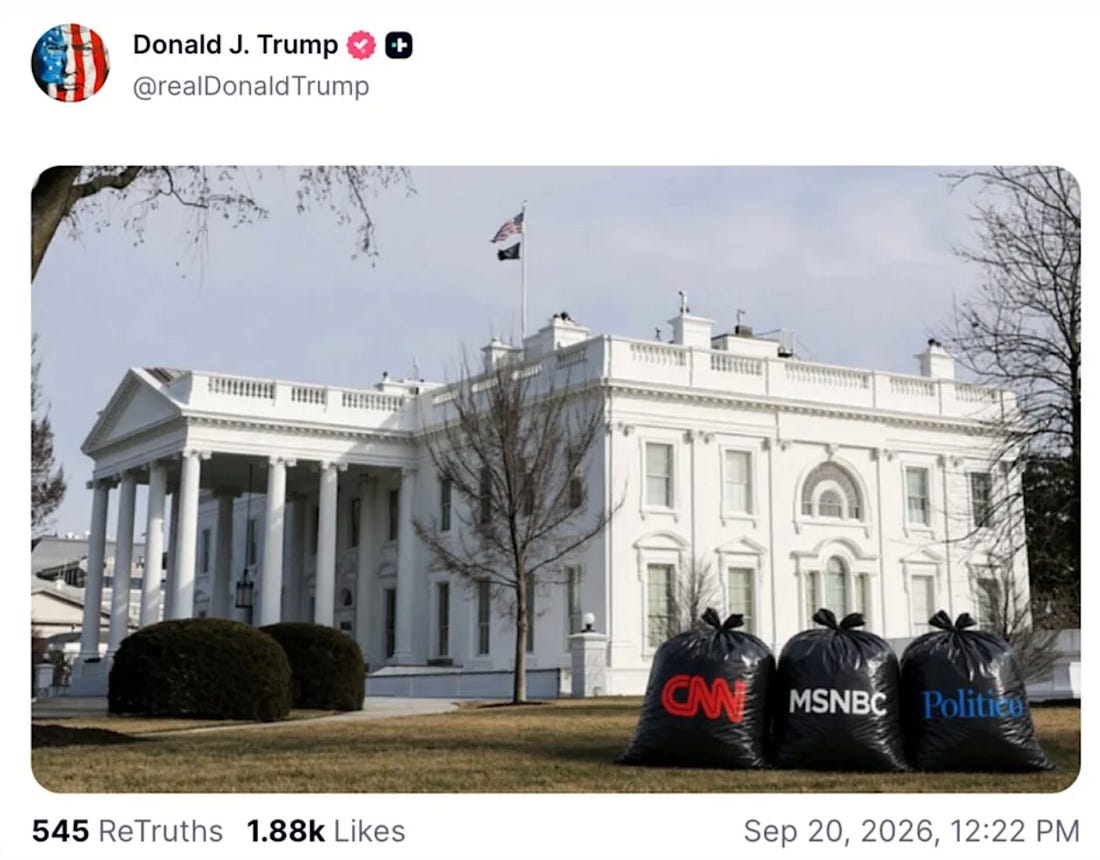
Last night we discussed Trump’s most recent attempt to damage the free press by banning MS NOW, CNN, and Politico from the White House grounds. This new reporting underscores just how important the free press is. It’s no wonder that Trump depicted the media organizations he’s illegally ejected from the White House as bags of trash on Truth Social today. He’s terrified of the press.
 |
So now, top DOJ officials are threatening prosecutors across the country that they will lose their jobs if they refuse to pursue meritless cases. “FBI and DHS may overrule a prosecutor who declines to pursue one of their investigations,” Leonnig and Dilanian write, “and that the office of the deputy attorney general would make the final decision on whether a case goes forward.”
But that’s not how prosecutions work. The Justice Manual, which contains the rules that guide prosecutors, provides that a case can be indicted only if prosecutors believe they have sufficient evidence to both obtain a conviction and sustain it on appeal. It would be unprecedented to have agents, knowing the Department’s political leadership will back them, decide what cases to prosecute. The overwhelming majority of agents are not lawyers and even when they are, they lack the experience prosecutors have in assessing charges and evidence and determining whether a case should be prosecuted. The process sketched out in the call would force prosecutors to take cases to the grand jury for indictment and then defend their merits before both the judge and the jury, whether they believed a crime had occurred and there was admissible evidence to prove it—or not.
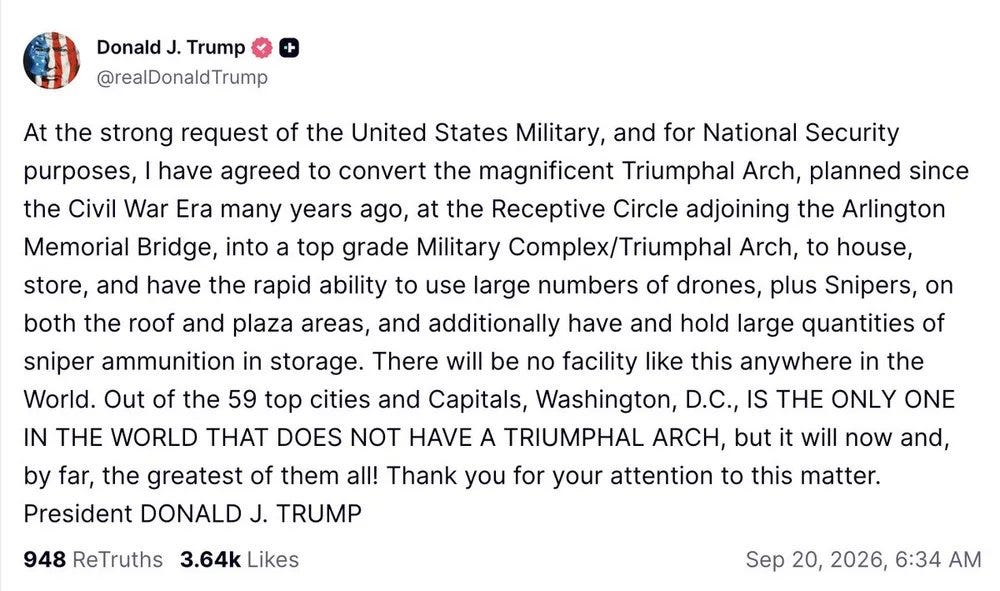
We’ll keep our eyes on this developing situation as we get into the week. But the crazy isn’t going to go away. On Sunday, Trump posted on Truth Social that “At the strong request of the United States Military, and for National Security purposes,” his “magnificent Triumphal Arch,” the one he wants to build overlooking Arlington Cemetery, will be a “top-grade Military Complex/Triumphal Arch.” He says it will house “large numbers of drones, plus snipers.” If Trump has learned anything from building his ballroom, it’s that if he claims it’s for the military and there’s a national security purpose, they let you do it. You can do anything. So he’s using the magic words again.
 |
Expect litigation. There will be the usual: ripeness issues, standing issues. But this time, Trump may not get away with the “national security” claim because it’s so patently false. He was captured on camera in the Oval Office telling a reporter that the arch is for “me.”
We may get a ruling sometime this week from U.S. District Judge Leonie Brinkema in the Eastern District of Virginia. She held a hearing in one of the cases regarding Trump’s slush fund late last week. This is a separate challenge from the one in Florida, where Judge Kathleen Williams entered an injunction that prevents the Trump plaintiffs from claiming any benefit of the faux settlement in Trump v. IRS. In this lawsuit, Democracy Forward asked the court to enjoin implementation of the fund and any payouts on behalf of its clients, Common Cause and others. We discussed the case back in June after the Judge held a hearing and blocked the fund.
What was most interesting about last week’s hearing was that Judge Brinkema didn’t accept the government’s representation that the slush fund is dead. Judge Brinkema said, “The issues that underlie this case are still alive and kicking, in my view,” adding, “They contradict themselves all the time.” Although she did not rule from the bench, that’s hardly good news for Trump. We will keep our eyes on the courthouse in Alexandria again this week.
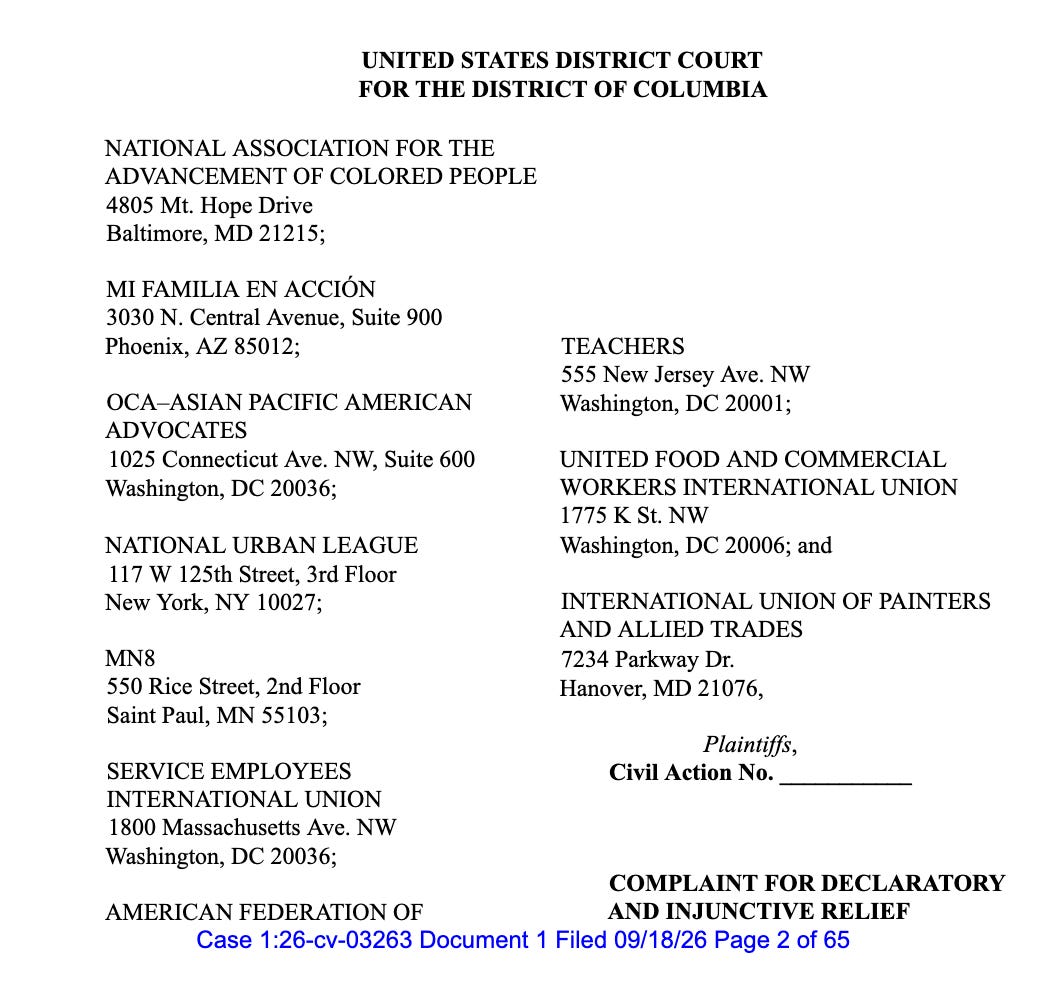
Last Friday, another lawsuit was filed challenging the administration’s ability to send armed agents to polling sites as part of its aggressive “immigration enforcement” work. Plaintiffs include the NAACP, other major civil rights groups, and labor unions. They are suing a laundry list of defendants including DHS, ICE, DOJ, FBI, the head of each agency, and Tom Homan, who is listed as the White House Executive Associate Director of Enforcement and Removal Operations.
 |
The lawsuit starts by explaining, “As the 2026 midterm elections begin, the federal government has claimed authority to station armed federal agents to unlawfully operate in the vicinity of voting locations … Federal law expressly prohibits sending armed federal agents to voting locations. Neither the Constitution nor federal law grants federal agencies any role in assessing or policing voter eligibility or regulating election administration in any way. Yet the Administration has repeatedly sought to interfere with election systems and announced its readiness to unlawfully deploy law enforcement to voting sites.”
The complaint accuses the administration of intimidating voters and others, which they allege violates Section 11(b) of the Voting Rights Act of 1965. That law provides that “No person, whether acting under color of law or otherwise, shall intimidate, threaten, or coerce, or attempt to intimidate, threaten, or coerce any person for voting or attempting to vote, or intimidate, threaten, or coerce, or attempt to intimidate, threaten, or coerce any person for urging or aiding any person to vote or attempt to vote, or intimidate, threaten, or coerce any person for exercising any powers or duties under” the statute. The plaintiffs allege that the “defendants’ conduct has an objectively intimidating effect on voters” and they are asking the court to “Enjoin Defendants, and anyone acting on behalf of Defendants or in concert with Defendants, from deploying agents in a manner that unlawfully intimidates voters or anyone urging or aiding voters.”
We add this case to our list of cases to watch this week.