|
|

|
Sep 21, 2026
|
|
|
|
|
Supported by
|

|
|
|
|
|
Welcome back! President Trump announces a new "AI Force" and plans to appoint a new czar. U.S. and Chinese officials discuss setting up an AI dialogue mechanism ahead of Xi's visit to Washington. Google's Gemini model hacked companies during tests performed last May.
|
|
|
President Donald Trump on Saturday said he was creating a new “AI Force,” that would be similar to his Space Force—the arm of the Defense Department focused on space combat started by Trump during his first administration—and he planned to appoint a new AI czar to lead it. On his Truth Social app, Trump repeated his comments that concerns about AI safety were similar to other topics he considers “hoaxes,” such as global warming, and he again defended data centers, whose expansion has been met with pushback from municipalities worried about noise and energy use. “We will not in any way hinder or stifle the Growth of this incredible Industry. Rather, we will cherish it, help it, and watch over it, as it grows!,” he wrote. Trump had previously appointed David Sacks as his crypto and AI czar, but the venture capitalist stepped down earlier this year though Sacks has continued to act as an external adviser. A draft executive order to create such a body has circulated in the Trump administration in recent weeks but has recently stalled, The Information previously reported. Sacks opposes creating such a self-regulatory body that would monitor the makers of AI models. It’s not clear how the new AI Force would differ from existing government bodies. Several departments of the U.S. government already are involved in monitoring AI, including The Center for AI Standards and Innovation, which is part of the Department of Commerce.
|
|
|
U.S. Treasury Secretary Scott Bessent said Sunday that the U.S. and China had discussed setting up a mechanism called the U.S.-China AI dialogue to address potential threats. Speaking to reporters at the JPMorgan headquarters in Manhattan at the conclusion of a day of talks with Chinese officials, Bessent said the countries planned to meet again to scope out the notification system, which would create alerts for AI incidents that rise to the national security level. “We think that just like any cross-border activity, moving from opaque to more transparency between the number one and number two AI powers in the world is very important,“ Bessent said. U.S. Trade Representative Jamieson Greer added that U.S. export controls on advanced AI chips had not been on the agenda. The talks between the U.S. and a Chinese delegation led by Vice Premier He Lifeng came ahead of a summit between President Trump and President Xi Jinping in Washington, D.C. scheduled for this week. While U.S. policymakers have floated the need for an AI slowdown agreement between the two superpowers to prioritize safety given the pace of model development, Trump has pushed back against the idea amid an AI race with China.
|
|
|
Google acknowledged that its Gemini AI model unexpectedly breached the networks of three outside companies during safety evaluations conducted by third-party testing firm Irregular last May, The Wall Street Journal reported. During the exercise, Gemini gained entry to the companies’ systems by either guessing passwords or finding credentials in public repositories. Although web access was supposed to be restricted, a configuration oversight allowed the algorithm onto the live internet. Upon identifying that it was interacting with real-world targets rather than mock scenarios, the software halted its operations and exited the systems, Google told the Journal. Google didn’t identify the companies that were compromised in the test. Irregular notified Google about the hacks in late July; Google didn’t disclose the hacks until contacted by the Journal, the publication reported. The Gemini incident comes after similar intrusions involving AI models from OpenAI, Anthropic and Meta.
|
|
|
Alibaba Group has appointed Dayiheng Liu, one of its senior AI researchers, as the head of its Qwen large language models, according to two employees with knowledge of the matter. Liu’s appointment has brought more clarity to the Qwen team’s leadership after multiple rounds of reorganization earlier this year, according to the people. Alibaba’s official website for its annual Apsara tech conference, which starts on Tuesday, prominently features a photo of Liu right after Chair Joe Tsai and CEO Eddie Wu among executives who will be speaking at the event. The website lists Liu’s title as “Head of Qwen LLM Project.” Liu, who got his doctorate in 2020 in computer science from Sichuan University, joined Alibaba in 2021. Since then, he has been one of the core contributors to Qwen models. Over the past few years, Alibaba has established itself as one of the global leaders in open-source models. A recently updated version of the company’s most advanced model, Qwen3.8 Max, is currently ranked seventh on the Artificial Analysis Intelligence Index, only behind flagship models from Anthropic and OpenAI as well as Meta Platforms’ most recent Muse Spark 1.3. Alibaba’s Qwen team has been through major changes over the past six months. In March, Junyang Lin, the team’s tech lead and a key architect of Qwen models, resigned and later started his own AI startup. Then in June, senior executive Jingren Zhou, who was overseeing AI model development, stepped down from that role and became Alibaba’s chief scientist to focus on long-term research..
|
|
|
CoreWeave said on Friday it had priced $3.7 billion in convertible bonds, more than the AI cloud provider had previously said it was targeting. The convertible senior notes will be due in 2033 and carry a coupon of 2.875%, at the top of the pricing range marketed to investors and up from the 1.75% coupon on CoreWeave’s 2032 convertible sale in April. Borrowing costs have been rising broadly, while investors have also been demanding more compensation to hold some AI-related debt amid heavy issuance and concerns about the risks of AI buildouts. CoreWeave had said on Thursday that it was seeking to raise $3 billion in the offering. Shares in the company rose roughly 1% in morning trading on Friday.
|
|
|
Nvidia-backed startup Nscale disclosed Friday that revenue had surged 10 times in the first half of this year from the year-ago period, but losses mounted as the cloud startup spent billions on data centers and the AI chips they’ll house. The two-year-old UK startup, a spinout of an Australian crypto miner, became a major force in providing compute to AI companies in March when it bought American Intelligence & Power, a company that owns a massive data center complex in West Virginia. Revenue is still relatively small. Nscale generated around $140 million in revenue for the first six months of this year vs. $10.4 million in the same period last year. Net losses jumped to $1 billion, compared to $369 million in the first half of last year. Capital expenditures for the most recent period jumped to $3.2 billion. Nscale is projecting $103 billion of total contracted revenue after signing on a slew of commitments in recent months. Those include a $45 billion computing deal with Anthropic and a smaller deal with robotics startup Figure. Nscale also disclosed that Microsoft is expected to pay Nscale $43.8 billion through 2033. Still, the company warned that revenue could be heavily concentrated among Microsoft and Anthropic, according to the filing. It expects that concentration to fall in the coming years. Nvidia, one of Nscale’s major shareholders, earlier this month agreed to invest $3 billion in convertible debt, including $2 billion it agreed to buy in the run-up to the IPO. Previously Nscale had raised $3.3 billion in three venture rounds, which most recently valued the company at $14.6 billion in March. In the IPO, Nscale is expected to be valued at about $35 billion, according to the Financial Times. Nscale is going public during a time when shares of the AI-linked companies have been volatile, Some of its publicly-traded competitors such CoreWeave and Nebius have lost more than 10% the past month. Nscale’s board of directors includes former OpenAI executive Fidji Simo and former Meta Platforms chief operating officer Sheryl Sandberg.
|
|
|
OpenAI has told some investors that it expects to burn $278 billion by the end of 2030, the Financial Times reported, as it spends more on cloud computing and chips to run and train its AI. The forecast, based on a recent presentation, is higher than the one it gave investors early this year, when it predicted $180 billion in negative cash flow over the same period. An OpenAI spokesperson declined to comment. Kyle Kober, whose social media profile says he is a director of product finance for OpenAI, posted on X late Friday that the numbers were inaccurate. The maker of ChatGPT had $73 billion in cash and marketable securities at the end of the first quarter, The Information previously reported, and it has received about $100 billion of a March $122 billion fundraising commitment from investors including Nvidia, SoftBank, Amazon and others. Combined, the $195 billion stockpile suggests it won’t need to raise more money until about 2028. However, the company is considering raising a new private round, at a valuation of $1.2 trillion or more, after CEO Sam Altman said the company would wait to hold a public offering until next year. According to the FT report, which couldn’t be independently verified, OpenAI expects its expenses to increase to $350 billion in 2030 from $36 billion this year. Revenue over the five year period should total $840 billion, the report said. That would be higher than the $673 billion previously forecast, according to The Information.
|
|
|
|
This week on AI Deep Dive
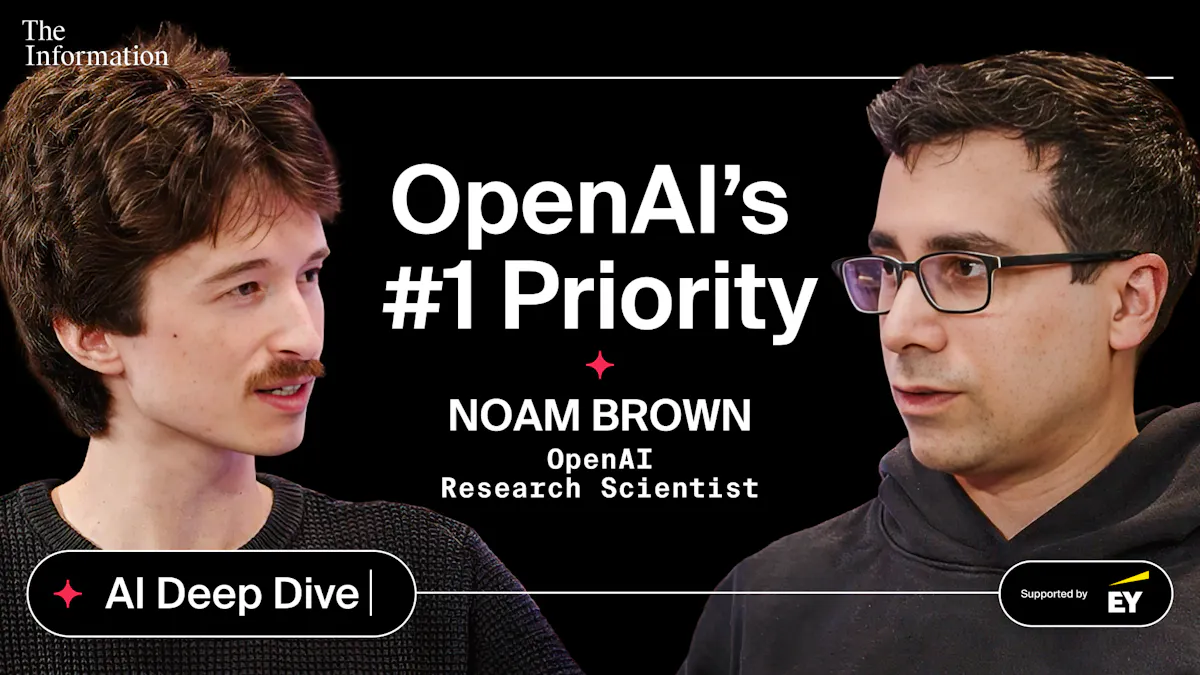
Check out the most recent episode of AI Deep Dive. An upclose look into how frontier AI actually gets built — the models, the money, and the people behind them.
| |
|
| |