

Things are pretty stupid out there, but don’t you ever think they can’t get stupider still. Take the massive Triumphal Arch that our Napoleon-idolizing president wants to build at the entrance to Arlington National Cemetery. The arch, Trump announced yesterday, is a simple arch no longer: He now intends to make it “a top grade Military Complex/Triumphal arch, to house, store, and have the rapid ability to use large numbers of drones, plus Snipers, on both the roof and plaza areas, and additionally have and hold large quantities of sniper ammunition in storage.”
Trump’s thinking here, as with his East Wing ballroom, is that the courts will be more deferential in letting him build his arch if he can claim it’s needed for a national security reason. We don’t know whether the appropriate response is to laugh or cry—depends on whether the courts swallow it, we suppose.
Bill, Ben, and Sam are off for Yom Kippur today—we wish an easy fast and a meaningful holiday to all who observe. Happy Monday.
|

Join Will Sommer and Sonny Bunch for MAGA Mondays at 10 a.m. EDT on Substack and YouTube.
 |
Nobody Wants ‘Supreme Intelligence’
by Andrew Egger
I’m going to keep banging this drum: It isn’t the most important issue in politics yet, but when it comes to AI, Donald Trump is handing Democrats an absolutely massive opportunity.
On Friday, I reported on a new poll suggesting Americans already realize that Trump is way out of step with their priorities on AI development. By a margin of 76 percent to 12 percent, the Tavern Research poll found, Americans want to see the country prioritize AI safety over rapid AI innovation. Trump, by contrast, is increasingly dug in on the opposite approach—insisting that a “STRONG AND SMART” president is the only “guardrails” AI safety requires while haranguing anyone who thinks development is going too fast as a coward or a commie.
This major disconnect is already coming through loud and clear to voters, and they don’t like what they see: Only 19 percent of those polled by Tavern Research said they approve of Trump’s approach to AI, with 52 percent disapproving.
That’s a terrible spread on the issue—and yet I don’t think Trump has even bottomed out. In fact, the full contours of Trump’s uniquely insane approach to AI are only just coming into focus.
For a year now, Trump’s basic AI outlook has been simple, reflective of both his usual zero-sum mentality and the hawks who have his ear: We have to develop AI as fast as we can, both because it’ll be—he hopes—a money-printing machine and because if we slow down we risk losing to China. At the policy level, this boosterism mostly meant squelching attempts to regulate AI at the federal and state level and cheerleading for the data center buildout across the country.
Until recently, the potential fissure between Trump and voters has mostly stayed in the realm of the boring policy paper. Opposition to data centers is real, but it’s also a decentralized infrastructure issue—not the sort of thing that seems likely to drive national political realignment.
Only in the last few weeks has the national AI conversation begun catching up to the existential questions that have been rattling the AI-development field for years: What will happen if AI companies do develop superintelligent AI systems? What should our regulatory approach to that possible future be? Will AI kill us all?
Most Americans look at that possible future with loathing and foreboding. Donald Trump, by contrast, seems almost comically excited about it.
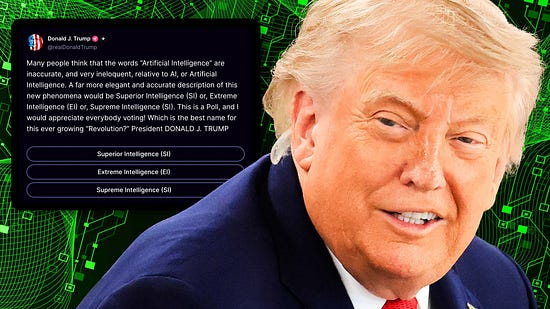
“Many people think that the words ‘Artificial Intelligence’ are inaccurate, and very ineloquent, relative to AI, or Artificial Intelligence,” the president mused on Truth Social on Saturday. “A far more elegant and accurate description of this new phenomena [sic] would be Superior Intelligence (SI) or, Extreme Intelligence (EI) or, Supreme Intelligence (SI).”
It’s hard to imagine how the public could be made to like AI even less. But the president openly cheerleading our speedrun to a future where we are governed by “SUPREME INTELLIGENCE” could probably do it. It certainly puts Trump’s call last month to “let Data Reign” in a new and more sinister light.
There’s a coherent, if insane, worldview on display here. Trump’s economic instinct is always the same: Let business leaders do whatever they want, so long as they’re willing to bend the knee personally to me. Apparently, his hubris extends far enough to include superintelligent AI agents. In much the same way that he truly believes Russia wouldn’t have invaded Ukraine if he were president, Trump genuinely seems to think a misaligned AI won’t dare to act up as long as he’s around.
As with so many other issues, Trump is hurt here by his total abandonment of actual populist voices in his ear during his return trip to the presidency. Once upon a time, the Tucker Carlsons and Steve Bannons of the world would have been a persistent whine in Trump’s ear suggesting that he meet the people where they are on charged issues like this. Instead, Trump has seemingly been totally captured by tech industry voices—so much so that he thinks he can persuade the American people that they’re just not looking on the bright side of the Great Robot Replacement.
But the Great Robot Replacement isn’t actually something anybody wants. If the last few weeks are any indication, anxieties around superintelligent AI are only going to continue to grow. Democrats should push the issue as hard as they can.
A MESSAGE FROM OUR SPONSORFinally, a memorial to Trump…
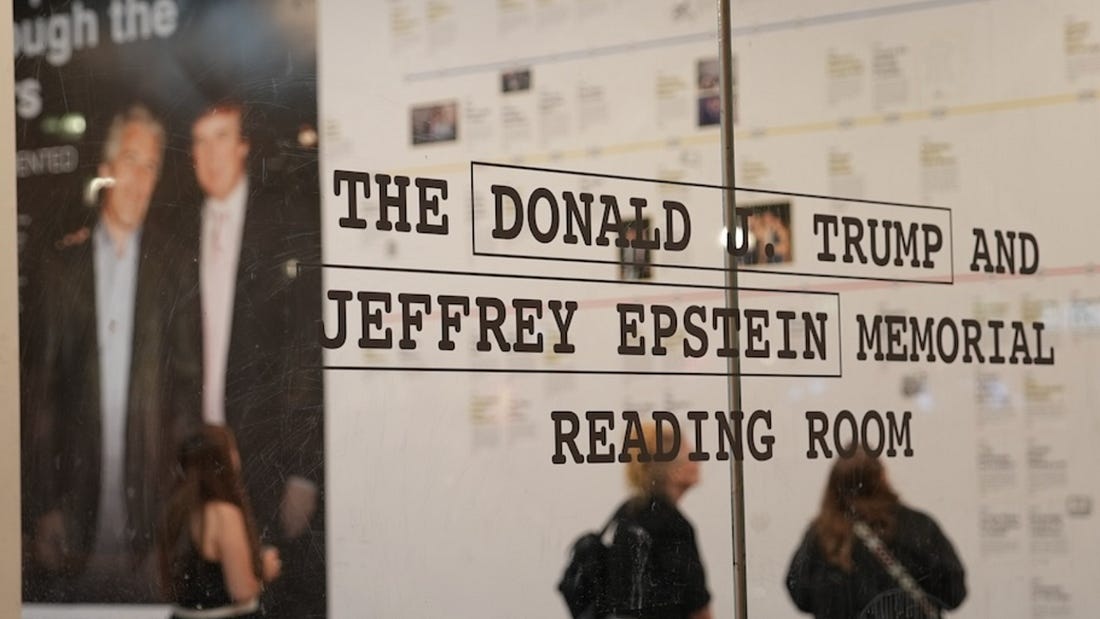
The Donald J. Trump & Jeffrey Epstein Memorial Reading Room: a free, traveling museum presenting all 3.5 million pages of the released Epstein files. We need your support to help more people witness the scale of Epstein’s crimes |