| | US President Donald Trump defends his war with Iran at UNGA, US Treasury Secretary Scott Bessent lea͏ ͏ ͏ ͏ ͏ ͏ |
| |  New York City New York City | Quito |  Taipei Taipei |
 | Flagship |  |
| |
|
The World Today | 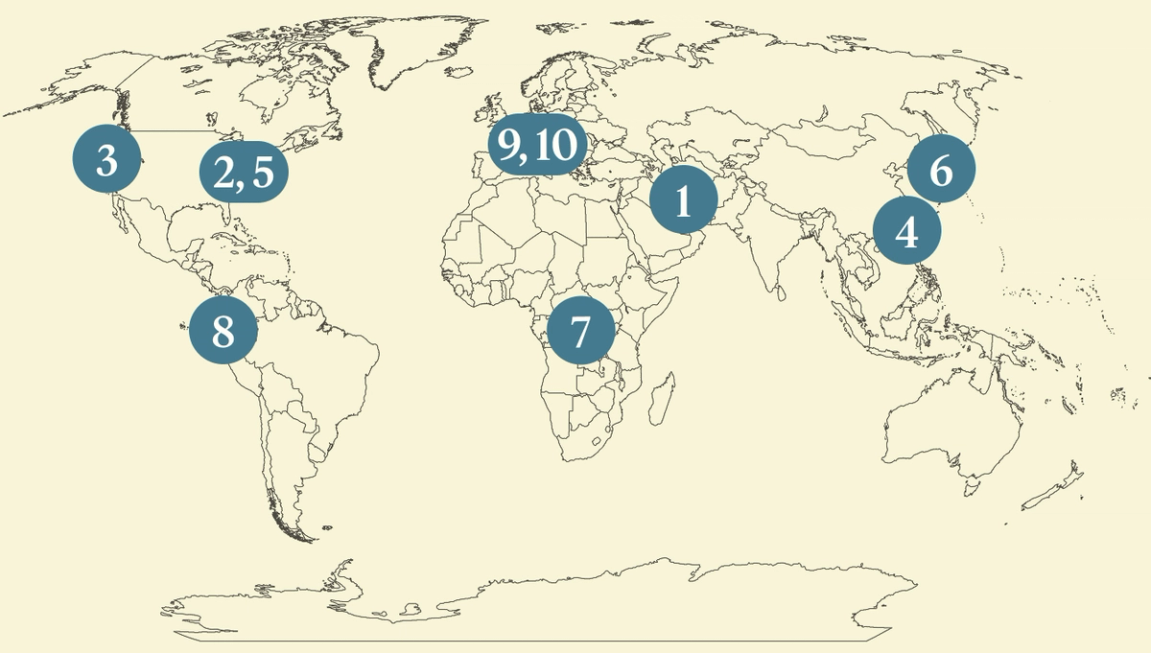 - ‘Productive’ US-Iran talks
- Trump addresses UNGA
- Bessent eyed as AI czar
- Xi sees Taiwan chance
- IMF head’s warning
- AI trade gets lumpy
- Africa’s vaccine push
- Anti-cartel campaigns
- El Niño helps Europe
- Organic farming debate
 A ‘highly underrated’ album from jazz legend John Coltrane. |
|
Trump hails ‘productive’ Iran talks |
 Mohammed Aty/Reuters Mohammed Aty/ReutersPresident Donald Trump hailed “productive” talks between US and Iranian officials on the sidelines of the UN General Assembly Tuesday, hours after he threatened to “annihilate” Iran unless it agreed to end the war. Oil prices fell as Trump said talks would continue, after earlier suggesting that a deal could arrive after the US’ November midterm elections. In the meantime, the war has escalated at a mounting cost to Washington — which has spent at least $43.6 billion and expended difficult-to-replace munitions — and its allies: Saudi Arabia’s Crown Prince Mohammed bin Salman “will not forget” Trump’s reluctance to intervene against the Houthis, a former US military intelligence officer told the Financial Times. |
|
Defiant UN speech belies Trump’s woes |
 Brendan Smialowski/Pool via Reuters Brendan Smialowski/Pool via ReutersDonald Trump took credit for ending wars and confronting Iran in a defiant speech before world leaders at the UN General Assembly Tuesday, even as the US president faces mounting obstacles to his agenda at home and abroad. Trump’s approval rating fell to a record low, according to a new poll, dragged down by stubborn inflation and surging fuel prices stemming from his war with Iran that is increasingly unpopular with voters and members of his own party; one Republican lawmaker pleaded with Trump to “stop the bleeding” by banning diesel exports before the midterms. Trump’s efforts to broker peace in Ukraine have also faltered, though its leader on Tuesday expressed hope that Washington would help end the conflict “before winter.” |
|
US will ‘only encourage’ AI growth |
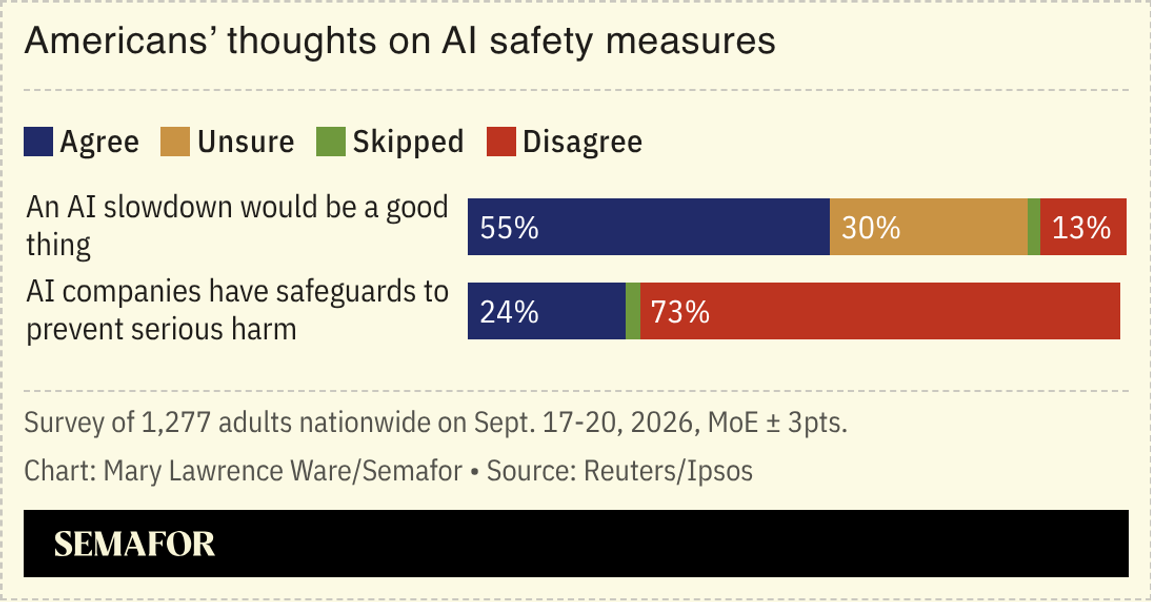 President Donald Trump said Tuesday that the US would “only encourage” AI growth but “rein things in” if needed, as he continued to downplay AI’s risks despite growing calls for a slowdown from tech leaders. Trump has cast doubt on the need for regulatory guardrails, arguing safety is companies’ responsibility, even as Americans grow skeptical that firms are doing enough to prevent AI-related disasters. An OpenAI executive told Semafor Tuesday that the company hopes governments pay attention to “the gravity of the moment” as AI safety discussions look set to dominate UN dialogues this week. US Treasury Secretary Scott Bessent, who said this week that labs shouldn’t expect a government “liability shield,” is currently the leading candidate to become Trump’s “AI czar”, Semafor reported. |
|
Xi to press Trump on Taiwan arms sale |
 Ann Wang/Reuters Ann Wang/ReutersChinese leader Xi Jinping is expected to press President Donald Trump to halt US arms sales to Taiwan in talks this week, Reuters reported, fueling Taipei’s concerns over a frozen $14 billion deal that Trump has described as “a very good negotiating chip.” Taiwan has encouraged firms to invest in the US with the view that “building structural interdependence [assures] our national security,” a Taiwanese expert said. But Trump’s past criticism of the island “betrays a clear preference” to minimize Taiwan in favor of other US-China priorities, a former Obama adviser argued. In Trump’s “unpredictability on US commitments,” Beijing sees a “rare window of opportunity” to exert more influence on the island, a Taiwanese government minister told The Wall Street Journal. |
|
| | Semafor Next 3 Billion • Exclusive |  | |
‘Winter is coming,’ IMF chief warns |
 Screenshot/Semafor/YouTube Screenshot/Semafor/YouTubeThe energy shock from the Iran war will get worse before it gets better, the head of the International Monetary Fund warned Tuesday. “Winter is coming,” Kristalina Georgieva said at Semafor’s The Next 3 Billion event in New York, warning that prices will keep climbing. The Iran war has elevated inflation globally, leading central banks, including the US Federal Reserve, to raise interest rates, creating a dilemma for governments: Higher interest rates will make borrowing costs more painful for countries already encumbered by record-high debt levels, limiting, in turn, how much policymakers can spend to cushion the economic fallout. “We should prepare for people being more unhappy, more in many places, maybe on the street,” Georgieva said. |
|
Delayed IPOs prompt AI trade fears |
 Manami Yamada/Reuters Manami Yamada/ReutersTwo companies in the AI ecosystem have delayed their IPOs, suggesting that investor appetite away from frontier labs and chipmakers appears to be shaky. SoftBank’s energy business and nuclear company Holtec delayed their listings after investors balked, The New York Times reported, while SoftBank’s junk-bond offering, which will fund its investment in OpenAI, appears to have healthy demand. “Look at this pipeline: SpaceX, Anthropic, OpenAI… these monster companies” heading toward IPOs will “crowd out” smaller offerings, investor Orlando Bravo told Semafor — ominously, for the private-equity firms holding $3.8 trillion in unsold companies. Meanwhile, Chinese regulators are holding back approvals for humanoid IPOs over skepticism toward soaring valuations and commercial demand for “embodied AI.” |
|
| | Semafor Next 3 Billion • Exclusive | | |
Africa CDC head calls for local vaccines |
 Screenshot/Semafor/YouTube Screenshot/Semafor/YouTube“It’s time for us to manufacture our own vaccines,” Africa’s CDC director told Semafor on Tuesday, as the Ebola outbreak in DR Congo — one of the worst ever — cuts a swath across central Africa’s economies. A vaccine hasn’t been developed over the 19 years since the Bundibugyo strain was discovered; if the outbreak had occurred in the West “the vaccine would already be available,” Jean Kaseya said. There are “200 rare diseases, mainly in Africa,” that have never gotten the “attention they need,” International Rescue Committee President David Miliband told Semafor, adding that technology can help bridge that gap: The IRC is using AI to diagnose Mpox in DR Congo from photographs of lesions with 98% accuracy. |
|
Latin America militarizes cartel fight |
 Mayela Lopez/Reuters Mayela Lopez/ReutersLatin American nations, under pressure from the Trump administration, are increasingly adopting militaristic tactics advocated by Washington as they take the fight to the region’s powerful cartels. The US has helped Ecuador bomb suspected drug smugglers and discussed building a military base in Colombia in recent months, while Costa Rica’s president has proposed deploying American troops on the ground to tame crime rates. Though local police forces may be incapable of fighting the cartels in the short term, Mexico provides a worrying example of the long term risks of using the military for police work: The country’s murder rate more than tripled after Mexico City deployed its armed forces to fight organized crime in 2006. |
|
|


