By Ivana Saric
Digital Editor, Council on Foreign Relations |
This week, world leaders came to New York City for the United Nations General Assembly (UNGA), Chinese President Xi Jinping got a red carpet welcome in Washington, and CFR opened its doors to government officials and thought leaders for conversations about the pressing issues of the day. The Daily Brief has been bringing you the latest UNGA-infused news and CFR analysis all week, and we still couldn’t fit it all in. Here’s a roundup of CFR long reads and videos to take you into the weekend: -
CFR President Michael Froman discussed his takeaways from both of the week’s major diplomatic events in a new column. “While little happening might not have been the best possible outcome of this week’s summits, it certainly wasn’t the worst,” he wrote.
-
Esther Brimmer dug into the significance of what President Donald Trump didn’t say in his UNGA address in this expert take—most notably that he did not threaten to withdraw from the body, despite withdrawing from several agencies. She also laid out a framework for how the United States can work with the UN system.
-
In this YouTube Short, Jessica Brandt broke down Trump’s attempt at UNGA to rebrand artificial intelligence (AI) as “superintelligence.” The effort, she said, was likely more a matter of “message management” for a domestic audience than policy.
-
As the Trump-Xi summit wrapped today, Chris McGuire examined the conditions needed to reach a U.S.-China AI arms control agreement in this expert take.
-
“America needs a much deeper supply of China experts to handle a fast-changing relationship,” Rush Doshi and the U.S.-China Education Trust’s Rosie Levine wrote this week. They make the case that the Trump-Xi summit provides an opportunity to restore education programs.
-
When Mia Mottley, prime minister of Barbados, stopped by CFR’s New York office for a panel event, she was asked why she wasn’t running to be the first woman UN secretary-general. Her answer was simple: “I have a country to run and a region to take care of.” Watch the full exchange in this YouTube Short.
-
CFR’s Associate Video Producer Antonio Antonelli has been filming behind-the-scenes TikToks this week as CFR hosted a slate of events. Check out this one about the logistical preparations—from catering to welcoming guests—that go into the Council’s biggest week of the year.
-
Looking for a weekend podcast? In the latest episode of The President’s Inbox, CFR’s James Lindsay sat down with Julian Gewirtz, a senior research scholar at Columbia University, and Bonny Lin, from the Center for Strategic and International Studies, to discuss what Xi’s first trip to Washington in more than a decade could deliver.
The Daily Brief team hopes readers have enjoyed all the UNGA coverage this week. Scroll on for the latest dispatches from CFR events and today’s top headlines from around the world. We’ll be back Monday.
|
|
|
|
World leaders and thinkers have been speaking at CFR during UNGA week. Senior Editor Diana Roy is on hand to bring their insights to the Daily Brief. -
Hungarian Foreign Minister Anita Orbán Describes Reform Efforts, Regional Ties: There is “a big desire for rapid change” in Hungary after former Prime Minister Viktor Orbán’s party was defeated in April 2026 elections, said Orbán, who is not related to the former prime minister. She noted that one of the biggest challenges facing Prime Minister Péter Magyar’s new government is how to “kickstart the economy” and “recreate” checks and balances following years of corruption. When it comes to regional relations, Hungary’s “most important alliance is NATO,” she said. However, the government is also pursuing a “pragmatic relationship” with Russia focused on interests such as energy needs and is “absolutely interested” in bilateral and regional cooperation with Ukraine, Orbán added. She also highlighted the neighboring Western Balkans, saying Hungary supports the region’s integration into the European Union.
Watch the full conversation with Foreign Minister Anita Orbán. -
Mexican Foreign Secretary Roberto Velasco Outlines Investment Priorities, Regional Relations: Mexico is seeing a “strong recovery” in private, national, and foreign investment, said Velasco, emphasizing the government’s efforts to create “longer-term certainty” for investors. At the same time, Mexico wants to be “less dependent on imports from other regions,” he said, while strengthening supply chains domestically. On the security front, Mexico has seen “a dramatic decrease in violent crimes” over the last two years, Velasco said, adding that the country has exchanged intelligence with the United States. As for the rest of the Western Hemisphere, Mexico has an “excellent” relationship with Canada, and is trying to “keep a positive dialogue” when it comes to cooperating with Latin American countries that “don’t think like us,” he said.
Watch the full conversation with Foreign Secretary Roberto Velasco. |
|
|
|
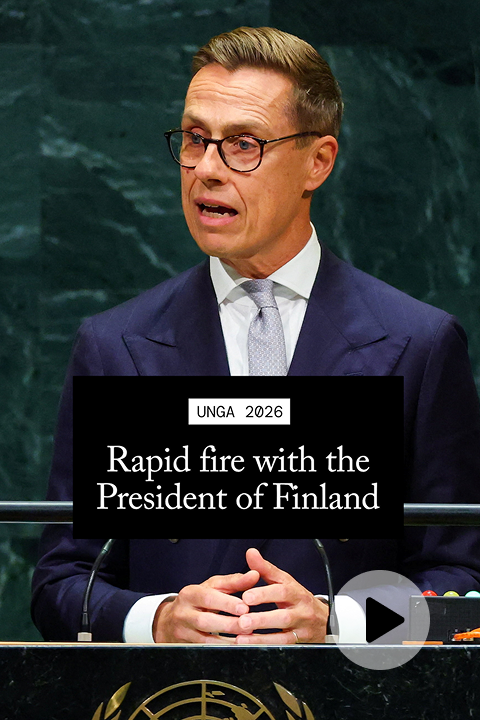
When Finnish President Alexander Stubb stopped by the Council’s New York office for an event earlier this week, CFR’s Associate Video Producer Justin Schuster caught up with him for a rapid-fire YouTube Short.
They discussed maintaining the transatlantic relationship, whether artificial intelligence (AI) risks could revive multilateralism, and expanding the UN Security Council. As for how can Europe keep cool in the face of rising Russian hybrid attacks? Stubb emphasized the need to stay alert to the different forms these attacks can take—drones, undersea cable cuts, cyber attacks, or online disinformation. In true Scandinavian fashion, he added: “I also recommend people take a sauna and a cold bath.”
|
|
| |
|
Every day, the Daily Brief brings you a curated list of the top stories from around the world. |
-
UN: Sudanese Migrants Surge Into Chad. The UN refugee agency said today that a twenty-fold increase in daily crossings this week is outpacing resources after aid cuts.
-
Center-Right Party Leads in Morocco Elections. Early results from the country’s legislative elections suggest that the party closest to the monarchy has pulled ahead, as the government grapples with fallout from the Ceuta migrant crisis and 2025 antigovernment demonstrations. Youth turnout was notably low.
|
-
Costa Rica Dismisses Minister Over Unauthorized Trump Meeting. President Laura Fernández fired her foreign minister for attending Trump’s “Shield of the Americas” meeting this week without notification, barring her from attending.
-
Carney Said He Prepared for ‘Extreme Tail Risk’ U.S. Military Action. In an interview with the New York Times, Canadian Prime Minister Mark Carney said he had considered the remote possibility of a military invasion by the United States, but did not offer more details.
|
-
India Uses Tear Gas and Water Cannons to Disperse Protesters. The country’s opposition movement staged nationwide protests today, spurred by a report about the chief election commissioner’s handling of voter rolls. The protesters are demanding his resignation.
-
Reuters: Vietnam and North Korea Hold Talks, Pledge Deeper Cooperation. The deputy defense ministers of both countries met in Hanoi and agreed to strengthen defense ties, the news agency reported.
|
-
Pope Leo Issues New AI Warning. During a trip to France, Pope Leo issued a warning that advancing technologies like AI threaten to create a “paradise of machines” that undermine people’s humanity. The pope’s remarks echo the message he issued in an encyclical on the dangers of AI earlier this year.
-
AP: Zelenskyy Says He Asked Trump to Encourage China’s Help in Russia-Ukraine War. Ukrainian President Volodymyr Zelenskyy said today that he sought Trump’s help in getting Xi to pressure Moscow to end the war. He is still waiting to hear from the White House about the results of Trump’s bilateral talks with Xi, Zelenskyy added.
|
-
Iran Proposes Plan to Reopen Strait of Hormuz. Iranian Foreign Minister Abbas Araghchi told reporters yesterday that Tehran’s proposal called for ceasing hostilities with the United States within seven days. If the United States met its conditions, including lifting its naval blockade and waiving sanctions, Iran would reopen the Strait of Hormuz and recommence nuclear talks.
- France to Send Soldiers to Protect Saudi Arabia Port. French President Emmanuel Macron announced yesterday that French forces and other military assets would be deployed to Saudi Arabia to protect energy infrastructure along the Red Sea.
|
|
|
|
Host: Ivana Saric
Editor: Xian Chiang Waren
Email Operations: Eric Rojas
Editorial Director, News: Phil McCausland
Editor-at-Large: Robert McMahon
Chief Digital Content Officer: Millie Tran |
|
|
|
58 East 68th Street, New York, NY 10065 |
1777 F Street, NW, Washington, DC 20006 |
|
|
|
|