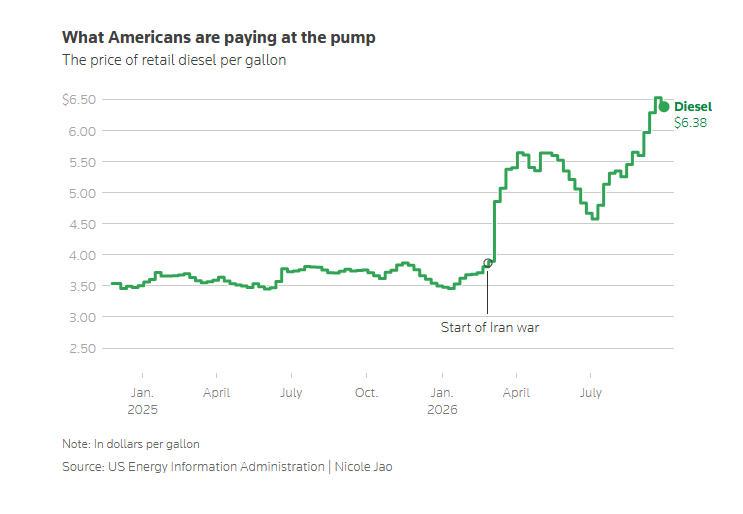
There are many reasons why investors are selling bonds but inflation concerns related to higher energy costs is definitely one of them. At the heart of all this is diesel. It rarely grabs the headlines like crude oil or gasoline but it is crucial for the global economy – powering agriculture and transport – and it hit a record high of $6.53 a gallon in the United States last week. That is bad news for President Trump ahead of the midterms.
Oil is flowing again from the Persian Gulf. Goldman Sachs estimates Gulf oil exports, including "dark exports" involving ships operating with their location transponders turned off, have recovered to 23.3 million barrels per day over the last week, in line with their 2025 average.
But the issue for diesel is that refining capacity has been knocked out both in the Middle East and in Russia. Ironically, the US has been a major beneficiary, stepping in to fill the gap. But that means US diesel inventories are low.
Trump last week urged Chinese President Xi Jinping to help stabilise global supplies of diesel, given that China has the world’s largest refining capacity. So far, no dice. In fact, Chinese refiners have suspended October fuel exports until further notice, sending Brent futures back over $100 a barrel. Russia, meanwhile, has extended its ban on diesel exports for fuel producers until the end of this month, adding further strain.
So Trump is turning up pressure on Europe. Reuters is reporting that the US has told Germany and France to draw down emergency diesel inventories or face a potential US diesel export ban. Trump has talked about a diesel ban before but it could backfire for him. It might initially lead to a drop in prices but fundamentally, it risks discouraging US oil refineries from making diesel, which could cause the fuel’s price to rise again. It could even hurt the supply of other fuels, like gasoline, because they are all refined from the same barrel of crude.
An export ban would also pile pressure on import-dependent economies. Mexico, Chile and Brazil are the biggest buyers of US diesel and together take more than a quarter of exports. Europe accounts for roughly another quarter and is particularly exposed because many of its cars are powered by diesel. As my colleague Ron Bousso writes, it’s a diesel dilemma.
As always, I'd love to hear from you by hitting reply on this email or finding me on LinkedIn.