| | US tech stocks power the Nasdaq to a record close, Brazilian stocks surge as investors bet on a Fláv͏ ͏ ͏ ͏ ͏ ͏ |
| |  | Flagship |  |
| |
|
The World Today | 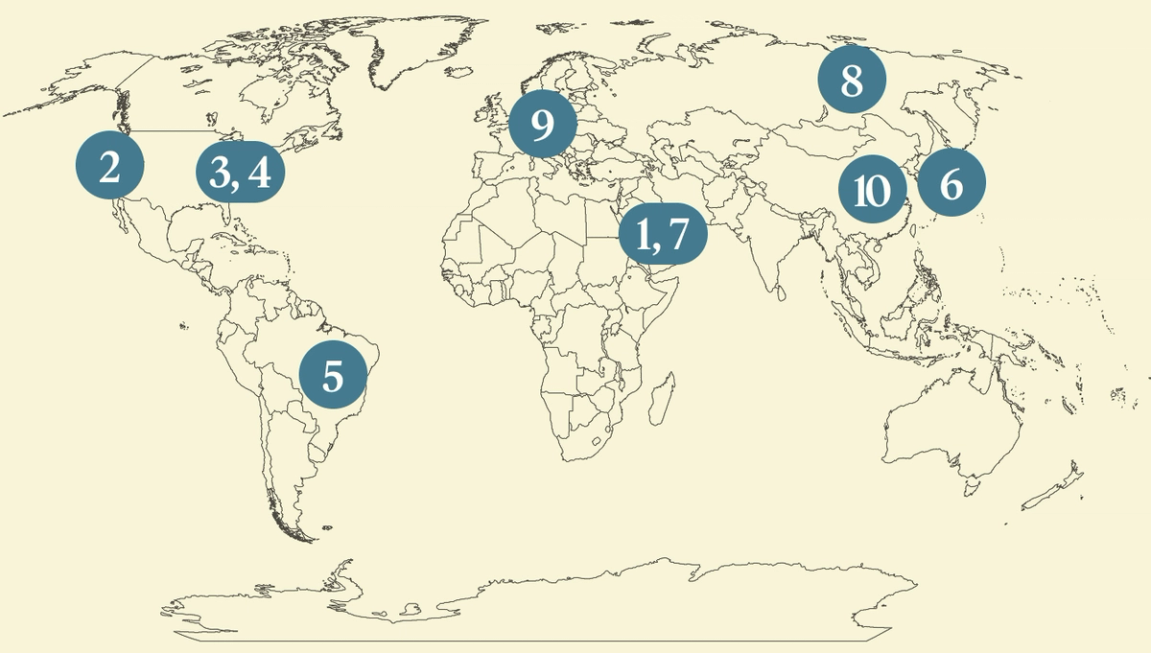 - Saudi-Houthi war ramps up
- US works to tamp diesel prices
- The Fed has an AI dilemma
- Private credit scrutiny grows
- Brazil markets surge on runoff
- Takaichi reassures markets
- Gulf SWFs are still on track
- Russia downplays lab death
- Nobel spotlights neuroscience
- China’s microdrama exports
 A ‘clear-eyed’ account of Silicon Valley’s breakneck race to build AGI. |
|
Yemeni forces repel Houthis from Red Sea |
 Ebrahim Al-Suhaibi/Reuters Ebrahim Al-Suhaibi/ReutersSaudi-backed Yemeni forces said Monday they had expelled the Houthis from key areas surrounding the Bab el-Mandeb Strait on the Red Sea following a major counteroffensive. Reclaiming coastal areas seized during the Houthis’ lightning advance last month curtails the rebels’ ability to significantly disrupt energy flows, but the counteroffensive — a hoped-for “zero hour” — among some Saudi and Yemeni pundits, could widen the Iran war, further upending energy markets: Saudi Aramco’s chief told the Financial Times that global oil stockpiles are now “scarily thin.” The kingdom’s previous war against the Houthis resulted in a yearslong quagmire and devastating humanitarian crisis, but former Saudi intelligence chief Prince Turki Al-Faisal told Arab Views that restraint “is no longer operable.” |
|
WH under pressure to ease diesel prices |
|
The Fed has an AI problem |
 Jeenah Moon/Reuters Jeenah Moon/ReutersAn AI-stock rally powered the Nasdaq to a record close Monday, as investors looked to Big Tech’s third-quarter earnings this month. SpaceX, Nvidia, Meta, and Microsoft all gained, suggesting a kind of “inverse bond trade,” an investor told CNBC: “It’s buy tech, sell everything else.” Demand for compute is strong enough that hyperscalers remain undeterred by higher borrowing costs, a dilemma for the US Federal Reserve: The AI investment boom is adding to inflation even as interest rates begin to bite elsewhere, suggesting the Fed may have to “hurt the part of the economy that is more rate sensitive,” Barclays’ global chairman of research told The New York Times. |
|
NY Fed reviews private credit exposure |
 Eduardo Munoz/Reuters Eduardo Munoz/ReutersThe Federal Reserve Bank of New York has visited JPMorgan, Wells Fargo, Barclays, and Morgan Stanley to review their exposure to private credit, Semafor’s Ellen DiMauro reported, as policymakers ramp up scrutiny of a financial industry that has unnerved investors. The review was prompted in part by JPMorgan’s move in March to mark down large swaths of loans in private credit portfolios, particularly those to software companies threatened by AI, after funds were inundated with withdrawal requests over fears of the so-called “SaaSpocalypse.” Redemption rates have since declined, and some investors are finding their way back to software: Thoma Bravo is selling a $1.5 billion stake in cybersecurity-software company Imprivata, with JPMorgan and Evercore leading the sale process. |
|
Brazil stocks surge on Bolsonaro lead |
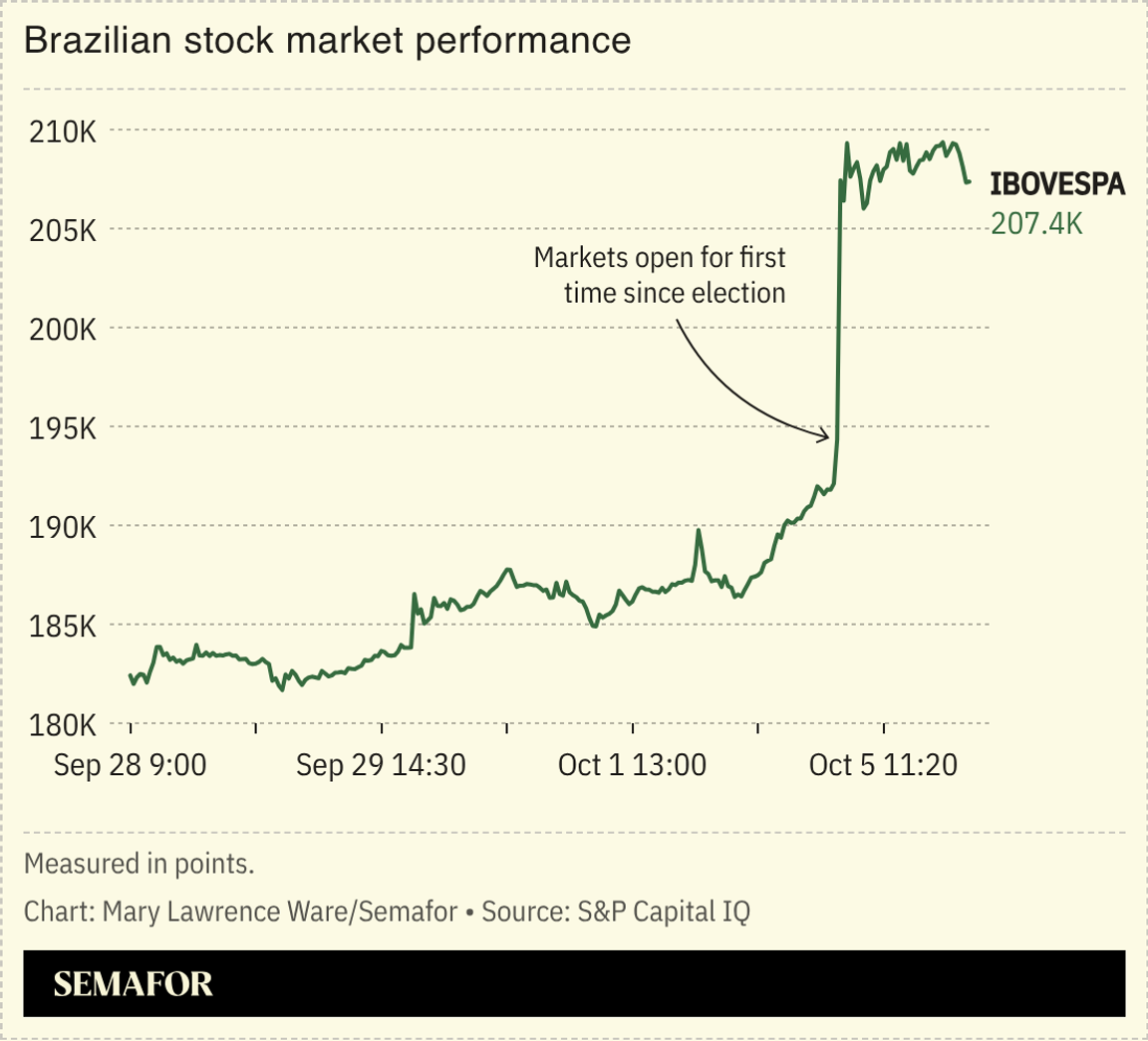 Brazilian stocks surged Monday after Flávio Bolsonaro emerged as the presidential frontrunner following first-round voting, with investors betting the right-wing candidate would win with a large enough majority to push fiscal reform. “The conditions have never been this favorable,” an asset manager told Bloomberg, after Bolsonaristas won up and down the ballot Sunday, strengthening a potential Bolsonaro presidency that could target major spending cuts, bolstering the case for lower interest rates: Brazil has some of the highest rates in the world, which are partly to blame for the slowing economy that has weakened the incumbent. Still, “neither candidate will have a free hand” on spending, given the difficulty of getting reform through the Brazilian Congress, a macro strategist told the Financial Times. |
|
Japan 30-year bond yield hits record |
|
Gulf funds unfazed by war |
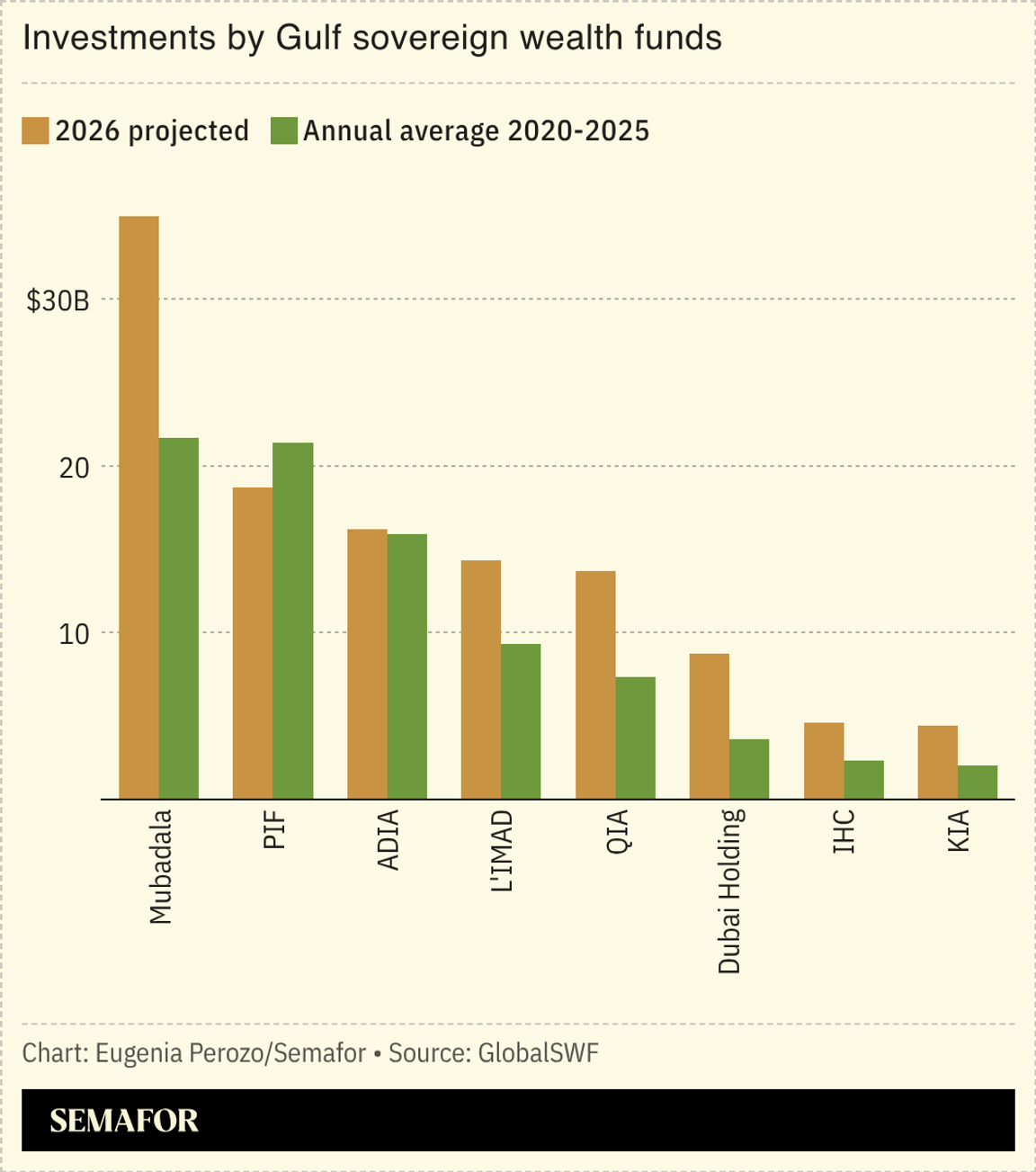 Gulf sovereign wealth funds are on track to have their second-busiest year of dealmaking ever, despite the war disrupting businesses and economic growth. Regional funds are forecast to invest $136 billion by year-end, with Abu Dhabi’s Mubadala leading the pack with $26.2 billion invested so far in 2026, according to consultancy Global SWF. Nearly half of Gulf sovereign fund investment went to the US, showing that American assets remain attractive despite the debate about the future of Gulf states’ relationship with their main strategic ally, Semafor’s Matthew Martin noted. Gulf funds are major backers of Paramount’s $110 billion takeover of Warner Bros. |
|
 Behind closed doors, a new era of healthcare policy is taking shape. From AI and access to care, to the race for new drugs and China’s growing role in global medicine, the forces remaking healthcare are accelerating, with implications for healthcare systems worldwide. Introducing Semafor Healthcare, your weekly read on the politics, policy, and business driving healthcare. Delivered weekly from David Lim, Semafor Healthcare will deliver the analysis and reporting leaders need to understand the forces reshaping healthcare, and what comes next. Subscribe for free. |
|
US, EU monitoring Russia plague reports |
 Stringer/Reuters Stringer/ReutersUS and EU officials said on Monday they were closely monitoring a suspected case of pneumonic plague in Russia that killed a lab worker in a Siberian research institute, prompting authorities there to quarantine dozens of people. “We don’t have a lot of intel,” one US health official told The Washington Post: “We should be alert but not panicked.” Central Asian countries tightened sanitary border controls, even as the Kremlin denied reports of plague and urged media to “to ignore various rumors” amid widespread censorship, The Insider reported. “Russia is well known to have an active military biological weapons program,” the Biden administration’s coronavirus response coordinator noted, suggesting that Moscow’s lack of transparency means “we have to build up our biodefense accordingly.” |
|
Neuroscience discovery wins Nobel |
 TT News Agency/Pontus Lundahl/via Reuters TT News Agency/Pontus Lundahl/via ReutersThree scientists won the Nobel Prize in Physiology or Medicine on Monday for developing a method of controlling brain cells with light, work that one expert said had ushered in a “golden era” for neuroscience. The technique, created by Karl Deisseroth, Peter Hegemann, and Georg Nagel, has been used to understand psychiatric disorders that affect millions such as obsessive-compulsive disorder and schizophrenia, as well as to explore the neural circuits involved in memory. Roughly 3% of people worldwide will experience OCD in their lifetime, according to a recent study, while |
|
|


