What militaries could do with AI ‘keeps me up at night,’ OpenAI exec says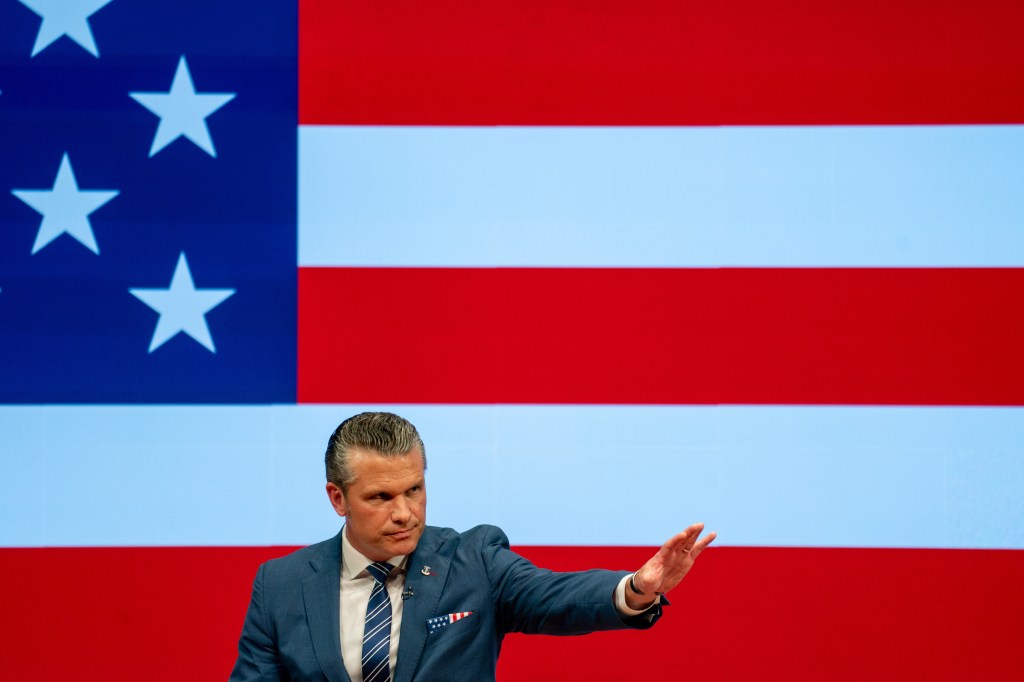
Pete Hegseth, U.S. Secretary of Defense, during an address at Marine Corps Base Quantico in Quantico, Virginia, on Sept. 30, 2026. Stefani Reynolds/Bloomberg/Getty Images
Militaries throughout the world are rapidly incorporating AI into their operations as they develop new weapons and autonomous systems like drones and robots.
Sarah Yager, the first Human Rights and Responsible Deployment Lead at OpenAI, said that concerns her.
“Everyone is very worried and rightly so,” Yager said
Tuesday at the ScaleUp:AI conference in New York City. “This keeps me up at night: ‘What is the military going to do with AI when it comes to targeting? And what about autonomous weapons? And where is all of this going?'”
Yager joined OpenAI in June. She now has a chance to grapple with the difficult questions this poses from inside one of the most powerful AI companies in the world.
“I have always wanted to go into places and persuade people where human rights was not necessarily the dominant idea,” Yager said.
OpenAI approached Yager for the job shortly after the company signed a contract with the U.S. military in late February to deploy advanced AI systems in a classified environment. The high-profile deal followed a public falling out between the Pentagon and OpenAI rival Anthropic. Anthropic wanted to put guardrails around how the military could use its technology; defense officials did not agree.
Since joining, Yager has had some success influencing the direction of the technology. She has been able to work directly with researchers and engineers to improve the models, such as making sure they have appropriate responses to basic international agreements, including the laws of war, established in 1949 at the post-World War II Geneva Conventions.
But real-world applications have proven tricky. For example the U.S. military nearly targeted a Chinese military ship earlier this year based on an inaccurate, AI-generated intelligence report,
according to CNN.
AI companies shouldn’t “reinvent the wheel” on what defines humanity and morality, Yager said. “Societies have already figured out a lot of those things, and it’s called human rights. That should be the baseline,” she said. “I do not want an AI company telling me what is good. If we allow the industry to determine what is good, then it’s a free for all.”
—Emily Forlini