| | In this edition, investors are calling Treasury Secretary Scott Bessent’s bluff, and lawsuits allege͏ ͏ ͏ ͏ ͏ ͏ |
| |  | Business |  |
| |
|
 - Bessent’s rose-colored glasses
- Dollar dominance?
- Private-credit marks
- SpaceX debt binge
- Skydance-ing
 $100 oil on Gulf tensions, global bonds drop, stock rally starts to cool … Investors await Fed minutes … Brussels’ taxman hits again |
|
 The bull market of the early 2010s was called the most hated rally in history. This one may be a close second. Back then, investors underestimated the power and determination of the Federal Reserve to prop up a flagging economy. Flatlining corporate earnings, European debt bombs, and runaway government spending disappeared into a sea of free money. Today’s problem is hyperscalers spending themselves into oblivion, spreading inflation well beyond Silicon Valley and obscuring problems nearly everywhere else. The S&P 500 hit another record yesterday, even as oil stays trapped in the Gulf and Europe tilts toward another debt crisis. The rally is driven by just a handful of AI companies. Some of them have the earnings to back it up — Goldman Sachs expects Nvidia and Micron alone to account for a third of the S&P 500’s earnings growth in the current quarter — but the return on their investments is far from certain, and far from now. Alan Greenspan’s declaration that the Fed can’t deflate a bubble without wrecking the economy is far from economic canon, but it’s holding up in the AI era. Mark Zuckerberg and Satya Nadella aren’t slaphappy consumers who can be sobered up by higher rates. They are self-styled great men of history in an existential race and won’t stop spending until their shareholders make them. Their shareholders are very happy. You see the problem. |
|
Cracks in Bessent’s story |
 Nathan Howard/Reuters Nathan Howard/ReutersScott Bessent isn’t worried. The market is. The US Treasury secretary has been trying to reassure investors that economic growth and budget restraint can put the US government’s financial house in order. But he’s 0-for-3 on his 3-3-3 plan of increasing oil production, growing the economy, and cutting the deficit. His bond buyback program landed as a curious half-step — big enough to suggest concern but too small to make a difference. Tempers are flaring, WSJ reports. Cracks are showing in the riskiest corners of the credit markets, always the first to surface confidence gaps. Take the loan market, where the amount of deeply distressed loans (those made to low-rated companies trading at 60 cents on the dollar or less) has ballooned to a level not seen since March 2020, as JPMorgan strategists pointed out this week. The biggest concentration of these highly distressed loans, of course, is in the technology sector, where SaaSpocalypse fears have eased among stock investors but not sandbag-packing credit investors. Rising global bond yields and Fed tightening haven’t helped. If Bessent “is the house now,” investors are calling his bluff. — Ellen DiMauro |
|
China’s coming for the dollar |
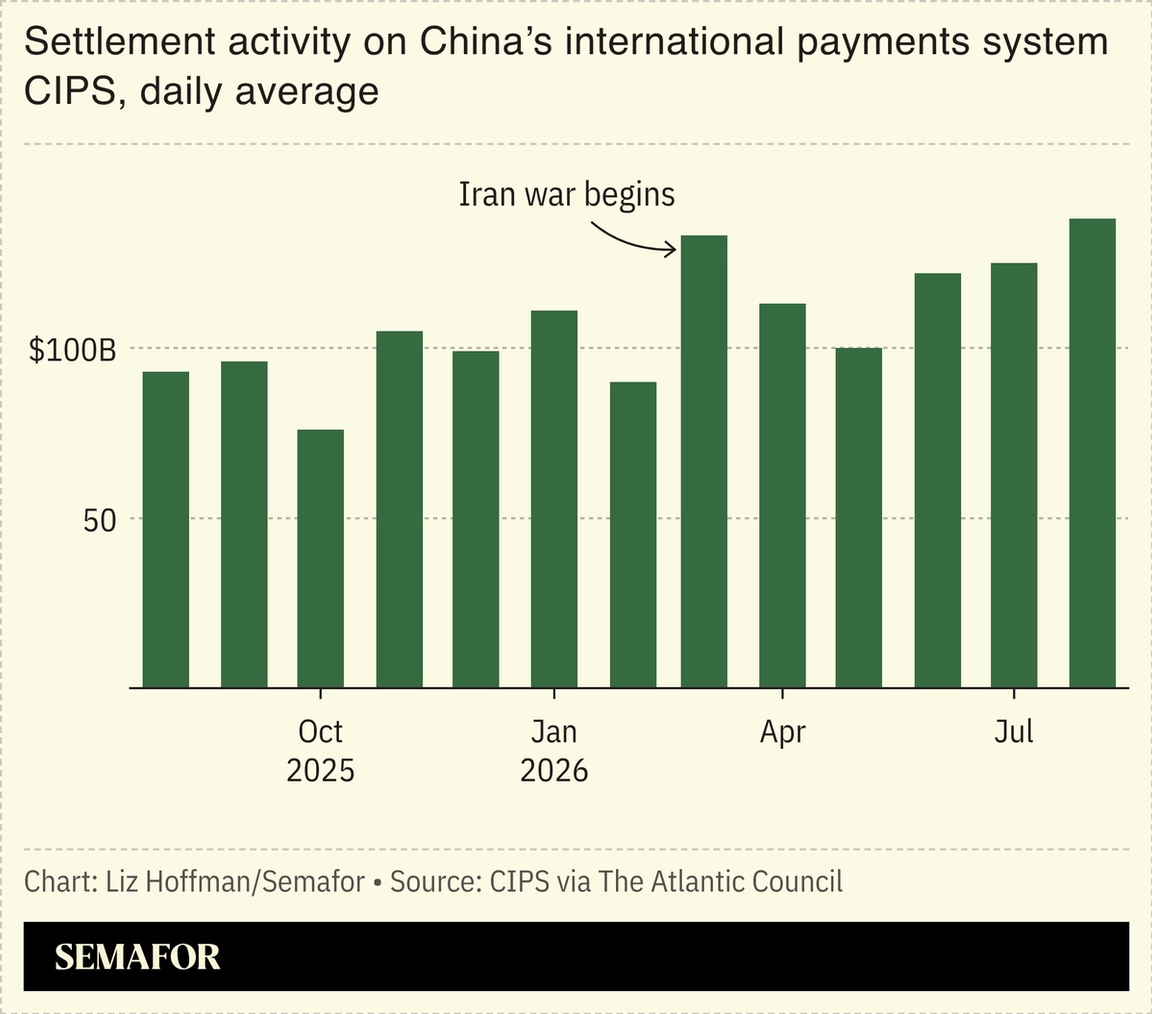 Here’s one for the dollar doomers: China’s competitor to the dollar-denominated system that zips money between global banks saw record daily volume in August. A spike last spring, as the Iran war sent sanctioned companies looking for a way around Washington, now looks less like a blip and more like a permanent, if small, leg-up for Beijing’s efforts to build a parallel system of financial plumbing. This isn’t the death of the dollar. New data from the Atlantic Council out today, shared first with Semafor, shows the greenback still underpins most global trade and foreign-exchange transactions. (Try converting Turkish lira to Indian rupees without going through the greenback.) “The top line numbers all remain stable,” said Josh Lipsky, the Atlantic Council’s chair of international economics. “But look underneath the hood and there’s some worrying signs.” China’s efforts to dethrone the dollar have so far mostly been a curiosity. Renminbi’s place in global central-bank reserve coffers has actually fallen since 2022, despite Beijing shoveling its currency into developing economies through central-bank swap lines. But crises can reset the board: The number of direct participants in Beijing’s cross-border interbank payment system has more than doubled since Russia’s invasion of Ukraine, and the resulting weaponization of Western financial networks to freeze Russian assets. — Liz Hoffman |
|
Are Wall St.’s biggest names inflating their marks? |
 Eduardo Munoz/Reuters Eduardo Munoz/ReutersThe investor rush to pull money from private credit isn’t gone but is at least cooling. Now comes the bigger question: Are those loans any good? A series of lawsuits on behalf of pension funds and investors against some of private credit’s biggest names, including Blue Owl, FS KKR, and Ares, allege the firms overcharged fees based on exaggerated valuations and payment-in-kind income, which allows borrowers to defer cash-interest payments. The firms dispute the lawsuits — filed, notably, by a longtime Wall Street insider — and maintain that their fees are fair and in line with industry standards. But the scrutiny on this corner of the credit markets is piling up: The Securities and Exchange Commission sent a rare shot to private-credit accountants, and the Fed is on a whistle-stop tour of big banks, assessing their own exposure to these firms, Semafor scooped. — Ellen DiMauro |
|
SpaceX goes on another AI-driven debt spree |
 Steve Nesius/Reuters Steve Nesius/ReutersElon Musk’s SpaceX is the in-betweener in the AI capex wars. SpaceX’s reported $40 billion debt raise to buy Nvidia chips shows it is stuck between mature tech giants like Google and Meta and startups like OpenAI and Anthropic, whose private status tends to forgive their inability to pay their own bills. SpaceX carries five times more debt than Alphabet, and three times more debt than Meta, relative to their respective profits, and while money from Starlink helps prop up SpaceX’s cash-guzzling rocket business, it isn’t nearly the cash cow that rivals’ ad businesses are. It needs to borrow because it’s spending more on AI than it’s taking in from the rest of its businesses. By going public in June, SpaceX locked itself out of the raise-and-pray venture capital world. But its stock price’s sideways lurch since then makes it unattractive to issue new shares to pay for its growing AI tab. Its BBB credit rating is two notches below Meta and Alphabet, and a tougher sell with blue-chip bond funds; enter Apollo, which has a pot of money to match seemingly every risk out there (including cash-strapped governments!). Oracle finds itself in a similar position. — Liz Hoffman |
|
 Kris Tripplaar/Semafor Kris Tripplaar/SemaforOne thing was clear on Skydance’s first day of life: Beneath David Ellison’s velvet glove is Ynon Kreiz’s iron fist. To earn his $40-odd million payout to help run the combined Paramount-Warner Bros., Kreiz will have to serve as a Tom Wambsgans-ian pain sponge — the executor and cost-cutter behind Ellison’s lofty vision boards. After Ellison told Skydance’s assembled employees at a town-hall meeting Tuesday that “there is something magical about” movie-making, Kreiz stated plainly “ultimately, our success will be determined by performance,” according to prepared remarks viewed by Semafor. Investors are warily eying Skydance’s freshly downgraded debt, and layoffs are coming. There’s only so far Hollywood and Washington connections can take Ellison before the reality of managing a debt-laden media giant forces him to prove he can actually run one. — Rohan Goswami |
|
A rare double-sell, given the mood of things: ➘ SELL: Bare knuckles. The owner of Mergermarket and Dealogic promises no hardball tricks with creditors on its $11 billion debt pile. ➘ SELL: Rare buckles. Luxury retail spending is down, with Coach, Kate Spade, and Louis Vuitton most exposed, new credit card data from Citigroup shows. |
|
 A border collie. Thomas Mukoya/Reuters. A border collie. Thomas Mukoya/Reuters.A sheepdog today can cost more than a new car. Sheep farmers are placing record-setting bids on the breed, many traveling overseas to land the most elite pick of the litter. In 2021, a 1-year-old collie named Kim sold at an online auction for a record-setting £27,100 ($35,820). Unlike the billion-dollar “doodle” craze, sheepdogs are prized for work, not lap time. Drones and robots have been floated as replacements for the four-legged shepherds, but it’s hard to beat centuries of breeding, and something furry and cute. |
|
|


