| | In this edition: Your guide to the midterm pre-spin cycle, Gallego rolls his AI pitch, and labor uni͏ ͏ ͏ ͏ ͏ ͏ |
| |  SKULL VALLEY, AZ SKULL VALLEY, AZ | CEDAR RAPIDS, IA | BATH, ME |
 | Americana |  |
| |
|
 - Gallego’s big ideas
- State unions’ new ‘Contract’
- Veep, the documentary
- ‘Bipartisan’ ad messaging
- Poll Watch
|
|
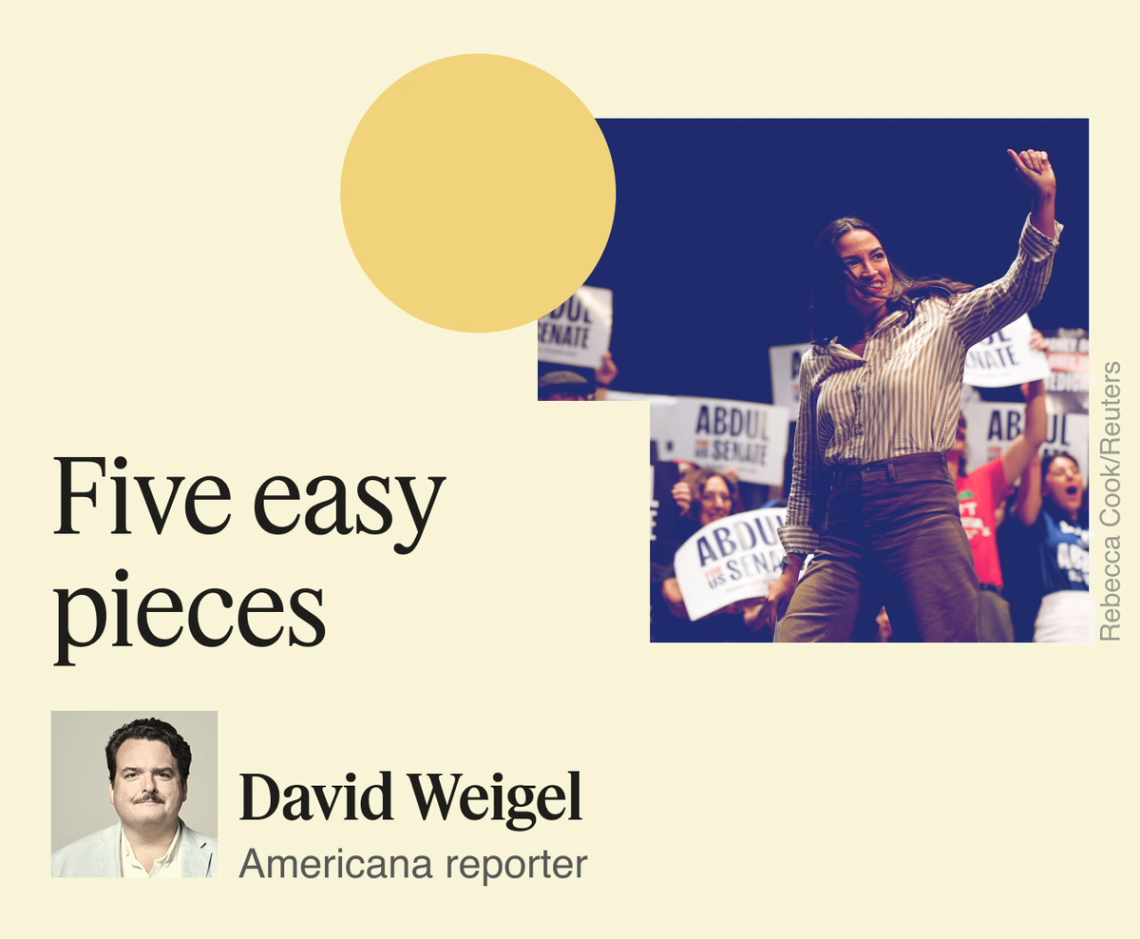 Prick up your ears, and you can hear it — the sound of many different kinds of Democrats grabbing credit for midterm victories that aren’t official yet. There’s Alexandria Ocasio-Cortez, assessing that when (not if) Abdul El-Sayed wins his Senate race in Michigan, the left will “break open the entire political calculus in America” — i.e., that progressives like them can win the Midwest. There’s Pete Buttigieg, making sure we know how many states he’s campaigned in (37) and how many candidates he’d endorsed (more than 100). At this time in any campaign cycle, groups, candidates, and strategists pepper reporters with early claims that they were right. The election, they say, will be a referendum on their issue, a validation of their spending strategy, proof that their ideas moved votes. These takes aren’t immaculate. I’ve never deleted the October 2017 email from a strategist who was ready to explain why Ralph Northam lost the election for governor of Virginia. In fact, Northam won easily, and that strategist got strategically quiet. As preposterous as it is, though, the pre-spin cycle matters, because anyone not ready to contextualize what happened to their benefit will lose face. It mattered in 2020, when centrist Democrats burst out to blame “defund the police” activists for their party underperforming the final polls. It mattered after President Donald Trump’s win in 2024, when Sen. Bernie Sanders instantly blamed defeat on the party having “abandoned the working class.” That quick analysis shaped the conversation. Here’s a quick guide to arguments people will be trying to make in a month. I’ve included the races that will be cited first to tell the story. → |
|
|
Gallego launches sweeping plan for an AI-proof workforce |
 Brendan McDermid/Reuters Brendan McDermid/ReutersSen. Ruben Gallego is launching an ambitious policy agenda today focused on AI and the workforce, a move that will increase speculation about his plans for the 2028 campaign. Gallego’s entry into what has fast become a Democratic Party battle of ideas would tax data centers and job automation, raise the minimum wage, beef up labor laws, and create a New Deal-esque public works program. His broader goal: Help insulate American workers from the negative effects of the AI boom. Why now, on the eve of the midterms? “People that are working right now don’t feel like their hard work is actually bringing them anything in return … and going into election season, people want to know where Democrats stand,” Gallego told Semafor in an interview this week. He said he’s not ready to make a decision on running for president — but that he’s “going to be involved” in Democrats’ big policy debate either way. Read more from Burgess Everett on Gallego’s pitch. → |
|
|
Unions look beyond their rolls to build a new movement |
 Nate Sawyer via Wikimedia Commons Nate Sawyer via Wikimedia CommonsEvery Thursday afternoon, a cadre of state AFL-CIO leaders meets on Zoom to advance a shared project: the “Contract with Working Americans,” a populist economic platform they devised independently of the national AFL-CIO. These calls are a new organizing tactic for labor, which historically leads top down from Washington. And their goal is new, too: to mobilize not only workers who belong to unions, but the many more American workers who do not. “We’re trying to connect two segments of a group that, quite frankly, should be naturally aligned, but just haven’t,” said Derrick Osobase, vice president of Communications Workers of America District 6, which covers Texas. “We are actively talking to working-class people who are not affiliated with the union, and wrapping them into an agenda that they have said will make their lives different.” In a moment of declining trust in Congress, political parties, the media, and many other institutions, labor activists believe a union-led movement could have real juice in setting a new national agenda as audacious as Newt Gingrich’s 1994 “Contract with America,” which helped produce a sweeping congressional majority for Republicans that year. Union membership has declined from 20% of all workers in 1983 to 10% last year, even as union popularity hovers at 90-year highs. Seventy-one percent of US adults approve of unions, according to Gallup, including 52% of Republicans. The widening gap between those figures is where organizers see an opportunity. Meet some of the Senate and gubernatorial candidates signing on. → |
|
|
What Vance is really saying on the campaign trail |
 Callaghan O’Hare/Reuters Callaghan O’Hare/ReutersThe president and vice president have been campaigning across red and swing states, warning voters that a Democratic victory would halt the “golden age” and bring “crazy” policies back from the grave. But there’s not been that much attention paid to what they’re saying, unless they veer off-script and talk about San Diego getting nuked. That’s a mistake. In his speeches, usually running 25 minutes after he’s finished thanking and naming local candidates, Vice President JD Vance is offering a preview of his party’s next message — and potentially, the next GOP nominee. He doesn’t mention the war in Iran. He highlights the best economic and crime data Republicans have — but doesn’t suggest that voters are happy now, as Trump does. He rips into Democrats over their statements (or votes) about trans rights, race, and policing, testing how much voters want to forgive them for positions they finessed or abandoned after 2020. Read more about what Vance is saying on the trail. → |
|
|
Republicans in Iowa and Arizona try a new label: Bipartisan |
 Ashley Hinson/YouTube Ashley Hinson/YouTubeTwo years ago, no Iowa Republican needed to run on their ability to work with Democrats. It was enough to run alongside Trump, who carried the state and all four congressional districts. Not this year. Rep. Ashley Hinson, the GOP’s Senate nominee, has run two ads that portray her as “working across the aisle” — one narrated by her, one starring a Democrat outside Cedar Rapids who says she avoids the game of “red team, blue team, pick a side, hate the other one.” (The new ad conspicuously doesn’t mention any particular issue she worked with Democrats to fix.) Trump narrowly won Arizona Rep. Juan Ciscomani’s seat, but he’s also now emphasizing his bipartisanship — “I’m not a rubber stamp for anyone” — and the fact that he’s an immigrant. These spots complement attack ads that portray Democrats as radical and unhinged. But there’s more work being done this year to sell Republican incumbents, contrary to most evidence, as eager to work with the other party, if it could only stop being crazy. |
|
Reading the tea leaves in Maine and Michigan |
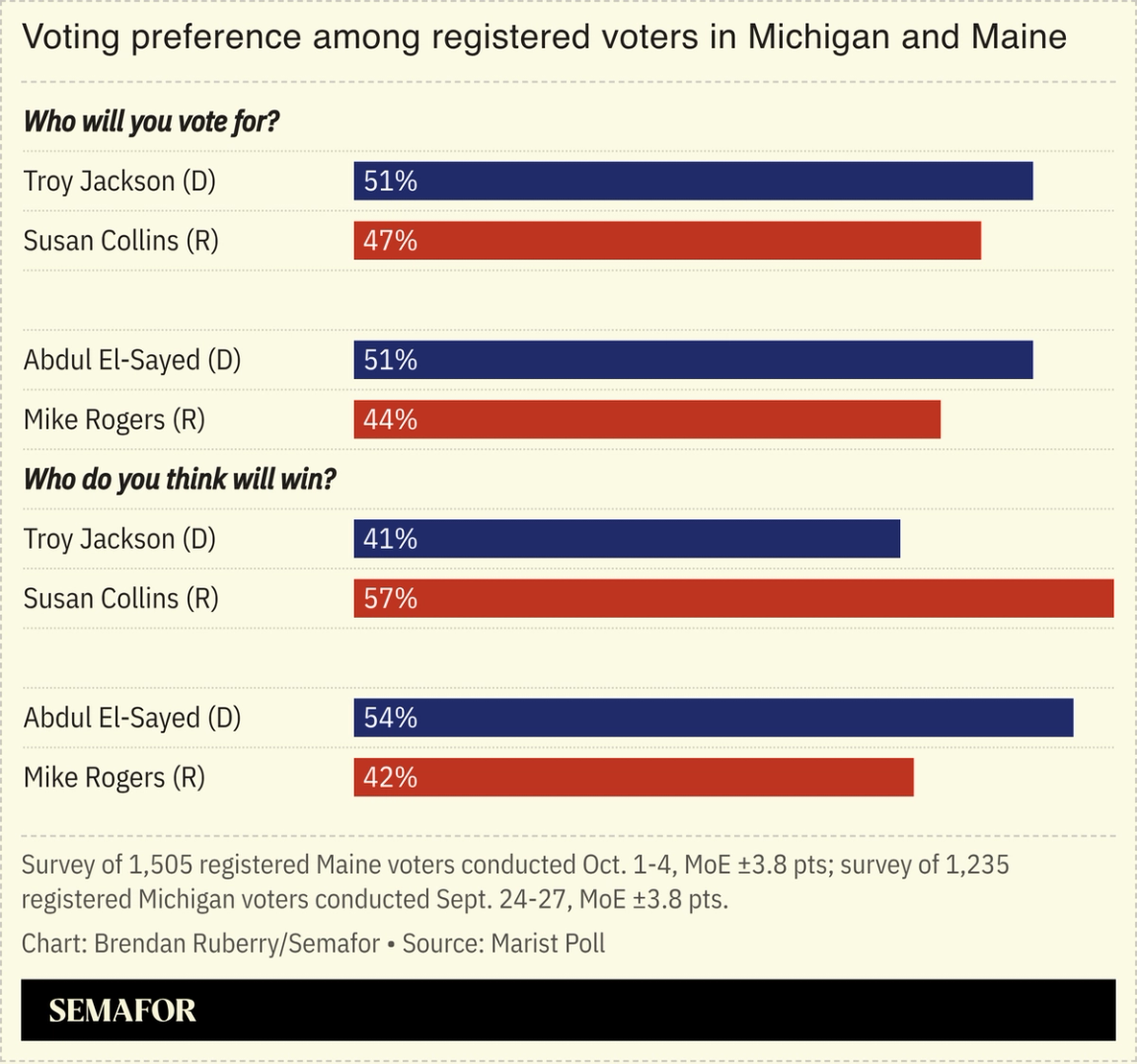 Among the most useful questions in polling are those that ask respondents what they think their neighbors will do in the voting booth. In 2016, pollsters found that asking people who they thought was broadly winning the election was a better predictor of Trump’s support than asking voters about their choice — because many were reluctant to say. We’re seeing some of that play out this cycle in two swing states. For many Mainers, the defeat of Susan Collins is as hard to imagine as the end of capitalism, and Republicans have handily outspent Democratic nominee Troy Jackson on TV. Independents back Jackson by a 7-point margin — but most independents expect Collins to win. It’s another story in Michigan, where Mike Rogers is trying to break a 26-year GOP losing streak in Senate races — one of those losses being his own, in 2024. Just 3% of Republican voters say they’re voting for El-Sayed, but 13% of Republicans expect him to win next month. |
|
 Technology is at an inflection point. From AI to the forces reshaping business, science and daily life, the pace of change is accelerating. Future Proof from Semafor Technology offers a direct look at the breakthroughs, risks, and questions defining what comes next. Hosted by Semafor San Francisco Bureau Chief Reed Albergotti, each episode features conversations with the builders, policymakers, and industry leaders shaping how technology is developed, adopted and governed. In Future Proof’s debut episode, Cognition CISO and former Facebook security chief Alex Stamos takes aim at Silicon Valley’s “nihilism” and separates AI’s real risks from those he sees as imagined, fueled by “almost religious beliefs.” Plus, he talks about how he plans to tackle cybersecurity’s coming “dark age” and why Aaron Sorkin’s version of Mark Zuckerberg wouldn’t attract employees. |
|
 Chip Somodevilla-Pool via Imagn Images/Reuters Chip Somodevilla-Pool via Imagn Images/ReutersDemocratic control of the Senate might prevent Trump from filling a Supreme Court vacancy, a repeat of the way Republicans handled then-President Barack Obama’s final court vacancy in 2016. Over at NBC News, Sahil Kapur did the smart, useful work of asking Democratic senators if their hypothetical majority would let Trump put a nominee on the floor. None said yes. Retiring Sen. Dick Durbin, who feels conflicted about the idea, is being replaced in three months by a more progressive Democrat. “We’ve got to do exactly what [Sen. Mitch] McConnell did to us,” said Gallego. |
|
|


