| | In today’s edition: Saudi Arabia vows retaliation after deadly airport attacks, DP World doubles dow͏ ͏ ͏ ͏ ͏ ͏ |
| |  | Gulf |  |
| |
|
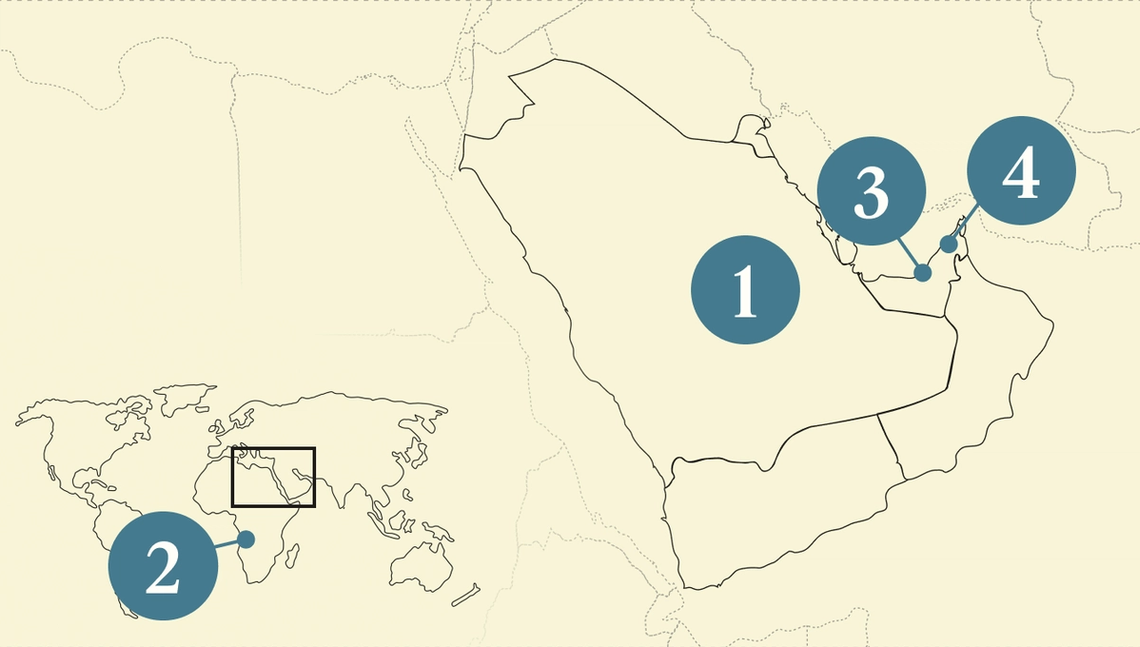 - Deadly strikes on Saudi airports
- DP World’s Angola expansion
- Falcon AI learns Emirati
- Outcomes-based philanthropy
 Dubai’s Michelin Guide glosses over shuttered restaurants. |
|
Three killed in Saudi airport attacks |
 Mohammed al-Mahdi/Reuters Mohammed al-Mahdi/ReutersSaudi Arabia vowed retaliation after Houthi attacks on two Saudi airports killed three people and injured dozens more. The escalation comes as US President Donald Trump is reportedly weighing fresh strikes against Iran before midterm elections. Riyadh’s airport has become one of the world’s most disrupted after frequent airspace closures in recent weeks, according to Flightradar24, while oil prices have risen above $104 a barrel. The Houthis also attacked Riyadh again on Thursday, and some offices in the capital’s King Abdullah Financial District were evacuated, according to people familiar with the matter. Overall, the latest strikes have been the deadliest attacks on Saudi Arabia since it began bombing Yemen this year, a campaign Riyadh initially cast as retaliation for Houthi strikes. The Oct. 6 and 7 attacks “will not go unpunished,” a Saudi official said on X. The US has so far declined to participate in the Saudi-led operation against the Houthis beyond operational and intelligence support, but Trump has asked the Pentagon to prepare strike options for Iranian targets ahead of next month’s midterms, The Atlantic reported. |
|
DP World to double Luanda capacity |
 DP World will invest $90 million over two years to expand its terminal at Angola’s Port of Luanda, more than doubling capacity as the Dubai-based firm deepens its bet on African trade. The expansion will lengthen the quay and add 15 cranes, allowing the terminal to handle two large container ships at once and cutting turnaround times by up to half, the company said. Angola also extended DP World’s concession by 10 years, to 2051. The company has spent more than $260 million on the terminal since it began operating there in 2021, and volumes have nearly doubled to more than 350,000 containers. The investment extends a two-decade buildout across at least nine African territories that has kept DP World profitable through the Iran war. The company plans to commit another $4 billion to the continent, its Africa chief told Bloomberg. |
|
Teaching AI the Emirati dialect |
 Courtesy of Technology Innovation Institute Courtesy of Technology Innovation InstituteAbu Dhabi’s Technology Innovation Institute, a state-run research body, released AI models trained on the Emirati Arabic dialect, improving translation, transcription, and voice-enabled services. The Falcon-Emirati model and related tools for speech recognition and extracting Arabic text from images and documents are relatively compact. The speech recognition model has 1.6 billion parameters, but is more accurate than a 30-billion-parameter model, according to TII. AI training in Arabic has lagged behind other languages, partly because dialects vary widely and can be incomprehensible to people who know only the formal Arabic used in news reports and textbooks. This has made some machine translations comically inaccurate, sometimes turning innocuous words into vulgar references in English. TII aims to eliminate those errors by training models on local dialects, idioms, and cultural references, ultimately making AI more useful in the region. — Mohammed Sergie |
|
Gulf philanthropy wants a seat at the table |
 Courtesy of the Abdulla Al Ghurair Foundation Courtesy of the Abdulla Al Ghurair FoundationAs Western governments slash foreign aid, many organizations are seeking Gulf philanthropy to fill the gaps. While wealthy individuals and governments in the region are ready to take on a larger role, a younger generation of donors isn’t content with plowing money into existing programs, and is instead seeking new ways of giving that have more effective and measurable outcomes. Sonia Ben Jaafar, CEO of the Abdulla Al Ghurair Foundation, told Semafor that private donors from the Gulf want to be more involved in designing development programs, rather than simply financing them. She said the region’s charities have developed their own expertise that can help inform changes to improve existing charitable initiatives. The foundation she runs — established in 2015 by Emirati billionaire Abdulla Al Ghurair and chaired by his son Abdul Aziz — has become one of the Arab world’s largest privately funded education initiatives, reaching about 500,000 young people over the past decade. — Mohammed Sergie |
|
 Semafor has announced new members and co-chairs of the Global Advisory Board for Silicon Valley & The World, a first-of-its-kind, multi-year initiative connecting the leaders building transformative technologies with the policymakers shaping their deployment. The expanded board includes more than 50 global figures, among them Olugbenga “GB” Agboola, Bhavish Aggarwal, Pedro Azagra, John Ketchum, Pratyush Kumar, Yann LeCun, Fei-Fei Li, Amjad Masad, Penny S. Pritzker, Kevin Rudd, Eric Schmidt, KR Sridhar, Mati Staniszewski, and Raj Subramaniam. As the board expands, Sam Altman joins Silicon Valley & The World as a co-chair. Designed to move the conversation beyond debate and toward action, Silicon Valley & The World will convene more than 350 founders, CEOs, investors, and policymakers in November, bringing together leaders with the ability to fund, scale, and implement new ideas. |
|
 Branding- The UAE’s biggest telecom has ditched the confusing, tech-inspired e& branding it forced on customers in 2022 and returned to Etisalat, Arabic for communications or connection. It’s what most customers — and every employee we’ve met during the ampersand era — called it anyway. The 50-year-old Abu Dhabi firm, which operates in 38 countries, said it will focus on four businesses: telecom, AI, infrastructure, and fintech.
Deals- Abu Dhabi-based BlueFive Capital made its first investment in Indonesia, agreeing to buy a stake in Majoris Asset Management, a provider of Sharia-compliant funds with more than 700,000 retail customers. The size of the stake was not disclosed.
- International Resources Holding, a unit of Abu Dhabi-based International Holding Company, made a non-binding offer to buy Kenmare Resources, a Dublin-based miner that produces titanium minerals in Mozambique. The proposal, which sent Kenmare’s shares up as much as 41%, could provide Abu Dhabi with titanium for its defense and aerospace industries. — Bloomberg
Food Security- The UAE will keep working with other countries to strengthen global food security, Vice President Sheikh Mansour bin Zayed said at the opening of a summit in Abu Dhabi. Delegates from 92 countries are discussing how to protect food supplies from supply-chain disruptions, geopolitical tensions, and rising costs. — The National
Real Estate- Dubai home sales fell 47% year on year in the third quarter to 72.6 billion dirhams ($19.8 billion), as deals signed before the war stopped cushioning the numbers. Prices have dropped 10.3% since February. — EnterpriseAM
|
|
 orfalibros/Instagram orfalibros/InstagramThere’s a mini-scandal brewing in Dubai’s elite food scene. The latest Michelin Guide awarded stars or distinctions to 11 restaurants that have temporarily or permanently closed because of the war. Food writer Samantha Wood questioned why shuttered restaurants made the cut. Michelin told her it was “fully aware that due to the current circumstances” some restaurants were closed, and said it would reassess when (if?) they reopen. One critic quipped that a new Michelin category is warranted: “Bib Fermé.” Controversy aside, there are still great meals to be had. Orfali Bros Bistro — run by Aleppo-born Mohammad Orfali and his siblings Wassim and Omar — now has two stars, adding to the accolades for the region’s most celebrated chef. They recently revamped the menu with creations like crème caramel caviar and a cold strawberry, tomato, and kohlrabi dish, while perfecting favorites like the corn bomb and spicy burghul salad wrapped in a shiso leaf. — Mohammed Sergie |
|
|


