





Elon Musk has spent $276 million trying to help Republicans win the midterms, according to a new report from the New York Times. The bulk of that money went into the main Republican Senate super PAC, the Senate Leadership Fund. Musk has a net approval rating of -16.2, according to Nate Silver. But that’s still better than Donald Trump’s -22.4. Happy Monday.
Join Will Sommer and Sam Stein for MAGA Mondays live today at 10:00 a.m. EDT on Substack and YouTube.
 |
Revitalizing Liberalism
by William Kristol
In three weeks, we’re likely to see a Democratic wave breaching—perhaps overwhelming—Republican electoral fortifications. In present circumstances, that Democratic wave will be a pro-democracy wave, and that will be something to celebrate.
Yes, I acknowledge that gas prices and other material concerns are probably more important to the voters than the theory and practice of liberal democracy. And, yes, I realize that this election will be more of a referendum on the failures of President Trump and his party than a deep reflection on the principles and institutions of a free society. Still, a thoroughgoing defeat for Trump and Trumpism will be a crucial victory for liberal democracy.
But it won’t be a decisive victory. It won’t even guarantee success in 2028—though, as Ron Brownstein noted in our conversation yesterday, there are very few instances in American history of a party retaining the White House when its outgoing president is strikingly unpopular. Which means one of the key tasks of Democrats in 2027–2028 is to not let up the pressure, and to keep Trump from recovering politically. If Democrats can succeed in doing this, they may have a couple more years of grace to work out their own problems.
But if you really do want to save the country, at some point you can’t simply depend on the failures of your rivals. We remember Franklin Roosevelt today not for capitalizing from the failures of Herbert Hoover in the 1932 election, but for what he then did as president. If the task we face over the next decade of reconstructing our government, our economy, and even our society is comparable to the challenge that FDR faced—and I think it is—it won’t be enough to enjoy the failures of our opponents. A reconstructed liberal democracy will need a revitalized liberalism.
Upgrade Today at 30% OFF & |
Is a re-thought and re-invigorated liberalism possible? The political philosopher Harvey Mansfield, writing “in defense of liberalism” and as “a friend of liberalism,” posed the challenge back in 1978: “From having been the aggressive doctrine of vigorous, spirited men, liberalism has become hardly more than a trembling in the presence of illiberalism . . . Who today is called a liberal for strength and confidence in defense of liberty?”
Looking across our fair land, you can wonder if you have a compelling answer to Mansfield’s question. But look abroad: at Volodymyr Zelensky, at Péter Magyar, at Mark Carney, at Pope Leo XIV. You see strong and confident defenders of liberty.
Is what they are doing over there beyond our power here?
If Zelensky could rally his nation to resist the brutal aggression of a neighboring dictator and show the world what free men and women can do in the jaws of peril, can’t we summon the courage and ability to defeat cut-rate Putinism here at home?
If Magyar could organize to defeat Viktor Orbán when all the powers and institutions were stacked against him, can’t we rout Trumpist authoritarianism on a far more advantageous playing field?
If Carney could rally Canadians to stand up to Trump’s bullying, can’t we Americans show as much strength as our neighbors to the north?
If Pope Leo XIV could use his pulpit in Rome to powerfully remind us of liberal principles—indeed, of American principles—can’t other leaders back home, not necessarily of his faith, follow his example?
At moments like these, things can change suddenly. Zelensky became president of Ukraine in 2019, and a world-historical figure in 2022. Magyar, Carney, and Robert Prevost all took office only within the last two years. What could the next few years hold for us?
I’ll add that a revitalized American liberalism could incorporate aspects of the achievements of each of these figures: Zelensky’s inspirational courage, Magyar’s organizing ability, Carney’s calm competence, and Pope Leo’s moral grounding. Is it too much to hope that we could combine some or all of these elements, if not in one candidate, then at least in one political movement?
Perhaps. But you know what else gives me hope for a revitalized liberalism? The American people, or at least an increasing percentage of them. Seeing support for President Trump collapse among the public—with very little help from our pitifully complacent and fearful elites—is heartening. Even inspiring.
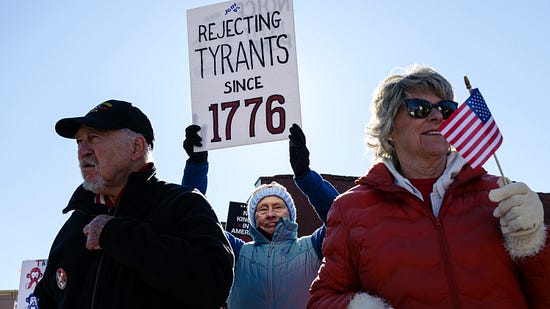
And so when you attend the final pre-election No Kings rally this Saturday, take heart from the coming setback to Trump and Trumpism. Begin to think about turning this reversal in 2026 into a decisive defeat in 2028. But give thought as well to the prospect of a revitalization of liberalism that may lie ahead. That is the true prize for which we fight.
Rapid Unscheduled Dissembling
by Andrew Egger
Yesterday, MAGA media thought they’d hooked a whale. James Talarico had been absent fr