
|
 |
| ||

Guest Lecture: What Really Causes Recessions?
Economic historian Tyler Goodspeed on booms and collapse.
|

| |||||||||||||||


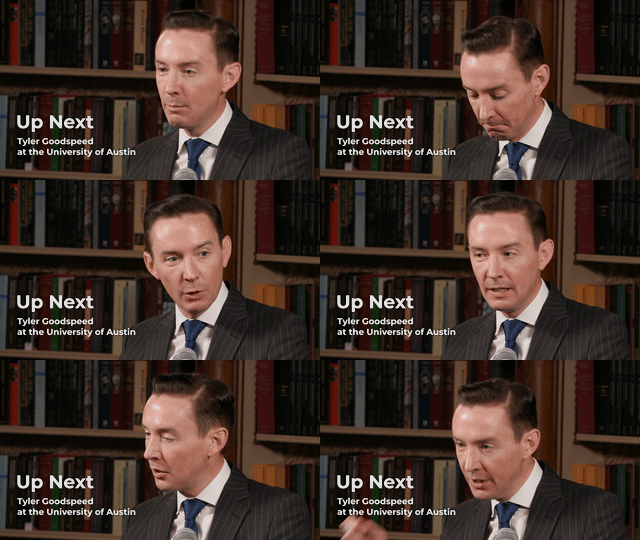
Do economic booms carry the seeds of their own collapse? It’s one of the most persistent ideas in economics, and Tyler Goodspeed thinks it’s wrong. Drawing on 132 recessions across more than three centuries of American and British history, Goodspeed argues that we keep telling ourselves the wrong story about why economies crash — and that recessions are typically caused not by the excesses of the boom that came before, but by adverse shocks we fail to anticipate or absorb. In this talk at UATX, Goodspeed presents his new book, “Recession: The Real Reasons Economies Shrink and What to Do About It.”
Tyler Goodspeed is chief economist of ExxonMobil and former acting chairman of the White House Council of Economic Advisers. He holds a PhD in history from Harvard and a PhD in economics from Cambridge.
Recorded at UATX on Sept. 29, 2026.
00:00 — Preview
00:38 — UATX President Carlos Carvalho introduces Tyler Goodspeed
03:26 — The highest oil price ever
06:32 — Why we call it the housing bubble
10:31 — 132 recessions, from 1700 to today
11:04 — Do expansions die of their own excesses?
14:43 — Peter Pan, not Dorian Gray
16:23 — The state as arsonist
20:35 — Slutsky’s lottery tickets
26:21 — A one-in-ten chance of an energy recession
30:24 — Jay Cooke and the Northern Pacific
35:56 — Lord Gordon Gordon
37:54 — The grasshoppers of 1873
42:24 — Cooke’s second fortune
45:51 — Student Q&A begins
47:46 — Q&A: Why Britain had fewer recessions
52:39 — Q&A: Could a planned economy abolish recessions?
55:55 — Q&A: Finding truth without false patterns
01:00:24 — Q&A: Hayek, interest rates, and bank branching
01:04:56 — Q&A: Has business cycle theory helped?
01:08:30 — Q&A: Did the 2017 tax cuts work?
01:12:21 — Q&A: How political are recessions?
Visiting Faculty Spotlight: Neil Rogachevsky
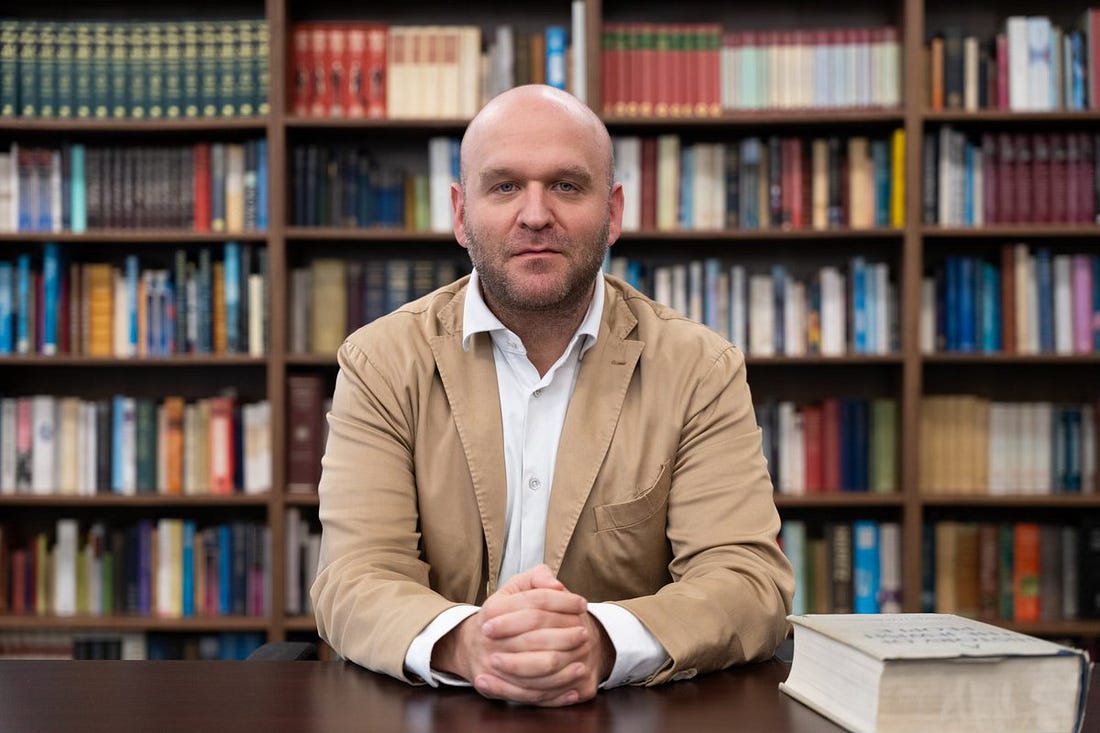
I've now been around quads large and small for quite some time, but I must say teaching at UATX has been among my most rewarding experiences. I have been seriously impressed by the ambition, open mindedness, and sheer desire to learn displayed by the students. There is very real potential in this student body.
This fall, I have been teaching a brand-new course on the history and political theory of Israel's founding built mostly around newly translated primary texts—speeches, letters, and other documents which shed light on the development of the modern Jewish state. Some of this material will be analyzed in my own soon-to-appear writing—and more than once a student intervention had me thinking about aspects of this significant material in Israeli history in a new way. I have been privileged to be a part of this wonderful experiment in higher ed.
Neil Rogachevsky joined UATX this fall to teach the founding of Israel. A political theorist and historian with a PhD in history from Cambridge, Neil is co-author of Israel's Declaration of Independence, a history of how the nation's founding document was drafted and debated.
 |
Public Events This Fall
All events are on campus in downtown Austin and free to the public unless otherwise noted.
October 13 · 5:30–7:00 PM: RSVP
The Myths of American Capitalism
Senator Phil Gramm shares his latest book The Triumph of Economic Freedom concerning pivotal moments in America’s economic history.
October 15 · 5:30–7:30 PM: RSVP
Unconventional Paths: The Setna iO StoryDavid Chaimovitz, founder and CEO of Setna iO, explores the pivotal decisions behind his entrepreneurial success.
October 16 · 12:45 PM-1:45 PM: RSVP
The Shroud of Turin
When we look at the Shroud, do we gaze upon the face of God? Fr. Andrew Dalton takes up this question in his uniquely biblical and scientific approach to the most treasured relic in Christendom.October 20 · 5:30–7:00 PM: RSVP
Do the Gracchi need to die for the Republic to survive?Professor Max Lykins of UT and Professor Isabella Reinhardt of UATX debate whether or not the Romans made the right choice in killing the Gracchi brothers for the good of the Roman Republic.