
|
 |



I’ve always pushed back on characterizing the execution of a lawful, court-ordered search warrant as a “raid.” I’ll do my best to stick to that tonight, although the context of the search warrant executed at Minnesota Representative Ilhan Omar’s D.C. residence early Monday morning makes it difficult.
 |
We do not yet know what charges the government may be contemplating; we haven’t seen the affidavit accompanying the warrant. There are a lot of unanswered questions. Omar came to this country in 1995—she was 12—and there is a five-year statute of limitations on most federal crimes. There’s a possible way around that because some immigration offenses are treated as continuing crimes for statute-of-limitations purposes. But that doesn't necessarily help the government here. Anonymous sources have characterized this investigation as involving her original immigration paperwork, perhaps some type of false statements case.
That raises additional questions. The government would already have all of the paperwork that accompanied her entry into the country. So what are they looking for? And what probable cause do they have to believe it would be found in her temporary D.C. residence, not her family home in Minnesota, which does not seem to have been searched?
We don’t know who the target of the investigation is. Omar’s age at the time would make it hard to establish criminal intent. And while others involved might have some technical liability depending on the facts, her father, who allegedly completed her paperwork, is deceased.
Here’s another question: Why now? DOJ has a longstanding policy against taking overt steps, like executing a search warrant or announcing an indictment, this close to an election. Often referred to as the 60-day rule, it’s meant to prevent prosecutors from using their power to unfairly influence an election's outcome. The concern is that the target has little meaningful opportunity to clear their name of the damaging insinuations before voters cast their ballots.
Without knowing what the government proposes to charge and who it proposes to charge, it’s difficult to assess whether this is another rank political investigation that will never develop into an indictment, a pure political stunt, or whether there’s more to it. But given the bad faith with which this administration has abused the criminal justice system to go after people Trump considers enemies, it’s hard to rule it out. Given the timing, you’d expect the government to make it known if there was some risk of evidence being destroyed, one situation that might warrant an action like this. But it hasn’t offered any explanation despite the unusual circumstances.
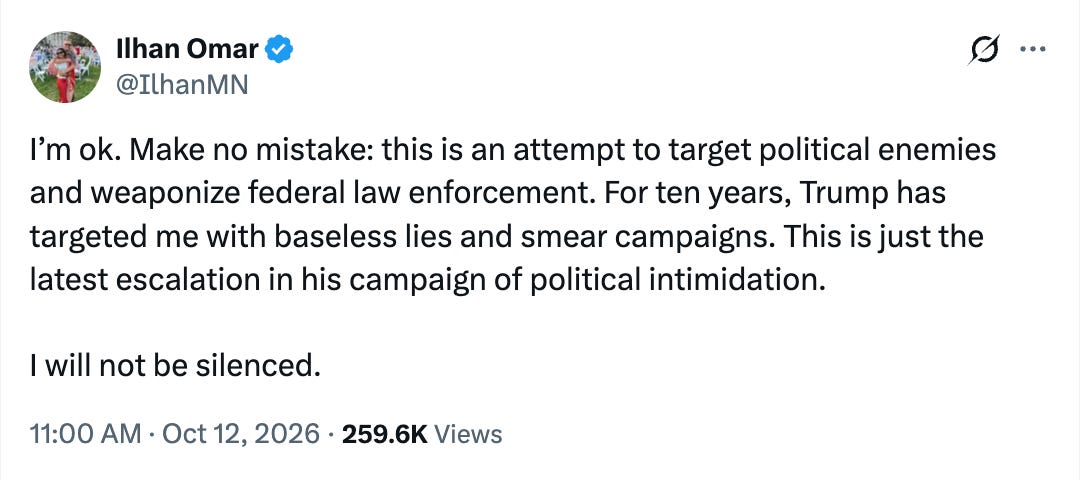
Omar was quick to respond.
 |
While there is a lot left to learn, we do know for certain that the election is already underway in Minnesota. Early voting is in progress and Omar is on the ballot. Even if this is a legitimate investigation, there was no apparent urgent need to execute a search warrant today. The original “crime” is decades old. It’s hard to imagine that DOJ just learned about the existence of evidence it so urgently needed to recover that it couldn’t wait the few weeks for the election to be over before striking.
It seems more likely that this is about politics than legitimate prosecution. And isn’t that what the Trump administration has turned the Justice Department into? A political tool in the president’s toolkit, no longer a bastion of the rule of law. No longer a place that prides itself on being above the political fray and doing justice regardless of who is in the White House.
The search warrant was signed by a judge. But we don’t know what facts the government shared with the judge to justify issuance of the warrant. It could be a solid case. Or it could be another revenge operation where they’ll never obtain an indictment. And it probably doesn’t matter to the man in the Oval Office who seems to be calling the shots at DOJ. Another investigation is open. That’s all it takes. Early voting in Minnesota is underway. The Trump administration has accomplished its mission. But whether it will have the effect the man calling the shots wants is an entirely different question. There’s already outrage over the timing of the search warrant. It could easily backfire.
One thing I’ve learned from my years in the Justice Department is that the questions we ask can be just as important as the answers we get. That’s what we try to do here at Civil Discourse: ask good questions, follow the evidence, and understand what the law tells us. If you’ve been reading along but haven’t subscribed, I hope you will. You can do that for free or decide to become a paid subscriber and support this work. Either way, I’d love to have you be a part of this community of people who care about getting it right.
We’re in this together,
Joyce
You're currently a free subscriber to Civil Discourse with Joyce Vance . For the full experience, upgrade your subscription.