|
|

|
Oct 13, 2026
|
|
|
|
|
Supported by
|

|
|
|
|
|
Happy Tuesday! Microsoft is overhauling the leadership of its Azure cloud business. Meta unveils new AI models. Anthropic is in the final stages of talks to build its first data center in Japan.
|
|
|
Microsoft is overhauling the leadership of its Azure cloud business, cloud chief Scott Guthrie told staff Monday, as the company consolidate units and reorients itself around AI. As part of the reorg, Arun Ulag, who previously oversaw Azure’s database products, will now also oversee executives who work on Azure Core, which provides computing power to customers such as OpenAI, and Azure’s engineering division. The executives include Girish Bablani, Billy Anders, Douglas Phillips and Mark Russinovich, Guthrie told staff. Charlie Bell, who previously led Microsoft’s security business before stepping into an advisory role earlier this year, will also now report to Ulag, said the person with direct knowledge of the reorg. The reshuffle follows a string of senior departures from Microsoft this year, including Azure leaders like Azure AI leader Eric Boyd, who left Microsoft to become Anthropic’s head of infra last spring. CEO Satya Nadella has meanwhile installed a new generation of leaders across the company while giving them more oversight of its business, including Ulag, whom Nadella has brought to board meetings earlier this year and is seen internally as one of Nadella’s proteges, The Information reported separately Monday.
|
|
|
Meta Platforms unveiled two new AI models, Muse Wonder and Muse Wonder Full, on Monday as it seeks to strengthen its position in the competitive AI race. CEO Mark Zuckerberg announced the models on Threads, describing them as significantly larger and more advanced than the company’s most recent line of AI models, Muse Spark. According to Meta, Muse Wonder Full delivers strong performance in reasoning, writing and coding, with benchmark results surpassing Anthropic’s Claude Fable 5.1 and OpenAI’s GPT-6 Astra on the Artificial Analysis Intelligence Index. Meta says the models offer “frontier” AI capabilities designed to handle complex tasks across both professional workflows and everyday life. The launch follows a broad overhaul of Meta’s AI division last year as Zuckerberg pushes to close the gap with industry rivals. The company aims to bring more advanced AI capabilities to its ecosystem of products, including its agent Muse, as well as its family of apps. Meta also recently launched a new unit called Meta Enterprise Platform to expand its AI offerings for businesses.
|
|
|
Anthropic is in the final stages of talks with NTT Data Group to build its first data center in Japan, Nikkei reported. The facility is expected to have a total power intake capacity of up to 500 megawatts, which would make it one of Japan’s largest data centers. Construction costs for the project, which is set to be based in western Japan’s Osaka prefecture, could potentially reach 1 trillion yen ($6.3 billion). Anthropic and NTT Data, a subsidiary of Japanese telecommunications group NTT, are aiming to sign a deal by the end of 2026. Partial operations could start as early as 2028, Nikkei reported. Anthropic has been on a sprint to increase its data center capacity to support model development and the deployment of its products. The company has struck $531 billion worth of compute deals in just the last 11 months, largely with cloud providers such as AWS, Google and Microsoft, The Information reported. It is in early talks to lease up to 1 gigawatt in capacity from a data center developer majority-owned by Apollo Global Management.
|
|
|
Microsoft on Monday announced the latest generation of its homegrown AI chips, dubbed the Maia 300, and said it plans to set up “multi-gigawatt deployments” of the chip starting next year. The move shows how Microsoft is aiming to reduce its dependence on Nvidia-designed GPUs, which currently make up the bulk of the chips it uses to power AI applications, and lower the cost of running its Copilot AI software. CEO Satya Nadella said in a post Monday that Maia 300 is 40% more efficient than “leading GPU-based systems” and that Microsoft plans to rely primarily on the chips to run its own AI applications. Whether Microsoft can meaningfully scale up its use of Maia may depend on how many of the chips it can manufacture in the coming year. The Information reported in August that Microsoft was in talks with chipmaker Taiwan Semiconductor Manufacturing Co. to secure manufacturing capacity for over 300,000 of the chips for delivery, an order of magnitude above the tens of thousands custom chips Microsoft has produced so far; deploying multiple gigawatts would require millions of chips. Microsoft has also been aiming to convince big AI customers like Anthropic to use the chips, The Information reported, but the company has yet to announce any large customers.
|
|
|
Dating app company Bumble is in advanced talks to be taken private by a holding company founded recently by former Sequoia’s partner Ravi Gupta, the Wall Street Journal reported Monday. A deal would value Bumble at roughly $1 billion, a steep premium to its last market cap of around $300 million before the Journal reported on the talks. Gupta, a general partner at Sequoia said in January that he would step back from his role at the venture firm and start his own company. The new company, founded together with former Meta chief revenue officer John Hegeman, was seeking to raise at least $1 billion to acquire companies, The Information reported in March. In recent years, venture capitalists including Thrive Capital and General Catalyst have started holding companies to snap up firms in traditional industries such as accounting and HOA management, with plans to use AI to transform them. Last month, Sequence Holdings, a venture backed by 8VC, Lux Capital and Conviction, took an insurance broker private in a deal worth $7 billion with billionaire Michael Dell’s family office DFO Management.
|
|
|
|
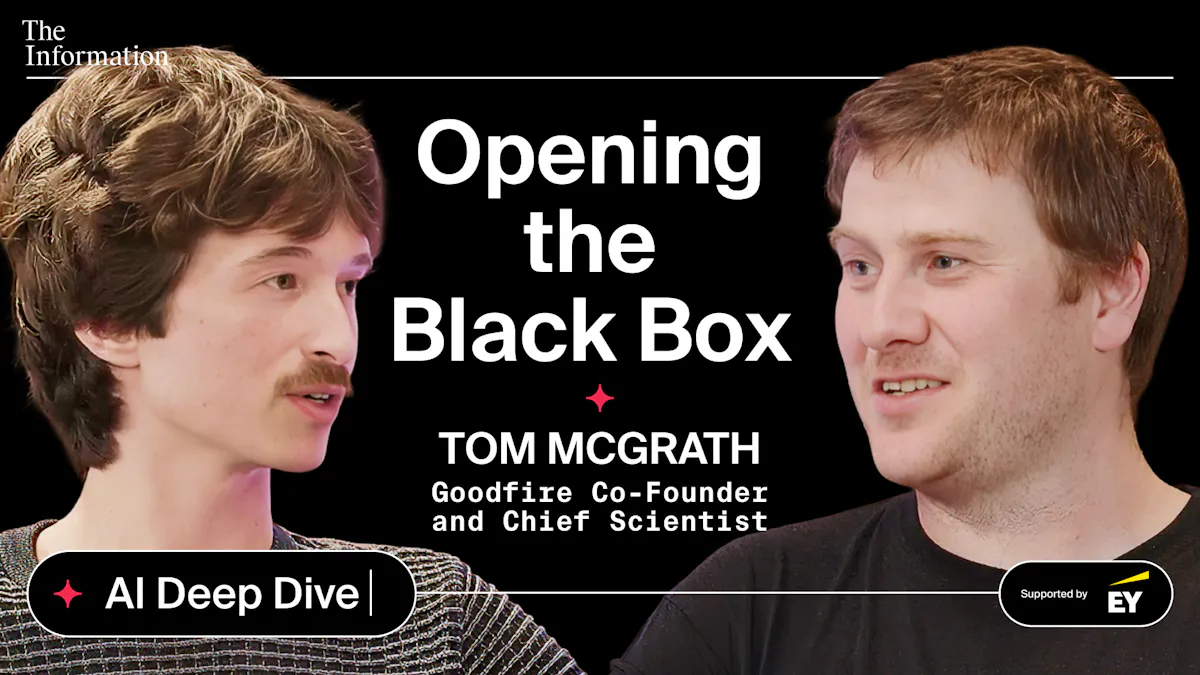
This week on AI Deep Dive
Check out the most recent episode of AI Deep Dive. A reported deep dive into how frontier AI actually gets built — the models, the money, and the people behind them.
| |
Popular articles
By Laura Bratton and Anita Ramaswamy
By Nick Wingfield and Aaron Tilley
By Phoebe Liu and Valida Pau
|
|
|
|
Opportunities
Empower your teams to stay ahead of market trends with the most trusted tech journalism.
Learn more
| | |