The long-struggling dating app has been looking for love in a hopeless place: the Nasdaq stock exchange.

(Malte Mueller/Getty Images)


Hey Snackers,

Somewhere between the invention of the internet and the rise of Wi-Fi, someone decided pigeons might be useful again. 

Back in 2001, Norwegian tech enthusiasts experimented with transmitting internet data via carrier pigeons. Of the nine packets sent, only four replies came back. Not exactly a technological breakthrough.

But 25 years later, one of those packets is up for auction at Christie's, with bidding already reaching $4,000. Apparently, even a failed technology venture can appreciate in value.

Stocks slid on Tuesday as US crude oil prices ticked higher while the global benchmark dropped.

 
OFF THE MARKET

Bumble is looking for love away from Wall Street

Bumble, the long-struggling dating app, has spent the past five years looking for love in a hopeless place: the Nasdaq stock exchange. 

The company announced Tuesday that Ithaca Holdings, an investment firm founded by two Silicon Valley veterans that appears to be less than a year old, has agreed to buy it for $1.3 billion cash in a take-private deal. Shareholders will receive $6.05 per share, a whopping 138% premium to Friday's closing price, the last trading day before the Wall Street Journal reported Bumble and Ithaca were in advanced talks. 

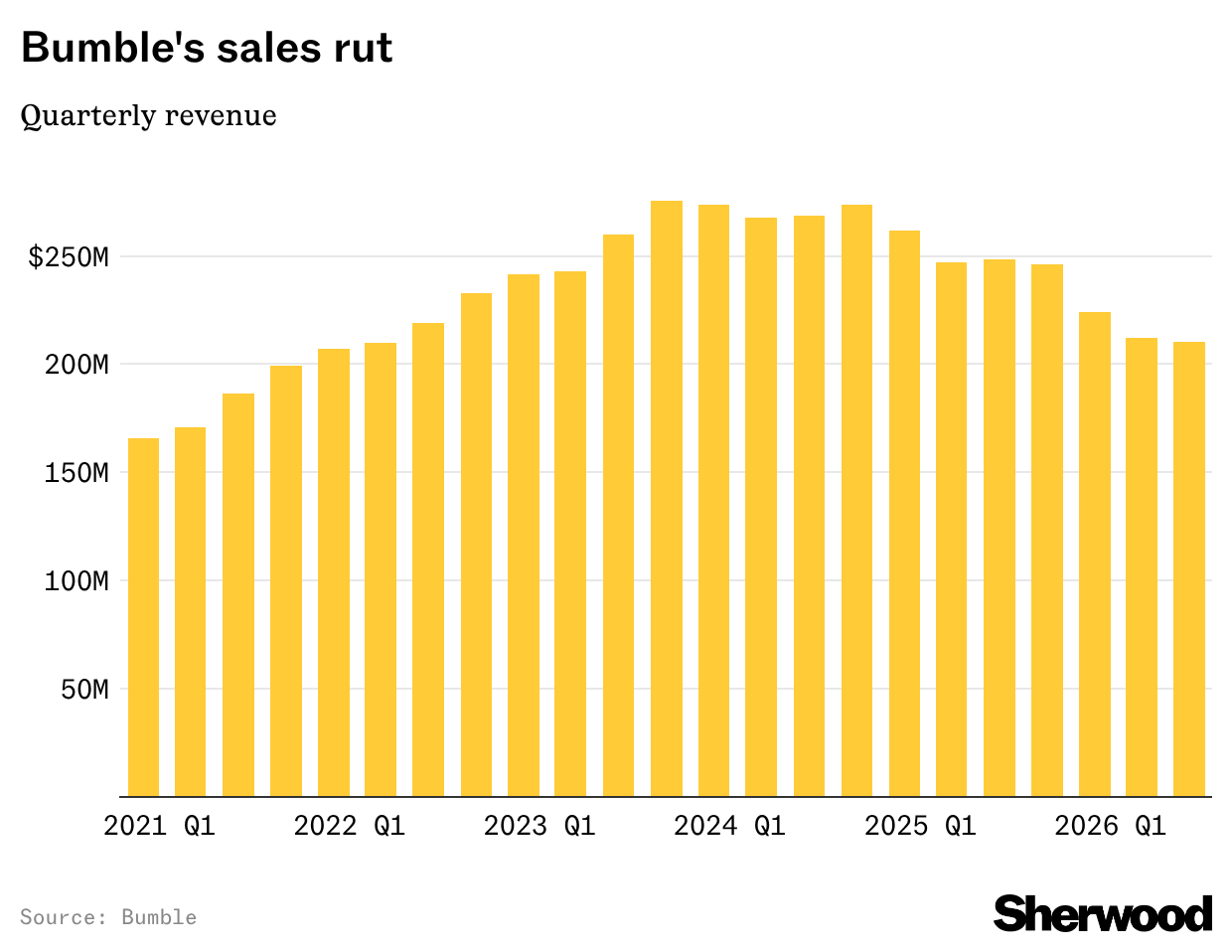
The $1.3 billion price tag may sound like a lot until you remember the company had a peak valuation of about $14 billion around the time it went public in 2021. Bumble has seen its sales decline for the past few years and is expected to report a $15 million net loss for this fiscal year which would mark its fifth consecutive year in the red.

It’s unclear exactly how Ithaca plans to turn it around. In a statement, Bumble CEO Whitney Wolfe Herd (who, notably, recused herself from the board vote on the takeover) said Ithaca is “a partner who shares our vision, believes in our women-first mission, and is committed to investing in Bumble’s future.” 

In case you forgot: Wolfe Herd founded Bumble as a women-focused dating app in 2014, she announced she was stepping down as CEO in 2023, then returned in 2025.

Bumble — not unlike its peer apps owned by Match Group — has struggled to keep users engaged, particularly younger ones who are growing tired of endless swiping. Its paying user base shrank 16% year-over-year to 3.2 million in the second quarter, while revenue fell about 15%.

The company has been trying to reinvent itself, loosening its signature women-make-the-first-move rule and experimenting with in-person events where users meet before matching. Its biggest planned change is doing away with the swipe altogether, although it hasn't revealed what will replace it. The new model is expected to begin rolling out in early 2027, following technical delays.

The takeover also means a changing of the guard: Ithaca founders Ravi Gupta, a former Instacart executive, and John Hegeman, a former Meta executive, will become Bumble's co-CEOs. Wolfe Herd will remain involved with the company she founded.

THE TAKEAWAY

Dating apps are a tough business. 

You need a big enough pool of people on your platform. Then you have to convince enough of those people to pay for premium features. And then, if those premium features actually work, you’re perpetually cannibalizing your own subscriber base. 

Not to mention the tides are turning away from swipe-based apps. Gen Z would rather touch grass and seek a meet-cute than brainrot on a dating app. While some startups are certainly trying, It’s unclear where Bumble or its peers squeeze shareholder value from in that world. 

— J. Edward Moreno


Snacks Shots