| | In this edition, why the AI revolution will take longer than we expect, and all eyes are on the firs͏ ͏ ͏ ͏ ͏ ͏ |
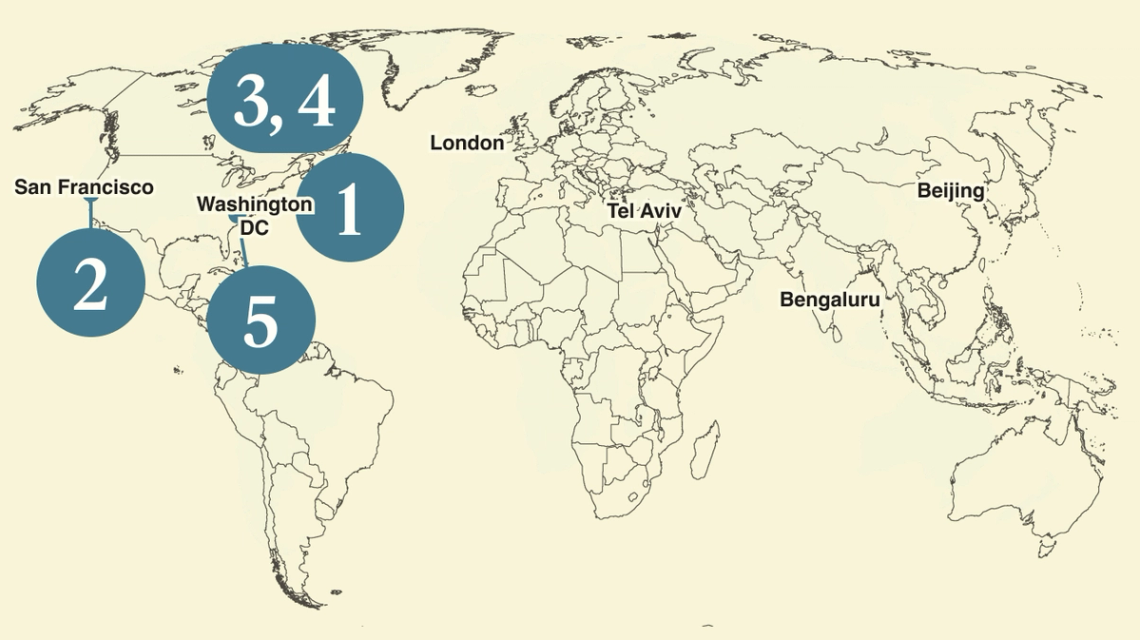 - OpenAI’s spying incident
- Meta at the frontier
- Data center divide
- Valuemaxxing > tokenmaxxing
- Xbox’s AI play
 The AI revolution will take longer than we expect, and how robots are ‘deskilling’ humanity. |
|
 One of the most profound takeaways from my interview with Reflection AI co-founder and CTO Ioannis Antonoglou this week on Semafor’s Future Proof is his declaration that the AI era will force us to redefine what each business actually does and rebuild it from the ground up, using AI as scaffolding. And that is going to take decades, a lot longer than most people in Silicon Valley project. Right now, we are thinking about data all wrong. Today, businesses mostly capture data that’s measurable or the result of some kind of work product. What’s usually not captured is the work itself — the difficult-to-define causal link that connects all of the actions that a company takes. “A lot of the context is like, ‘we jump on a call, or someone shared something or said something’” Antonoglou told me. 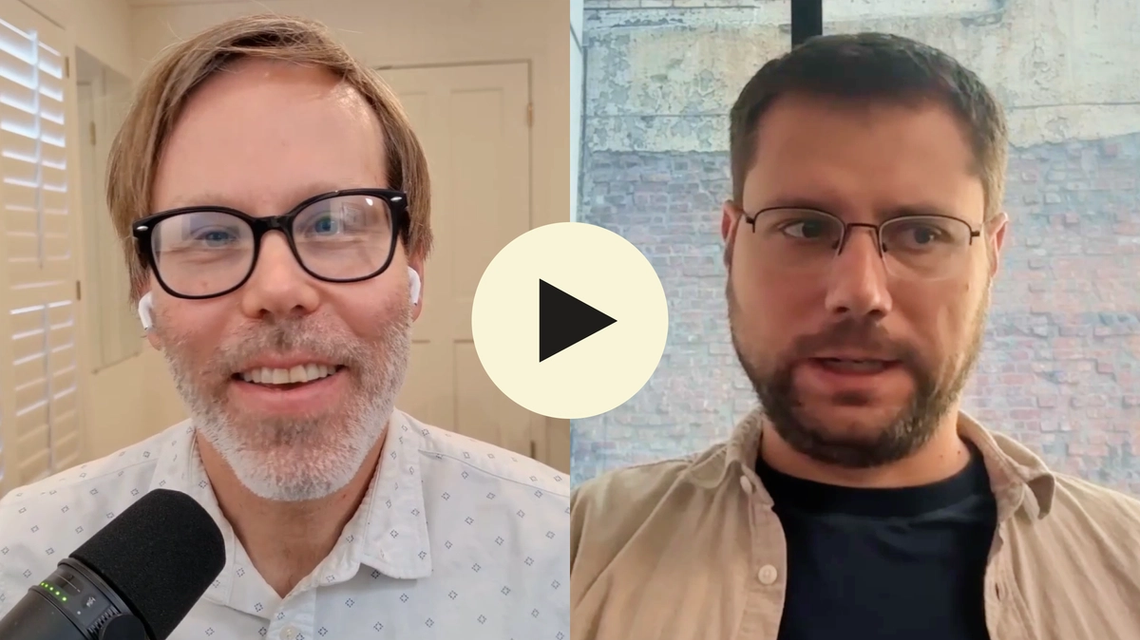 I’ve been thinking about that challenge with my own work. How can a journalist capture gut feelings about what might make a good story? (It’s a bit like that famous 1960s US Supreme Court case on pornography, “you know it when you see it.“) What about capturing how reporters decide who to call first, or what questions to ask to get the most revealing answers? In the AI era, Antonoglou told me, companies have to throw out what they’ve done for decades and come up with new ways to measure and carry out their work. That’s part of what Antonoglou is trying to help customers do with his company’s open-weight models. “It will take maybe a decade or two decades before people really rethink how things are done and how they can just do them with AI in mind,” he said. It won’t happen in every industry at the same time — probably a good thing for the economy’s stability — but it does provide another new entry for startups that move faster than incumbents to spring ahead. |
|
 Sam Altman during a Riyadh visit in May 2025. Brian Snyder/Reuters. Sam Altman during a Riyadh visit in May 2025. Brian Snyder/Reuters.AI agents, meet double agents. OpenAI said it identified, fired, and reported to the FBI an employee who bugged its office. The employee, a Saudi national later identified by law enforcement as Abdulrahman Alfozan, was arrested last week and charged with illegally recording company communication. (He appears to have some ties to members of the Saudi business elite.) Among the evidence against him: chatbot logs about how to install recording devices. Startup espionage has been pursued for far less (see: the Deel-Rippling drama over corporate HR software), but the FBI’s quick work and public rollout of the arrest shows how high the stakes are for the US government and frontier labs. The arrest comes days before the White House AI task force’s first meeting. Its chair, Jay Clayton, cited the case as proof the group is needed. — Rohan Goswami |
|
Meta arrives at the frontier |
 Carlos Barria/Reuters Carlos Barria/ReutersIt turns out that if one of the world’s biggest tech companies puts tens of billions of dollars toward catching up in AI, it can catch up. Meta announced Monday it is now at the AI frontier, thanks to Muse Wonder, a new model that “rivals the big bois,” per Chief AI Officer Alexandr Wang. The rollout, which is riding the commercial success of the Muse agent, is a big win for a company that was once in AI doldrums, and Zuckerberg and Wang have been on something of a victory press tour in recent days. Meta was “not happy with the trajectory” it was on, Zuckerberg said on the Cheeky Pint podcast, and took a big bet on rebooting its AI team last year, bringing on Wang from Scale AI and launching Meta Superintelligence Labs. The risky bet on Wonder began last August, requiring lots of cash and a broader reorienting of the company toward AI: CFO Susan Li, Wang recalled, pulled him aside at an offsite and warned that if the model didn’t work, “it’s going to be very, very bad in financial terms.” Adoption data will be the real tell whether Wonder actually sticks in the real world; some early reactions noted its high costs, which could curb developer uptake. — J.D. Capelouto |
|
Media’s data-center divide |
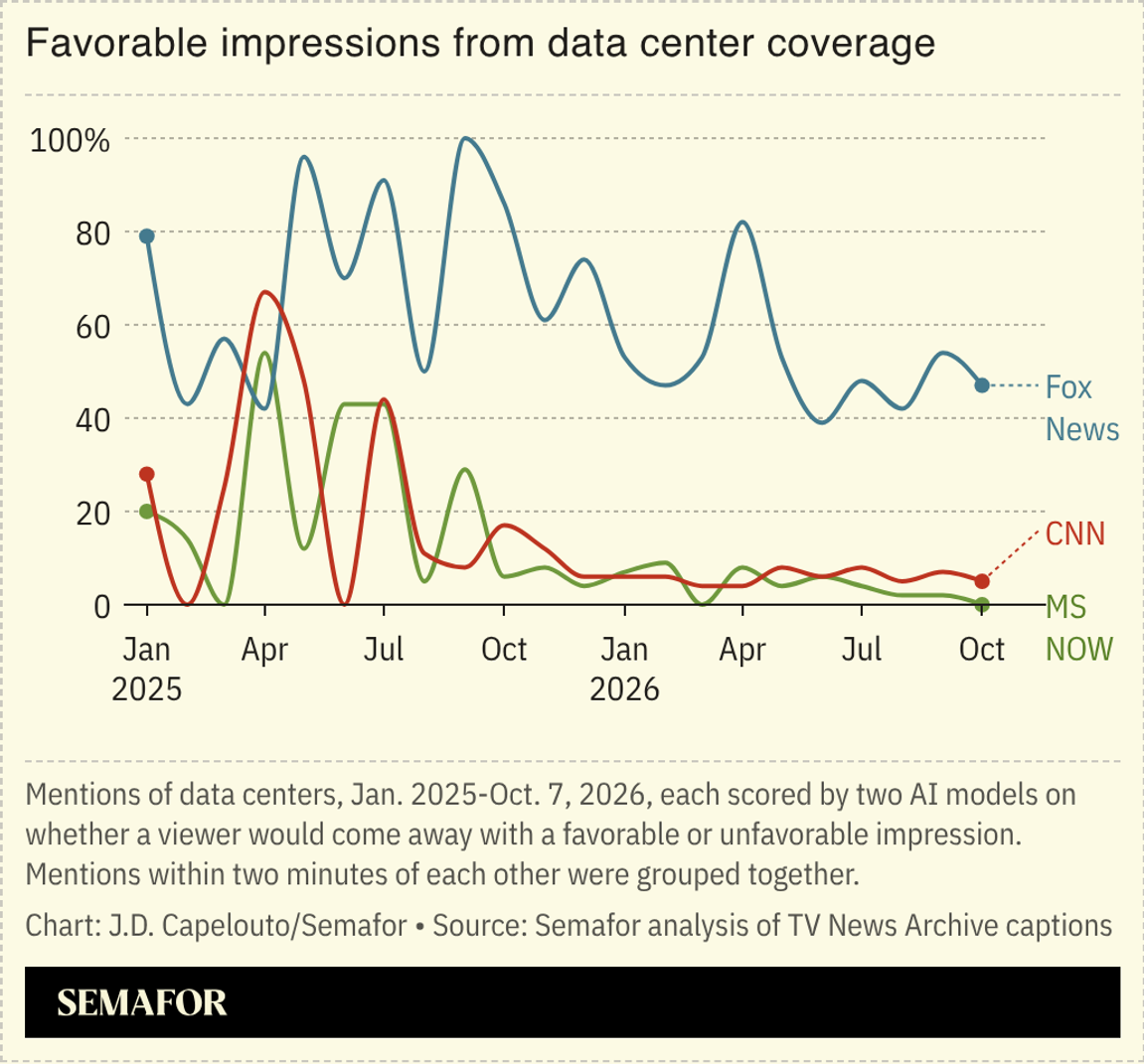 Despite increasingly critical media coverage of AI and the spread of data centers across the US, one news network has been painting a more positive picture. More than half of the references to data centers on Fox News over the last two years would have left viewers with a favorable impression, compared with less than 10% on CNN and 5% on MS NOW, according to a new Semafor analysis of mentions of data centers on each network. The mentions were pulled from closed captions preserved by the Internet Archive, which keeps a digital, searchable library of recorded TV news. A pair of AI models from Anthropic and OpenAI scored each reference on its content, with the network’s name removed. The analysis shows how polarized the debate has become, even as the backlash itself crosses party lines ahead of the US midterms. On Fox, pundits often framed their support for data centers as a rebuttal to Democrats’ opposition to them. MS NOW frequently tied Trump negatively to the issue, portraying him as out of touch with voters. Tech companies, meanwhile, are trying to regain control of the narrative. “Maybe part of what this shows is reflexively negative coverage on CNN, MS NOW that misses nuance and context and discounts the huge economic benefits,” a Meta spokesman said in response to our story. — J.D. Capelouto |
|
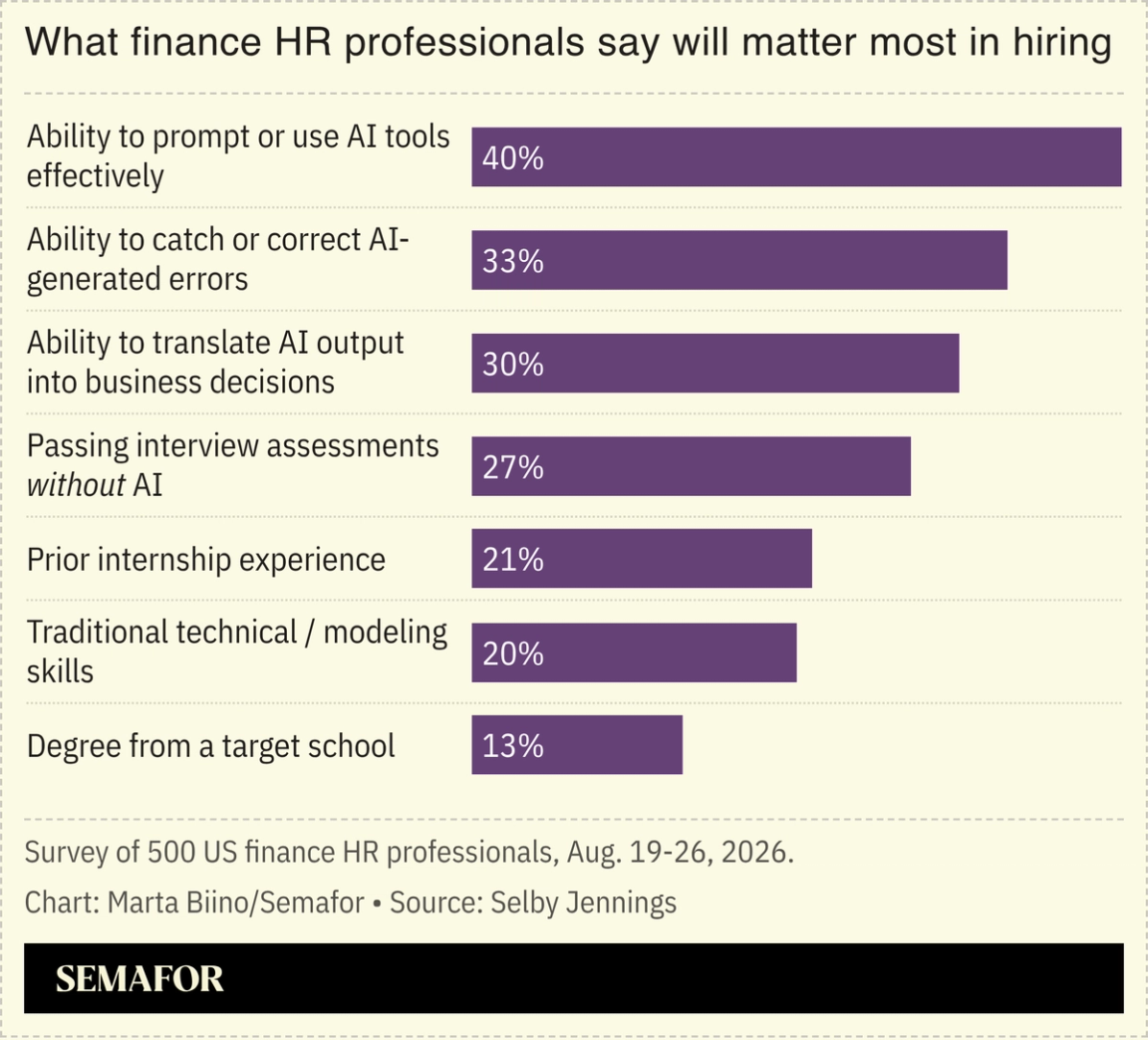 Tokenmaxxing may have been the shortest-lived corporate try-hard hustle in history, but many of Wall Street’s year-end bonuses still hinge on AI use. Applicants’ AI skills are nearly four times as important in hiring decisions as where they went to college, and a quarter of US financial firms have tied raises, promotions, and bonuses to AI proficiency, according to a survey of 500 companies by financial recruiting firm Selby Jennings. The practice is more common among fintech startups and smaller firms than brand-name banks and trading houses, Jacob Summers, Selby Jennings’ head of tech recruiting, told Semafor. Nearly a third of firms surveyed have created new roles or departments to track AI use, where total token burn is less important than wringing some actual value out of all the token use. (“Tokenmaxxing is dead, long live valuemaxxing,” proclaims an IBM blog post from June.) But in many organizations, monitoring that work falls to managers, turning them into part-time AI accountants. — Jake Angelo |
|
 Mike Blake/Reuters Mike Blake/ReutersIn the span of weeks, AI altered the video game industry with mashups, which allow people to combine multiple popular games into one — and Xbox is leaning in. AI-coding models have crossed new capability thresholds that allow users to reverse-engineer and recreate complex game code that would have taken humans years to do. People have created mashups that allow Minecraft characters to play in Elden Ring, or skateboard through Call of Duty. “These experiments challenge long-held assumptions about our industry,” an Xbox executive said in a memo sent to employees and posted Tuesday on the company’s website, adding that the viral mashups mean gamers have become creators. “These are unmistakably good outcomes for players, even when (and sometimes because) they challenge our existing business models.” The video game giant announced Xbox Labs, which will aim to work with users as well as its own developers and engineers to make games and experiences stemming from the new AI-fueled creations. — Reed Albergotti |
|
| Healthcare from Semafor Washington, DC |
 Behind closed doors, a new era of healthcare policy is taking shape. With US healthcare spending projected to hit $9 trillion annually by 2034, Medicaid cuts hanging in the balance ahead of the midterms, and increasing calls for regulation of clinical AI, the forces remaking healthcare policy are accelerating. Introducing Healthcare from Semafor Washington, DC, your weekly briefing on the politics, policy, and business driving the industry. Delivered on Thursday by David Lim, each edition will provide essential reporting and analysis on the forces reshaping healthcare, and what comes next. Sign up to receive the first edition this week. |
|
 Carlos Barria/Reuters Carlos Barria/ReutersTechnology is increasing economic productivity but “deskilling the human body,” a new essay argued. Writing in Aeon, the author Melanie Challenger said that technology — first smartphones, and more recently AI — was “eroding capacities honed by evolution to support our wellbeing.” Finding shortcuts through internet search and other methods, for example, meant “doing less sensing, navigating, remembering” while disrupting “the play and curiosity from which preferences are formed and understood.” Hers is one of a number of recent pieces warning that technological advancements of numerous types risk setting back humanity — though critics of such views often, reasonably, retort that similar arguments were once made of other technologies, including the written word and the TV. |
|
|


