| | In this edition, the president rallies in a Rust Belt stronghold, Texas’ Senate race gets weirder, a͏ ͏ ͏ ͏ ͏ ͏ |
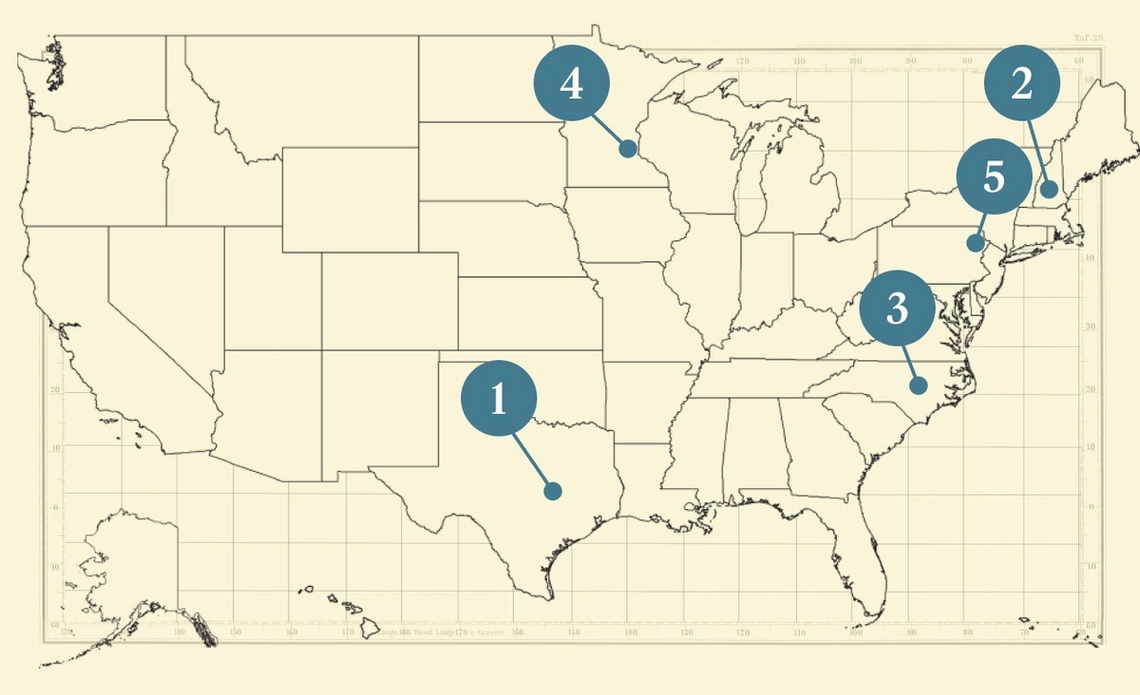
| |  SAINT PAUL, MN SAINT PAUL, MN |  YOUNGSTOWN, OH YOUNGSTOWN, OH | SALVO, NC |
| |
|
 - Texas gets stranger
- Spoilers go national
- PACs exit NC, GA
- Minnesota’s partisan lean
- Artificial flavor
|
|
 YOUNGSTOWN, Ohio — Toward the end of Monday night’s MAGA rally, after Jon Husted heard Donald Trump compliment his jawline and his “ass,” he thanked the president for making Ohio so much easier for Republicans to win. “The Youngstown area, for decades, used to vote Democrat,” the Republican senator said. “And then you ran for office in 2016, and flipped it red forever.” For a decade after that, Youngstown has become the first stop on what media critics derided as “Trump voter safaris,” journeys into the working-class counties that never voted Republican until he showed up. Husted’s claim of a permanently red state, however, isn’t adding up for Democrats: As soon as I arrived this week, they insisted that MAGA’s advance was over. This isn’t because Democrats have snapped back to the image and values they ran on in the 1970s, when they had a lock on this state. No, the party insists that Republicans are in charge, making voters angry with their handling of the economy and the Middle East, so the culture-war politicking that worked for a decade won’t be as potent in November. “People aren’t buying that again because they’ve realized you can’t deposit culture war into your bank account,” said Chris Anderson, the chairman of the Mahoning County Democrats, who’d spent years trying to limit their losses and defections. “You can’t fill your gas tank with it.” Campaigns have a queasy rhythm to them — hype followed by panic followed by hype. We’ve reached the time in the cycle where the party that built a post-Labor Day polling lead begins to question its own confidence. “They’re undersampling Republicans,” Speaker Mike Johnson told the faithful in South Texas on Tuesday, a part of that state that seemed to be following the same rightward march as northeast Ohio — and before that, Appalachia. Republicans around Youngstown expected the trend of underestimating their vote to hold this year, but not accelerate. They agreed that Democrats would at least be competitive. Rep. Michael Rulli, who represents the Mahoning Valley in Congress, said that the GOP got an opening when “Clinton came in and lied about NAFTA,” which made local Democrats thrash around in search of a populist alternative. “When Trump came around, the people just took to it, and so they’re giving us a shot,” Rulli added. “This area will not always stay Republican or Democrat.” |
|
Talarico’s faux scandal doesn’t shake his Senate lead |
 Joel Angel Juarez/Reuters Joel Angel Juarez/ReutersJames Talarico’s bout with the flu produced one of the strangest scandals, and backfires, of this midterm — a failed effort by conservative influencers to prove that he had left the trail to go to an Ohio mental hospital. The story began when Republicans realized that the Democratic nominee had gone dark in October, without the campaign explaining why he wasn’t on the trail after some late September fundraisers. “Where is James Talarico?” GOP nominee Ken Paxton asked at rallies last week, as his campaign created a faux “help line” for reports of Talarico sightings. After Talarico’s campaign explained that he contracted the flu, MAGA operative Caroline Wren noted that “a private plane took off from Austin and flew to tiny Hamilton airport in Ohio which is 20 mins from the Lindner Center, a private inpatient mental health treatment facility.” That launched a race on the right to find proof that Talarico was not just stricken by flu, but mentally feeble and covering it up. Powerful Republicans insisted that something else was going on, including White House deputy chief of staff Stephen Miller. One influencer released a call to the Lindner Center that, he alleged, confirmed the chatter. But the recording didn’t actually say that, and the center quickly clarified on social media that Talarico was never there. Talarico’s campaign embraced the story, which fell apart after he attended Austin City Limits with reporters tagging along. And on Wednesday, a new Marist poll conducted amid the flap showed Talarico holding onto a lead — albeit, one within the margin of error. |
|
Why one spoiler candidate is now trying to replicate his work nationwide |
 Evan Vucci/Reuters Evan Vucci/ReutersAaron Day’s third-party campaign cost Republican Kelly Ayotte her Senate reelection bid in 2016. Now he’s trying to take his spoiler project national, Semafor’s Burgess Everett reports. With several Senate races tight enough for an alternate candidate to make a real difference, whether they’re Libertarian or another third party, Day is looking to spend as much as $2.5 million — or perhaps less, if his effort works as designed — to cost the GOP the Senate. Day’s strategy is simple: Use his Stark Freedom PAC to spend relatively small amounts on online ads made with AI that boost name ID for spoiler candidates, figuring he can do just enough to hand those races to the Democrats. Republican leaders are highly skeptical of Day’s efforts, but he sees a real chance at disrupting races across the country. What’s more remarkable is how open he is about his goal of ending the Senate Republican majority. “You call it a spoiler campaign, I call it holding Republicans accountable,” Day told Semafor in an interview. His website is equally explicit: “We fund the margin. It costs the GOP the Senate.” Day is targeting eight states where he’s deduced that boosting third-party candidates would hurt the Republican nominee: Texas, Iowa, New Hampshire, Minnesota, South Carolina, Michigan, Ohio, and Kansas. It’s a “Moneyball” theory of modern politics, banking on a relatively small amount of cash to mess up the margins in close contests. |
|
Spending pause in NC, GA frees up funds |
 Jonathan Ernst/Reuters Jonathan Ernst/ReutersPACs are shifting their spending deeper into red territory and pulling out of Georgia and North Carolina, as the Senate races there look all but buttoned up. With Sen. Jon Ossoff of Georgia and former North Carolina Gov. Roy Cooper heavily favored to win, GOP groups are scaling back ads there. They’re also redirecting funds away from candidates in Democratic-leaning purple districts, like those represented by Reps. Tom Kean of New Jersey and Mariannette Miller-Meeks of Iowa, toward GOP incumbents in districts more handily won by President Donald Trump in 2024, like Reps. Monica De La Cruz of Texas and Rob Wittman of Virginia. Having paused its own spending in North Carolina and Georgia, Democrats’ top super PAC is pouring more money into those must-win races in Maine and Michigan. Senate Majority PAC, aligned with Minority Leader Chuck Schumer, is pouring nearly $7 million more into two major races, according to details shared first with Semafor; it’s also adding $3.7 million to its campaign in Michigan, bringing the group’s total investment up to nearly $35 million in the race between Democrat Abdul El-Sayed and Republican former Rep. Mike Rogers. The group’s ad campaign this week offers a road map to the battlegrounds: New Hampshire, Michigan, Maine, Kansas, Ohio, Iowa, Alaska, and Texas. |
|
Klobuchar anchors Dems’ Minnesota polling |
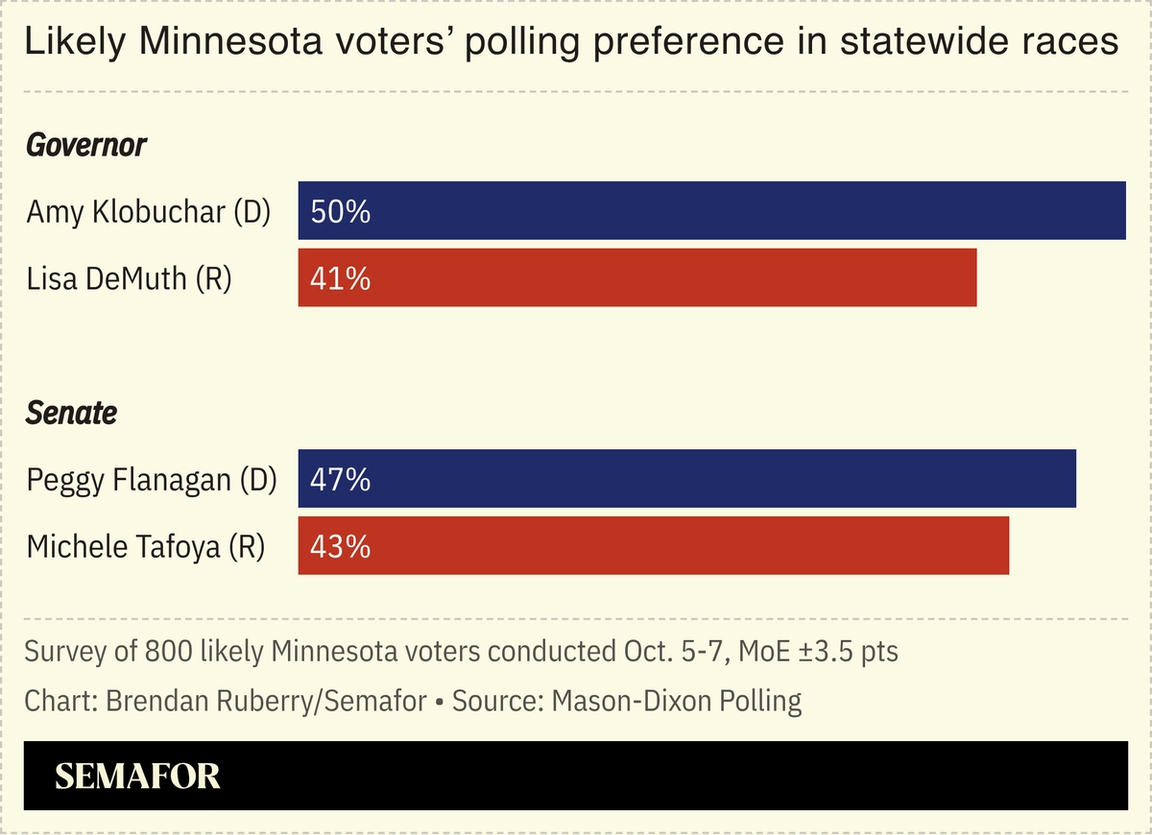 Minnesota Republicans started the year expecting to run against Gov. Tim Walz and wrap the ongoing investigations into welfare fraud around his neck. By the end of January, ICE agents had killed two Minneapolis residents, Walz had announced his retirement, and Klobuchar entered the race to replace him, ensuring that the state’s most popular Democrat would lead the ballot. Klobuchar is holding up the sky for her party: She leads in the Twin Cities by a landslide and trims the party’s deficit in greater Minnesota. Flanagan is marginally weaker outside of Minneapolis and St. Paul, and Tafoya leads narrowly with independents. That Flanagan weakness is what Rep. Angie Craig warned about in their primary battle, which Craig lost by a landslide. The fraud investigation is central to both Tafoya’s campaign and statehouse Speaker Lisa DeMuth’s race for governor; the Republicans ask why the Democratic lieutenant governor should be elevated to the Senate when she didn’t stop the fraud. Even so, that question isn’t outpacing Minnesotans’ partisan preference: to elect a Democrat. |
|
AI-skeptical PAC launches new anti-Republican ads |
 Tomorrow Together/YouTube Tomorrow Together/YouTube
Tomorrow Together launched in September with plans to raise $10 million and help elect AI critics to Congress. Its first midterm move happened this week, with ads in four swing districts that Democrats have targeted all year. Unlike some ads funded by industry PACs, the Tomorrow Together ads are directly about the use of AI. “Kids” goes after GOP Reps. Rob Bresnahan of Pennsylvania and Juan Ciscomani of Arizona for taking “big AI” money even though chatbots have “groomed” children and been blamed for suicides. “Emptying” warns that AI companies — protected with tax breaks by GOP Reps. Derrick Van Orden of Wisconsin and Tom Barrett of Michigan — could create systems that “deny your insurance.” In 30 seconds, they accuse each incumbent of being bought off, putting your job and health at risk, and endangering your children. |
|
| Healthcare from Semafor Washington, DC |
 Behind closed doors, a new era of healthcare policy is taking shape. With US healthcare spending projected to hit $9 trillion annually by 2034, Medicaid cuts hanging in the balance ahead of the midterms, and increasing calls for regulation of clinical AI, the forces remaking healthcare policy are accelerating. Introducing Healthcare from Semafor Washington, DC, your weekly briefing on the politics, policy, and business driving the industry. Delivered every Thursday from David Lim, each edition will provide essential reporting and analysis on the forces reshaping healthcare, and what comes next. |
|
|


