
|
Almost Timely News: 🗞️ What Are Open Weights Models? (2026-10-18)
Teaching a Terminator to play softball
|

| |||||||||||||||


Almost Timely News: 🗞️ What Are Open Weights Models? (2026-10-18) :: View in Browser
 |
The Big Plug(s)
🚗 Missed MAICON 2026? You can catch the replay of my session here!
✍️ Enroll in my new course, AI for Writers and learn how to make AI write better.
My Unofficial LinkedIn Algorithm Guide is updated for October 2026!
👉 Get the paid version here, USD 20, with one-pagers and AI Skills.
Content Authenticity Statement
95% of this week’s newsletter was made by me, the human. The lead image is generated by ChatGPT’s Image model. Learn why this kind of disclosure is a good idea and might be required for anyone doing business in any capacity with the EU in the near future.
Watch This Newsletter On YouTube 📺

Click here for the video 📺 version of this newsletter on YouTube »
Click here for an MP3 audio 🎧 only version »
What’s On My Mind: What Are Open Weights Models?
This week, a reader request from Claire who asked over dinner at MAICON if I could explain open weights models more, because it’s a term heard a lot, but people don’t understand what they are or why they’re important.
Part 1: Weights
Before we dig into open and closed, what are model weights? You’ve likely heard terms like models that have a certain number of parameters, like a 70 billion parameter model or a 9 billion parameter model or a trillion parameter model. To make this concrete, let’s express this in terms of softball.
Bear in mind, my expertise is in AI, not sports, so if I get some of the sports terminology wrong, I apologize.
Think of a softball player like a model architecture. You have some players who are batters, some who are outfielders, some who are pitchers. While you can move some players from position to position, in general, the more specialized the position, the less you can swap players. A pitcher and a catcher are hard to interchange.
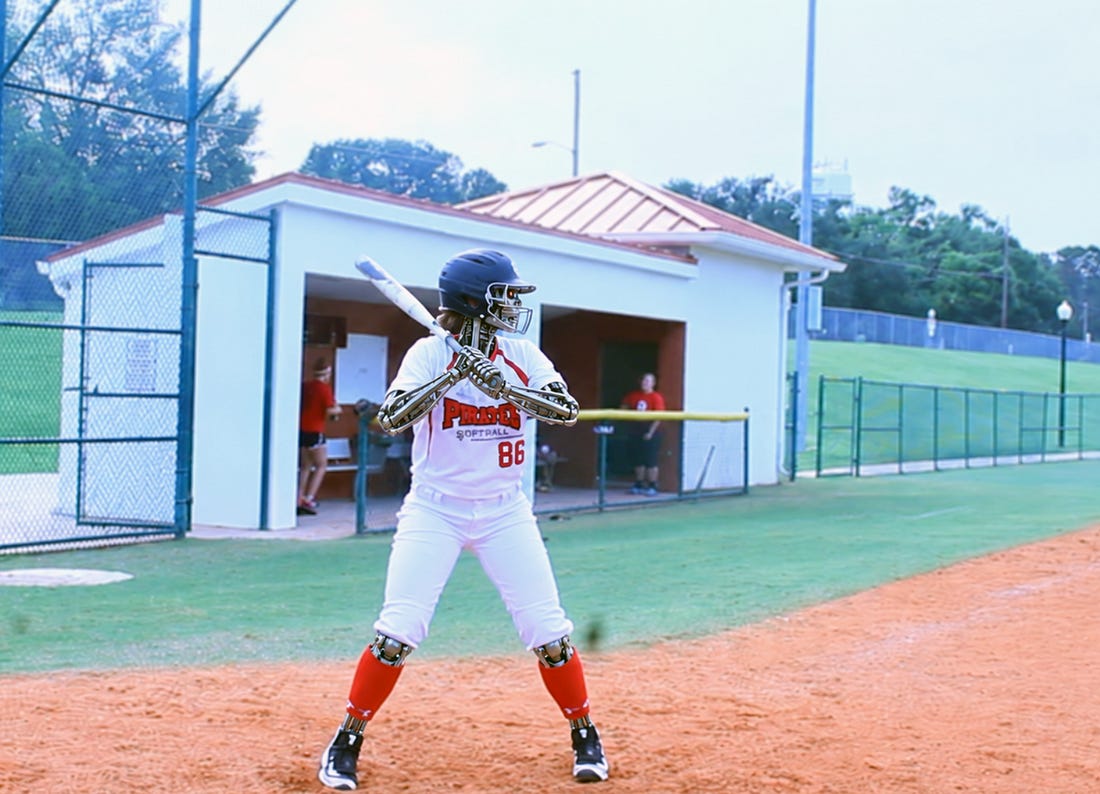
Let’s take this a step further into the absurd. Imagine you just got a shiny new T-800 Terminator robot, completely untrained. Instead of giving it a pulse rifle and hunting down humanity, you give it a baseball bat and you want to teach it to become the best softball player in the world. How would you do that?
 |
You’d have to teach it things like grip position, swing, stride, stance, all the things a real softball player would learn to do through muscle memory. Those are parameters - all the things you can adjust in the robot’s memory to remember how to play softball.
And there are different models of Terminators. Some are smaller and have fewer articulations - elbows that only bend a certain way, or limits to their running speed. They have fewer things available to tweak, fewer muscle memories to build, so they have fewer parameters. That means they’re ready to hit the field sooner - they need less training - but it also means they will screw up more because they simply can’t adapt to some situations.
A deluxe T-800 has thousands, maybe millions of different things you can tweak. Where their lead elbow points, how far their hips are turned, when to swing, how to hold their hands to maximize a line drive. Even something like where their pinky finger is positioned on the bat can make a different in some situations. It takes a lot longer to teach this Terminator how to play softball because there are so, so many different things to learn.
In this ridiculous scenario, the training data is literally softball training. You put the Terminator in a batting cage with a pitching machine and you throw millions of pitches at it, adjusting it incrementally. For an entire series of pitches, you increase the height of the left elbow by a millimeter at a time until you find the sweet spot for the left elbow.
Once you find the sweet spot for something, the Terminator remembers it. That memory of exactly at what height their left elbow should be positioned to hit a line drive is a weight.
The parameter is what, and the weight is how.
Smaller models have fewer parameters, and thus fewer weights, fewer things to remember. When the field changes and the team takes the field, the smaller Terminator is ready faster because it has less to remember. The larger Terminator is ready slower because it has more to remember, but it’s more skilled at dealing with more situations.
In AI, the fewer parameters, the less precise the model is. It’s faster, it’s less overhead, but it runs into trouble more frequently.
When we’re talking about model weights, we’re talking about a database of all those tweaks for every parameter, exactly what makes it work best. That’s part of the reason why AI companies devour so much data. Model training is exactly like softball training.
The ball is the data, by the way. Each pitch from the machine is a piece of data, and you’re trying to train the Terminator for every conceivable pitch. So now you can see why model training is so intensive and expensive - you have to test every parameter possible against every pitch possible. Do you hit a line drive better when your left elbow is 44 inches off the ground when the pitch is a curveball versus a straight pitch? To find that out, you need to test millions, billions, or maybe even trillions of pitches.
You’ll hear terms like mixture of experts model sometimes. These models are faster because they have their knowledge segmented. Imagine the same Terminator, but instead of having to remember everything for every single situation, it can selectively just remember how to be a great outfielder when it’s in the outfield, and just remember how to be a great batter when it’s batting - and not have to re