U.S.-China Trade War, Regional Summits, and Japan’s Path Forward |
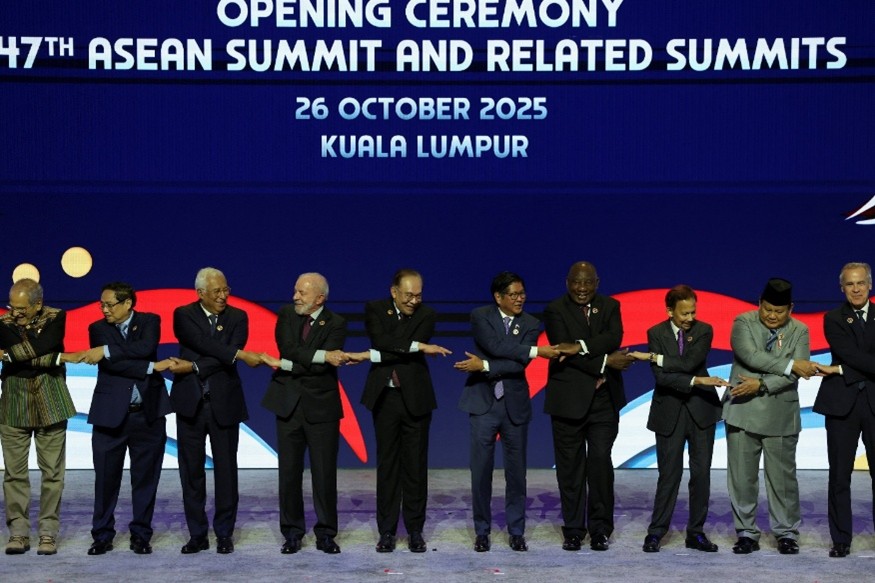
Malaysian Prime Minister Anwar Ibrahim (center) poses with other world leaders during the opening ceremony of the forty-seventh Association of Southeast Asian Nations Summit and related summits in Kuala Lumpur, Malaysia, on October 26, 2025. (Chalinee Thirasupa/Reuters) |
In this month’s newsletter, Council on Foreign Relations (CFR) experts explore the outcomes of two consecutive major regional summits and the trajectory of Japan’s foreign policy under its new prime minister, among other topics. |
|
|
In a New York Times opinion piece, C.V. Starr Senior Fellow for Asia Studies Rush Doshi argues that the recent U.S.-China summit shows China is now, potentially, a true peer to the United States. Despite the Trump administration launching a trade war on China earlier in the year, Beijing has absorbed the pressure and applied counterpressure, including halting rare-earths exports. Its strategy has led to an economic retreat by the White House, sidelined U.S. partners, emboldened China to step up its pressure, and, Doshi writes, showed the world that China’s coercion can work. Read the full piece
|
|
|
On October 30, U.S. President Donald Trump and Chinese leader Xi Jinping met during this year’s annual Asia-Pacific Economic Cooperation (APEC) conference. Fellow for Asia Studies David Sacks argues that the meeting’s outcomes could have fewer implications for the United States than White House readouts suggest. Although the two sides have reached a temporary trade truce, Sacks notes that relations “may well settle in at this level” ahead of another Trump-Xi summit in April 2026, leaving China in a much stronger position economically than before the trade war started in early 2025. Find out more
|
| |
Trump’s flurry of bilateral trade deals at the recent Association of Southeast Asian Nations (ASEAN) summit did little to reassure Southeast Asian countries, writes Senior Fellow for Southeast Asia and South Asia Joshua Kurlantzick in an Asia Unbound blog post. Before the conference, reducing U.S. tariff rates seemed to be a top-of-mind goal for the leaders of states such as Cambodia and Malaysia, who faced limited export markets after the Trump administration levied tariffs of up to 40 percent on Southeast Asian goods shipped to the United States. Dealing with Washington one on one regarding trade has fractured ASEAN’s collective foundation, endangering its preferred tactic of hedging and its mantra of collective action. Get the rest of the story
|
| |
APEC and ASEAN Aftermaths |
Ahead of the 2025 APEC summit, several experts from CFR’s Asia program contributed to an analysis series on the geopolitical effect of the Trump administration’s tariff policies on select members of the trade bloc. Sacks’s brief highlights the understudied harm of Washington’s new approach to reshoring key industries, such as semiconductor manufacturing, to the U.S. relationship with Taiwan. Sacks warns that alienating the island—which counts the United States as its second-largest trading partner—could prove costly and damage U.S. credibility across the Indo-Pacific at large. Read on
|
| |
For CFR’s series analyzing U.S. trade with Pacific Rim countries, Maurice R. Greenberg Senior Fellow for China Studies Zongyuan Zoe Liu writes that China’s relative success in its bilateral trade war with the United States, as well as its ability to portray itself as a global leader in comparison, has masked long-term challenges to China’s economy, such as low rates of domestic consumption and manufacturing overproduction. Without implementing meaningful domestic structural reforms, China’s economy still risks underperforming its potential and undermining its global diplomacy, Liu writes. Read the full brief
|
| |
In recent years, Thailand—one of the United States’ two treaty allies in Southeast Asia—has drifted closer to China, Kurlantzick writes in an expert brief. He notes that U.S. tariffs and broader regional economic policy likely will push Thai leaders further away from support for U.S. policy. If the People’s Party (PP), Thailand’s leading progressive party, wins a parliamentary majority in the upcoming election, it could further complicate relations with the United States, as PP supports military reform, which the current White House does not back. Read on
|
| |
Barely two weeks after the two countries’ leaders signed a formal peace agreement on the sidelines of the ASEAN summit, Thailand and Cambodia have resumed their conflict after an explosion along their shared border seriously wounded four Thai soldiers and reignited tensions between Bangkok and Phnom Penh. In a new article for CFR, Kurlantzick and Annabel Richter, research associate for Southeast Asia and South Asia, break down the collapse of the October “peace accords” and what the continuation of conflict portends for the upcoming Thai election, Cambodia’s geopolitical ambitions, and U.S. engagement with both states. Find out more
|
| |
Under new Prime Minister Takaichi Sanae, the Liberal Democratic Party (LDP) is struggling to balance its dependence on opposition party cooperation to avoid a government collapse with its broader strategic vision, which the public does not yet support, writes John E. Merow Senior Fellow for Asia-Pacific Studies Sheila A. Smith in the Diplomat. Smith notes that Takaichi faces many challenges her late mentor, Abe Shinzo, did not, including a much weaker LDP and a regional strategic environment that includes a more powerful China and a United States uncertain about long-term commitments to allies and partners. Read the full article
|
| |
In November, CFR welcomed Chris McGuire to the David Rockefeller Studies Program, CFR’s think tank, as senior fellow for China and emerging technologies. McGuire is a former career State Department official who was the deputy senior director for technology and national security at the National Security Council from 2022 to 2024. At CFR, he will work with Doshi and others in the China Strategy Initiative on technology protection policy, U.S.-China technology competition, and U.S. strategies and policies related to artificial intelligence diffusion, nonproliferation, arms control, and governance.
|
| |
-
Wolf in Sheep’s Clothing: China’s Sharp Power From Latin America to Australia (in Bosnian) (Joshua Kurlantzick, Radio Slobodna Evropa)
Fight of the Century (David Sacks, Wire China)
How Are Leading Western Think Tanks Unboxing the Xi-Trump Summit? (David Sacks, South China Morning Post)
American Scholar: Kaohsiung’s Remarks on Taiwan Make His Political Foundation More Fragile (in Chinese) (Sheila A. Smith, Phoenix News)
Can Japan’s New Leader Afford to Go Hard on Immigration? (Sheila A. Smith, Newsweek) How Did Japan’s Takaichi Fare in Her First Diplomatic Test With Trump? (Sheila A. Smith, Channel News Asia)
Trump and Takaichi Share Surprising Similarities: Japanophiles Discuss Tomorrow’s Summit) (in Japanese) (Sheila A. Smith, Asahi Shimbun)
Trump in Japan: New Deal on Rare Earths and Other Critical Minerals Signed (Sheila A. Smith, DW News) Trump’s Week in Asia: Gifts, Deals, and Submarines (Sheila A. Smith, War on the Rocks) -
Why Japan’s New Warning on Taiwan Has Beijing Outraged (Sheila A. Smith, Christian Science Monitor)
|
|
|
The Asia program at the Council on Foreign Relations informs policymakers, business leaders, and the public about the complex challenges facing the world’s largest continent.
To stay up to date on the latest Asia-related commentary and analysis, follow CFR’s Asia program on X and visit our blog Asia Unbound. |
|
|
Rush Doshi
@RushDoshi C.V. Starr Senior Fellow for Asia Studies and Director of the China Strategy Initiative |
| |
|
|