| | In this edition, Disney makes a savvy move in the fog of AI economics, and Acestory’s new AI feature͏ ͏ ͏ ͏ ͏ ͏ |
| |  | Technology |  |
| |
|
 - Disney caves on AI licensing
- Congress targets chatbots
- Ancestry embraces AI
- Trump takes over AI rules
- The power of a spreadsheet
 What the Disney–OpenAI agreement tells us about dealmaking in the age of AI, and a startup is building an AI-powered self-running chemistry lab in Singapore. |
|
 The Disney–OpenAI licensing deal (read more about it below) is the latest example of a media company making a savvy move in the fog of AI economics — something also true for quality news and information. The important question is, what kind of content creation will the AI economy support? As Cloudflare CEO Matthew Prince argues, this is a chance to right some of the clickbait wrongs of the internet. “I’m hopeful that we get a lot more really interesting, long-form, knowledge-generating content, which is what we all want,” he said recently on the Hard Fork podcast. But there are a lot of smart people who warn against media companies — especially news organizations — giving away the farm in these deals. They include my former boss, Jessica Lessin, who points out her industry got screwed by big tech companies in the Web 2.0 era. But Web 2.0 companies didn’t need quality content, and tech companies found they could get clickbait without paying much of anything. When people use AI chatbots, on the other hand, they want reliable answers rooted in trustworthy content. AI companies know this. Erroneous or unpredictable responses are an existential threat to the industry. That difference is why these content deals should happen as lump-sum, multiyear agreements, rather than programmatic structures that automate compensation on individual pieces of content. People always figure out how to game the algorithm, and the losers are the ones who put the most resources into content creation. The right structure that values an entire body of work or catalog is more important than the dollar figures, at least in the beginning. If both sides get value out of it, the price will go up over time. |
|
Disney tiptoes into AI licensing agreement |
 Go Nakamura/Reuters Go Nakamura/ReutersThe most magical place in tech. Disney, renowned for its aggressive actions against perceived copyright infringement, shocked the media world Thursday with a $1 billion investment in OpenAI and licensing agreement allowing Sora users to create AI-generated videos with some of the studio’s characters. But rest assured, Disney has not broken its litigious character, or warmed up to the tech industry overall — it simultaneously sent a cease-and-desist letter to Google, accusing it of copyright infringement for training its models on the company’s content, just a few months after suing Midjourney and targeting Character.AI for its Disney-themed bots. Even the OpenAI deal is limited. It can’t train on Disney’s content, and the outputs will be short, voiceless videos that pale in comparison to the studio’s own content. Still, the move is a major shift in how AI companies interact with Hollywood. Opening up its characters to the possibilities of AI concedes to a larger movement that Disney can’t fully control — its characters have been appearing in AI videos for months, some of which were explicit. In a way, the OpenAI deal gives Disney more control, and allows it to connect with fans through content outside traditional mediums (plus, warrants to gain more shares in OpenAI). It also indicates a shift in how Disney sees these videos, as more akin to fan art than theft. There’s a Kumbaya movement happening lately with some music studios, content creators, and authors licensing their content to AI companies. Disney’s move swings that further into Hollywood, where others are likely to join. — Rachyl Jones |
|
Congress edges closer to regulating chatbots |
 Sen. Mark Warner, D-Va. Eleanor Kaufman/Semafor. Sen. Mark Warner, D-Va. Eleanor Kaufman/Semafor.While President Donald Trump and the states have a turf war over regulating AI, Congress is beginning to find common ground on the issue, at least when it comes to sweeping problems with chatbots and social media. Semafor hosted some of these lawmakers Wednesday for its Architects of the New Economy event, where that alignment was on display. “Ten years ago, if we put some guardrails on social media, we would have a hell of a lot healthier group of young people,” said Sen. Mark Warner, D-Va. “The transformation brought about by social media is tiny compared to what AI will do.” Republican Sen. Josh Hawley of Missouri echoed a similar sentiment earlier in the evening. “Our kids are not safe online, and there’s no amount of corporate profiteering that can justify that,” he said. “Let’s be honest. Why hasn’t more social media legislation passed Congress? Money.” The two are among a dozen bipartisan senators sponsoring a bill that would restrict children’s use of chatbots, though Congress has long struggled to regulate social media. The event was part of a larger effort by Semafor to identify key economic influencers and their impact, published on an interactive site this week. David Sacks is the most prominent AI voice on the list, marked by his lasting influence in public and private circles. He is joined by free market champions, political outliers, and regulation junkies. Check out the market makers here. |
|
Ancestry’s new AI feature won’t make ‘dead people dance’ |
 Courtesy of Ancestry Courtesy of AncestryGenealogy companies are using AI to fill in the sensory gaps of your ancestors’ lives. Ancestry on Friday released its new AI Stories tool, which allows users to quickly create an AI-generated audio narrative based on a family member’s historical record. It’s planning a video component, too, CTO Sriram Thiagarajan told Semafor’s J.D. Capelouto. Companies across the popular genealogy sector have partially reoriented around generative AI as they hunt for new consumer-facing applications. But it opens up difficult questions about how to accurately handle and analyze records of a person’s family lineage that carry emotional, personal weight and relate to complex historical topics. Thiagarajan said they are mindful of the risks of embracing generative AI, and that he’s not in the business of “bringing your ancestors to life” and making “dead people dance.” Running AI models on Ancestry’s DNA data is also off-limits, for now. |
|
Trump seeks to block states from regulating AI |
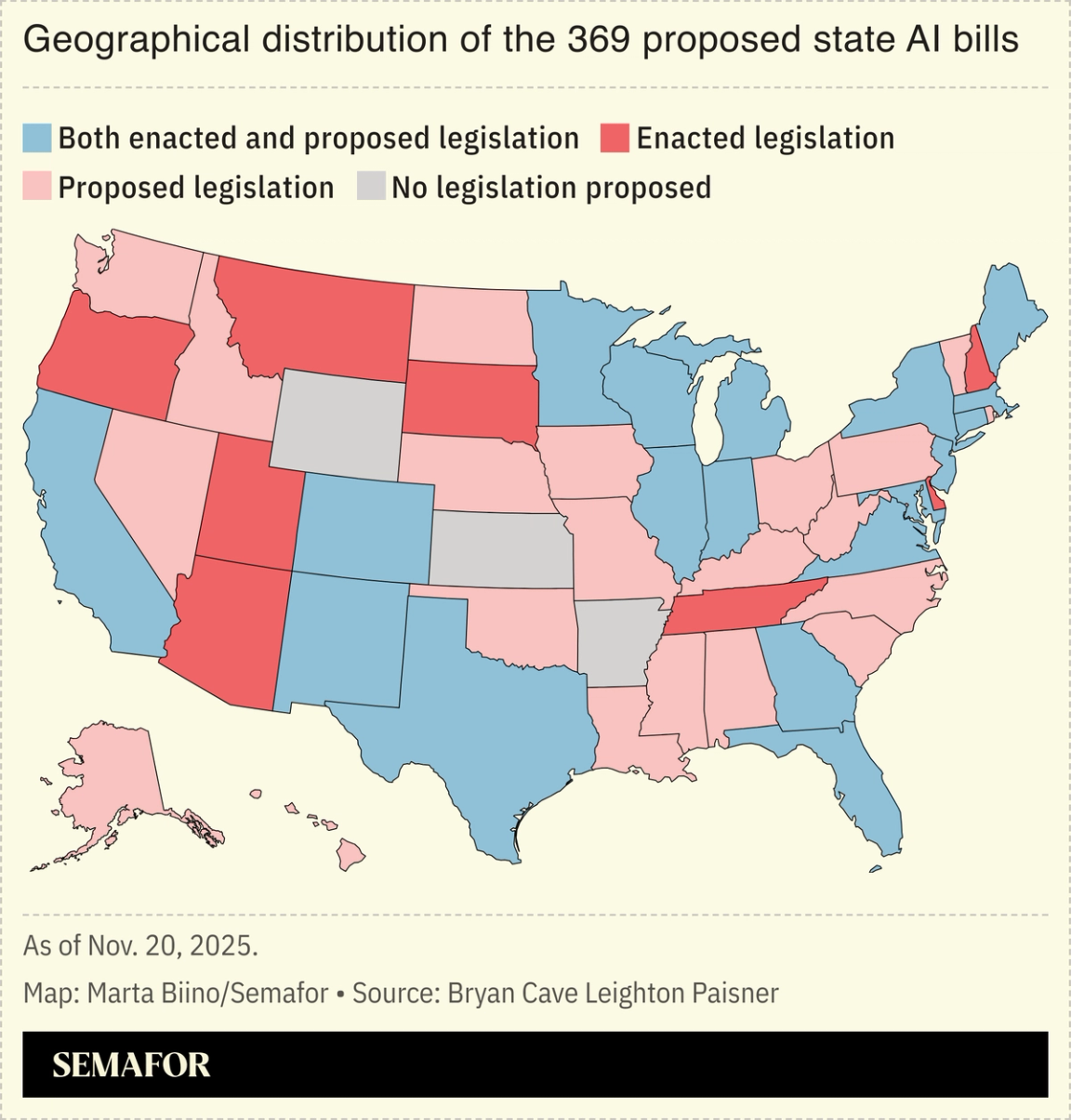 Trump signed an executive order Thursday meant to stop US states from passing laws regulating AI, a move likely to complicate more than clarify how tech stays in compliance. We’ve covered this effort from the beginning, when Anthropic’s resistance to the provision slipped into the administration’s Big, Beautiful Bill, causing a rift with the White House. We scooped the administration’s plan to circumvent failed legislation with an executive order last month. Now that it’s signed, the legal challenges to the order — which is opposed by people on the right and the left who believe it oversteps the power of the federal government — will be interesting to watch, and likely confusing for the industry to follow. Even some AI companies that oppose a morass of annoying and expensive state AI legislation have raised concerns about the constitutionality of an executive order prohibiting states from rulemaking. In a footnote of a document sent to the White House responding to Trump’s AI Action Plan, OpenAI said, “Federal preemption over existing or prospective state laws will require an act of Congress.” |
|
 Edgar Su/Reuters Edgar Su/ReutersMicrosoft recently upped the price of Excel — which remains the company’s killer app, despite the rise of AI. A Bloomberg feature noted that the spreadsheet software — originally a knockoff of rival products — turned the PC into a serious business tool upon its release in 1985. Since then, a huge ecosystem has developed: Excel bundled with Office, and it became central to most businesses’ workflows, so rivals like Google Sheets were unable to dislodge it. Hundreds of millions of people use Excel worldwide, influencers’ how-to videos get millions of views, and there is an Excel World Championship. It also appears surprisingly AI-resistant, for now: Chatbot models, so far, struggle with calculations. CEO Satya Nadella recognizes the app’s centrality to Microsoft’s success, even as the company pivots to AI. He told Dwarkesh Patel that Microsoft is wiring AI models directly into the software itself, to turn Excel into the infrastructure for future agents. |
|
 Be the first to hear about the latest developments in artificial intelligence with MIT Technology Review’s weekly newsletter, The Algorithm. Sign up for free today. |
|
 Courtesy of ChemLex Courtesy of ChemLexRobot see, robot do. Singapore-based ChemLex raised $45 million to build out its autonomous chemistry lab with hopes it can speed drug discovery and therapy development for pharmaceutical and biotechnology companies. The self-driving lab consists of AI software and robots that design experiments, run them, and gather data, according to the company. The facilities run all day, everyday, with limited human intervention. The technology represents what many executives and government leaders are painting as the ideal future of AI — software and hardware working together to do the heavy lifting, overseen by a handful of human workers, which would speed up development and free scientists to perform other high-level tasks. It’s still early days for ChemLex and unclear if the technology can scale, but if so, it will be a game changer for other industries on optimizing their time, investment, and talent. |
|
|


