|
 |


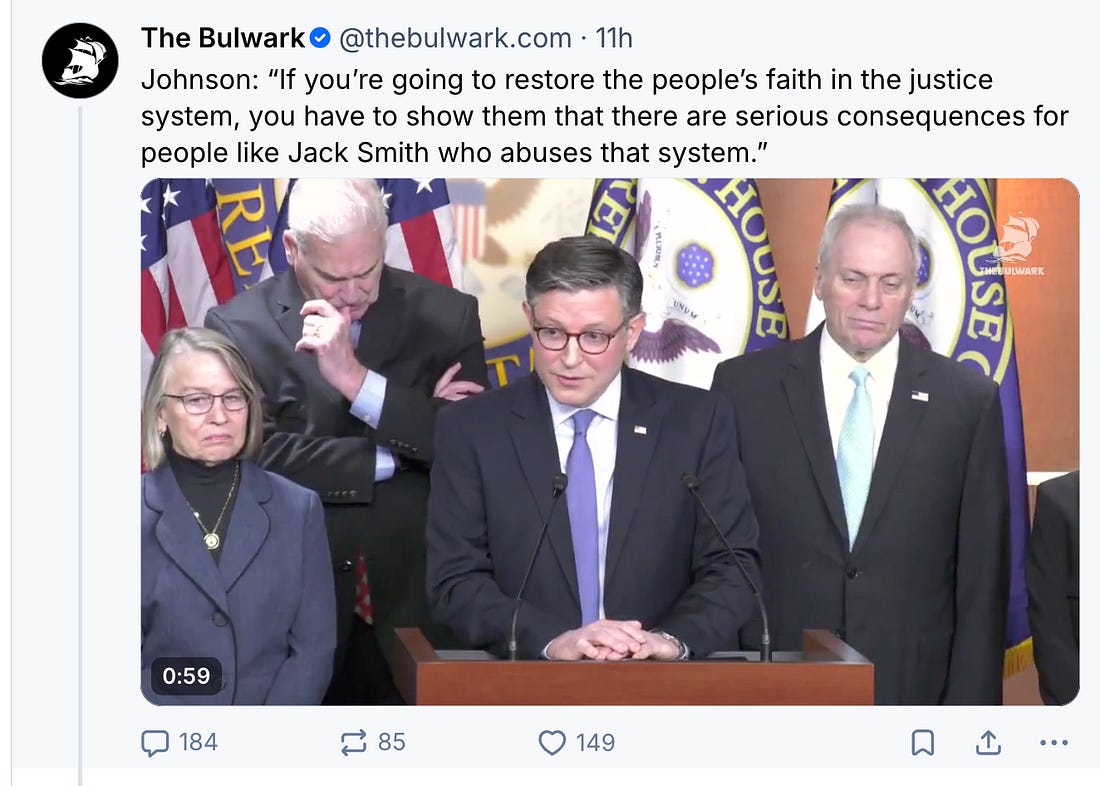
On Wednesday, former Special Counsel Jack Smith, who investigated and charged Donald Trump in two separate cases, will testify before the House Judiciary Committee. Smith wanted to testify publicly, but Republican representatives insisted on closed-door proceedings.
 |
The subject of Smith’s testimony
Why would Republicans balk at the prospect of public hearings? Possibly because Democratic members will also be able to question Smith about the Trump prosecutions. At least some of that information is public, and Smith will be able to discuss it. There were reports that his lawyers previously requested guidance from DOJ on how he should answer questions about non-public materials, a standard practice for former DOJ employees who speak publicly on matters they handled during their employment. That could be uncomfortable for the president and awkward for members of his party if done publicly.
Smith dismissed the cases against Trump in November 2024, following his election, because DOJ policy prohibits the prosecution of a sitting president. One case involved allegations that Trump illegally possessed classified material at his Mar-a-Lago home. The other involved charges related to January 6.
Why do Republicans want to hear from Smith?
Smith, of course, is under investigation by Republicans for his work as special counsel, part of Representative Jim Jordan’s Trump-aligned push to claim that Joe Biden weaponized the Department of Justice. In October, Senate Republicans announced that as part of the January 6 investigation, prosecutors used court orders to obtain the phone records of nine GOP lawmakers: Senators Lindsey Graham of South Carolina, Bill Hagerty of Tennessee, Josh Hawley of Missouri, Dan Sullivan of Alaska, Tommy Tuberville of Alabama, Ron Johnson of Wisconsin, Cynthia Lummis of Wyoming, and Marsha Blackburn of Tennessee. Representative Mike Kelly was also on the list. The Pennsylvania Republican’s name came up because Senator Johnson had publicly identified him as the source of the fake slate of electors that there was an attempt to pass to Vice President Pence, a claim Kelly denied.
The House initiated its effort to get Smith to testify shortly after the disclosure that these records were collected during the investigation.
Investigators working with Smith used grand jury subpoenas to obtain the phone records. That’s an entirely lawful and properly documented process. There is nothing nefarious about this—it would have been prosecutorial misconduct not to get phone records, because there was publicly available evidence suggesting the Trump/Giuliani camp had reached out to these elected officials about blocking certification of the election on January 6. Investigators sought records that could show if a phone call from a number associated with Trump or Giuliani had been made to these people during the relevant time. These records would only show whether a call had been placed and, if it was answered, how long the call lasted. That’s all. This wasn’t a wiretap.
This is a standard way of collecting information during an investigation. Members of Congress’ phone records were requested just like anyone else’s could be—not with an intent to prosecute, and in fact, none of them were ever changed—but with an intent to learn the truth about what happened so prosecutors could assess whether crimes had been committed and, if so, what further investigation was appropriate. Members of Congress don’t have immunity from criminal prosecution, but phone records also routinely reveal witnesses and victims of a crime, essential information for prosecutors to compile during an investigation. In this investigation, developing witnesses who could talk about what the White House asked them to do at this critical juncture was essential.
Alabama Senator Tommy Tuberville is an example of the basis investigators had for believing they needed to learn more about possible contacts. Tuberville was a newly minted Senator on January 6, fresh off the ballot and onto the floor of the Senate. He said publicly that he spoke with Donald Trump that afternoon. CNN reported the call was for “less than ten minutes.” Trump’s defense team denied the call happened. But Utah Senator Mike Lee’s office said Trump had accidentally called his phone, which he carried over to Tuberville so he could talk with the president. It would have been irresponsible under the circumstances not to check to see what other calls were placed to Tuberville.
Jack Smith’s team used subpoenas to collect evidence and also to develop investigative leads and witnesses.
House Republicans want more (but so do Democrats)
There was news today that Republican House Judiciary Committee members also want to take the testimony of four current and former Department of Justice officials who worked on or with Jack Smith, and who the Trump administration believes were involved in efforts to obtain the phone records. They include:
Raymond Hulser, one of Smith’s top deputies, was fired by the Trump administration in February after 34 years of service prosecuting public corruption cases.
Kenneth Polite, the first Assistant Attorney General for the Criminal Division during the Biden administration. Polite left before the end of the administration.
Timothy Duree, an attorney from DOJ’s fraud section who joined Jack Smith’s team and was fired by the Trump administration in January.
Molly Gaston, another DOJ lawyer who went over to Smith’s team. Gaston served as a prosecutor for almost 10 years and was highly regarded for her public corruption work. Gaston, too, was fired by the Trump administration.
“We believe you possess information vital to our constitutional oversight responsibilities,” House Judiciary Chair Jim Jordan wrote to each of the four, according to a report from CNN. No word on whether the four will agree to interviews or wait for subpoenas. Presumably, Republicans have no more incentive to permit these witnesses to testify publicly than they do with Smith.
But the Committee’s Republicans aren’t the only ones after information. Democrats want DOJ to release part two of Smith’s final report on the Mar-a-Lago case, which remains under seal. According to House Democrats, that report “details how Donald Trump knowingly retained hundreds of presidential and highly classified records at his Mar-a-Lago club and then deliberately defied subpoenas, obstructed law enforcement, hid evidence, and lied about his continuing retention of these records.”
The lawsuit to release the report is still pending in the Southern District of Florida before Judge Aileen Cannon. House Democrats filed an amicus brief in that case and wrote to Attorney General Bondi, demanding that she release the report before Smith testified, so it would be fair game. “This Administration has repeatedly boasted that President Trump is ‘the most transparent and accessible president in American history.’ Your campaign to bury Mr. Smith’s report makes a joke out of that claim,” they said to her. “You are permitting prosecutors to be hauled before Congress to defend their work while denying Congress and the American public the written record that would explain it.”
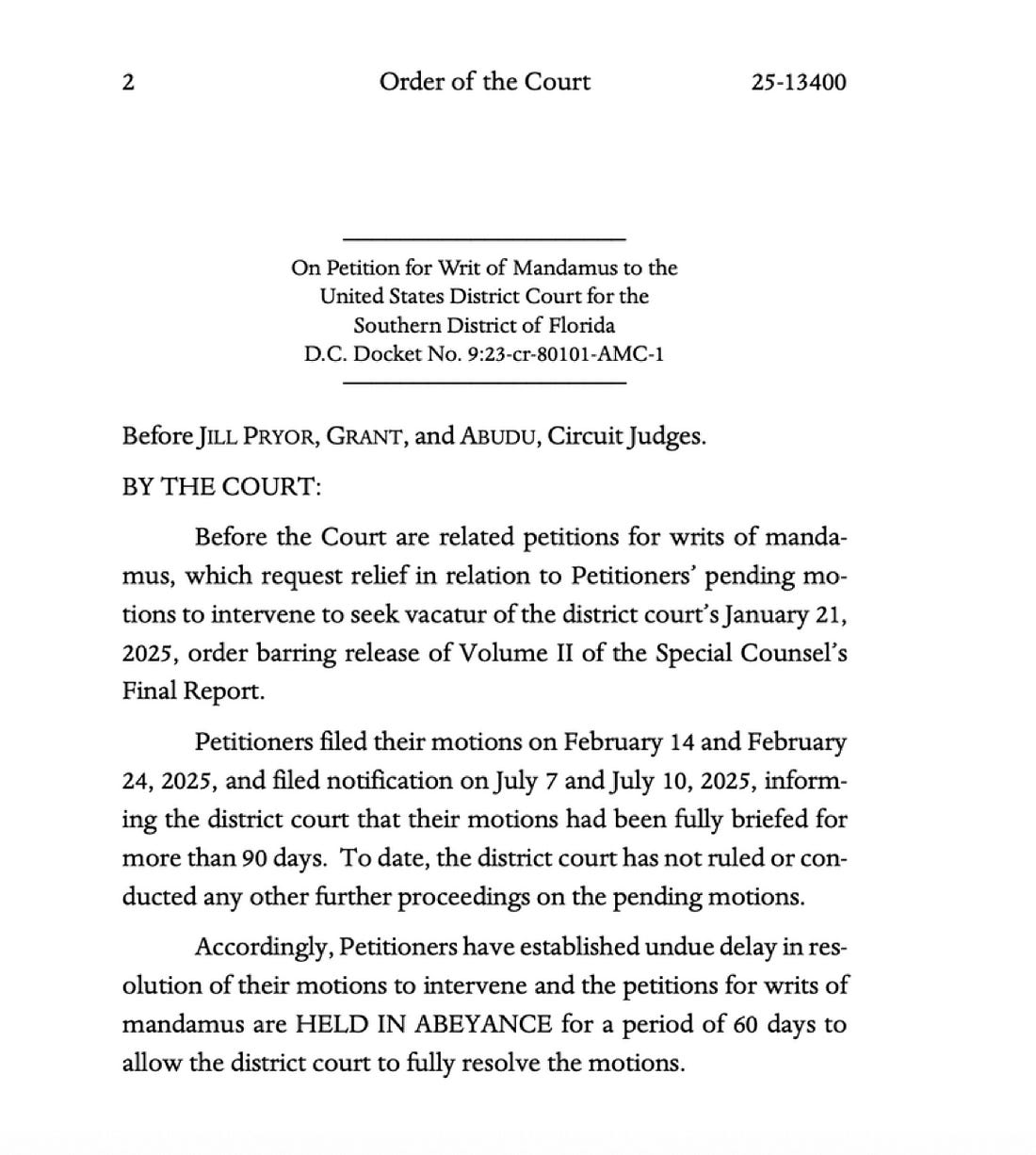
Judge Cannon has been dragging her feet on ruling on the release since January. American Oversight, a bipartisan group that works to expose misconduct and hold government accountable, filed a petition for mandamus, asking that Judge Cannon be ordered to rule. The Eleventh Circuit, in a rare move, granted that request in November and gave the Judge 60 days to get it done, finding she had engaged in “undue delay.” Expect Judge Cannon to take virtually all of those 60 days before she rules, although perhaps Trump’s lawyers, at least those of them who haven’t joined his new administration, will seek further delay.
 |